Showing posts with label Vahram Papazian. Show all posts

Monday, July 1, 2019

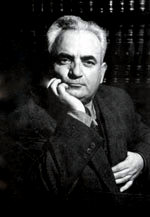
Death of Garnik Stepanian (July 1, 1989)

One of the best specialists of Western Armenian culture in Soviet Armenia, Garnik (Der) Stepanian was born on February 14, 1909, in the village of Mamakhatoun, district of Derjan, in the area of Erzinga. In May 1915 most Armenians of Derjan were killed during the genocide; many were forcibly converted to Islam, and the remainders were deported towards Der-Zor. Young Garnik managed to survive and, after the war, he reached Sepastia, where he received elementary education. In 1923 he was moved to Greece together with many Armenian orphans, where he found shelter in the orphanages of Edipsos, Khalkis, and Oropos. Two years later, he found his way to Egypt and worked for the next five years as a typesetter in the daily Arev and the printing house Voskedar.

Stepanian’s life would make a turn in 1930 when he immigrated to Soviet Armenia and found his lost parents there. He continued working as a typesetter, this time at the first printing shop of the State Publishing House. In 1938 he graduated from the Faculty of Philology of Yerevan State University. Meanwhile, he taught Armenian language and literature at the Alexander Tamanian technical school (1937-1939), and Classical Armenian at the Faculty of Philology from 1939-1940. He was a student of famous linguist Hrachia Adjarian, about whom he would write an intriguing memoir (1976).

He wore several hats in the editorial world: he worked at the daily Sovetakan Hayastan, the monthly Sovetakan Hayastan (published for the Armenians of the Diaspora), and the monthly Teghekagir, the social studies publication of the Academy of Sciences of Armenia. In 1943 he became a member of the Writers Union of Armenia and two years later, he published the first novel about the Armenian Genocide in Soviet Armenia, Nightmarish Days (1945), based on his own experience, which was reprinted three times.

Garnik Stepanian worked at the Institute of Literature of the Academy, directed the Museum of Literature and Art from 1954-1963, and was a researcher at the Institute of Art of the Academy from 1963 until his death. He became a prolific and well-regarded name as a historian of Armenian culture, specializing in the fields of Western Armenian literature and theater. He authored monographs about several famous actors in the history of Western Armenian theater, like Bedros Atamian, Arusiag Papazian, Megerdich Djanan, and Siranush, a volume of correspondence by Atamian, and a memoir about another famous actor, Vahram Papazian. His most important contribution to the field was the seminal three-volume monograph, Outline of the History of Western Armenian Theater (1962, 1969, 1975). He would also delve into the theater of the Diaspora, with a series entitled Essays on the History of Diasporan Armenian Theater, of which he managed to write two volumes on French-Armenian (1982) and Armenian-American theater (posthumously published, 2008).

Stepanian not only published monographs on two famous Western Armenian writers, Arpiar Arpiarian (1955) and Hagop Baronian (1956, 1964), but he also translated from Turkish into Armenian the first Turkish novel, Hovsep Vartanian’s Akaby (1953, originally published in 1851), and several works by Baronian.

Another important contribution by Stepanian to the field of Armenian Studies was his three-volume Biographical Dictionary (1973, 1981, 1990), which unfortunately remained unfinished .

In 1967 he earned the title of Emeritus Art Worker of Armenia and four years later he defended his second doctoral thesis in the field of art. In 1980 he was a co-winner of the State Prize of Armenia for the five-volume collective work, History of Modern Armenian Literature.

Stepanian passed away on July 1, 1989, in Yerevan. Among his posthumous works is an especially remarkable 600-page monograph on the history of his birthplace, Erzinga (2005).

Friday, June 5, 2015

Death of Vahram Papazian (June 5, 1968)

From Constantinople to Yerevan and from Paris to Moscow, Vahram Papazian would become the most accomplished Shakespearean actor of the Armenian scene worldwide for half a century.

He was born in Constantinople on January 6, 1888, in a middle-class family. He graduated from the Esayan School (1902) and the lyceum of Kadikoy (1902-1904), and had his debut on the stage in 1904. Then he went to the Murad-Raphaelian School of the Mekhitarist Congregation, in Venice, where he studied from 1905-1907.

In 1907 he departed for Paris and then for Baku, where he performed with an Armenian theater group for a few months. After this experience, he returned to Italy and studied at the Art Academy of Milan from 1908-1911. Famed actress Eleonora Duse was among his teachers. During his student years, he performed with Italian itinerant groups and gradually perfected his roles (Othello, Romeo, and Hamlet, among them). He returned to Constantinople in 1908 and his performances of Othello, at the age of 20, earned him the applause of Armenian audiences and the press. He went to Paris in the early 1910s to study the different currents of theater and become closely acquainted with acting techniques. As a professional actor, he performed from 1910-1913 in Constantinople and Smyrna, and from 1913-1917, in Baku and Tiflis. He enriched his repertory with a roster of roles in Armenian and non-Armenian plays.

Papazian as the title character in Shakespeare's Othello
Papazian played in fifteen Russian silent movies from 1917-1918 with the pseudonym of Ernesto Vahram, and would later play in three more films in 1922-1923. In 1920 he returned to Constantinople, where he performed until 1922. After the occupation of the city by the Kemalist forces, he settled in Soviet Armenia. He would perform and direct in Yerevan, Baku, and Tiflis between 1922 and 1927. He moved to Moscow in 1928 and then performed in Leningrad (now St. Petersburg) from 1929-1931. In 1932 he played in Lithuania, Letonia, and Estonia, and in the same year he left for Paris, where he played Othello with the Odeon Theater group; his performances were singled out by the French press. In 1933 he visited Berlin, where he met the famous director Max Reinhardt and studied closely the German school of acting.

Thereafter, he returned to the Soviet Union and was distinguished as People’s Artist of Armenia and Georgia in 1933, and People’s Artist of Azerbaijan in 1935. He toured the cities of the three countries in 1934-1935, and continued his tour through Russia and Ukraine from 1936-1941. He played in Moscow in 1941 and settled in Leningrad from 1941-1944, where he survived the German blockade.

After years of new presentations in Russia, Ukraine, Central Asia, and Transcaucasia, from 1946-1954, Papazian finally settled back in Yerevan as a member of the Sundukian Academic Theater, and he also directed plays in Yerevan and Leninakan (now Gumri). He returned to cinema in four films from 1953-1964, and in 1956 he was given the title of People’s Artist of the Soviet Union. In the last fifteen years of his life, the actor revealed himself to be an accomplished writer with his two-volume memoir, Retrospective Regard (1956-1957). He also wrote his reminiscences on Western Armenian actors, My Heart’s Duty (1959), and several books on performance analysis about the roles of Hamlet, Othello, and King Lear.

His art belonged to the classical school, enriched by elements of neo-romanticism and psychological realism. His performances of Shakespearean roles were grounded on the traditions of ancient tragedy and the Renaissance, as well as his own Armenian viewpoint.

Vahram Papazian passed away in Leningrad on June 5, 1968, and was buried in the Pantheon of Yerevan. The State Theater of Stepanakert (Karabagh) carries his name.