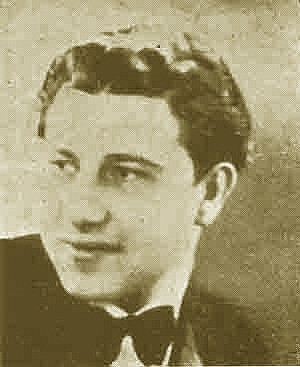
Kourken
Alemshah was a well-established, even if prematurely disappeared
Armenian composer of the Diaspora in the first half of the past century.
He
was born in Bardizag (now Bahcecik), an Armenian village near Izmit, in
Western Turkey, on May 22, 1907. He studied at the Mekhitarist School
in the neighborhood of Pera (now Beyoglu), in Constantinople, and
graduated in 1918. Afterwards, he entered the Moorat-Raphael
(Mourad-Raphaelian) School of the Mekhitarist Congregation in Venice,
graduating in 1923. He had already shown his talent as a pianist at
school, and he pursued musical studies at the Milan Conservatory. His
professors saw in him an exceptional talent, unique inspiration, and the
ability to mix Oriental music and popular motifs to European technique.
Alemshah
graduated in 1930 and settled in Paris, where he taught at the
Samuel-Moorat (Samuel Mouradian) school of the Mekhitarists in the
suburb of Sevres, as well as in Italian high schools. Along his prolific
labor as composer, he also organized the “Cilicia” choir, which became a
well-known choir in the big Armenian community of France. In 1933, at
the age of twenty-six, he was elected member of the Association of
Musical Authors, Composers, and Editors of France. In the 1930s, he
composed many works of European inspiration under the pseudonym of Jean
Valdonne.
It
was particularly impressive a concert of the “Cilicia” choir he
directed in 1934 at Salle Gaveau, in Paris, with more than 1,000 people
in the audience. Along works by Komitas, he premiered his “Oriental
Nights,” composed in 1931 and the vocal-orchestral work “The Battle of
Avarayr” (1934). In 1936, on the centennial of his alma mater, the
Moorat-Raphael School, he took his choir to Venice and gave concerts
both in the famed hall of the school and the St. Mark Square, presenting
Komitas songs and his own songs on popular motifs. In 1937 his work
“Armenian Wedding,” a combination of Alemshah’s music with popular
songs, won the second prize at the international competition of People’s
Music, with the participation of twenty nations.
He
later conducted the choir “Alakiaz” from 1938-1939, and was appointed
conductor of the Sipan Komitas choir from 1939 until his death. He
conducted Armen Tigranian’s “Anoush” opera and the performances of the
Divine Liturgy in a number of French cathedrals.
In
the fall of 1947, Alemshah visited the United States for a series of
presentations. In October he conducted a concert at Town Hall in New
York City, devoted to Armenian orchestral and choral music. He passed
away unexpectedly on December 14, 1947, in Detroit, from a heart attack,
a day before his scheduled performance. His funeral was held in New
York by the Armenian Catholic clergy, with the participation of the
choir of St. Illuminator’s Cathedral. His body was sent to France and
buried in Paris.
Some
of his vocal scores were published in Paris in 1947. His songs, which
are still part of musical programs, are characterized by rare emotional
intensity.

