Showing posts with label France. Show all posts

Friday, August 23, 2019

Birth of Arthur Adamov (August 23, 1908)

The Theater of the Absurd was one of the avant-garde directions of theater in the 1950s and 1960s, created after the great shock produced by World War II. One of its founders was an ethnic Armenian writer émigré in France, Arthur Adamov.

The son of a wealthy oilman from Karabagh, Suren Adamov (Adamian), Arthur (Haroutioun) Adamov was born on August 23, 1908, in Kislovodsk, a spa city in the northern Caucasus famous for its mineral waters. In one of his autobiographical novels, he would write: “I forgot to say that my family has Armenian origins. At a certain time I even spoke that language…” In 1914 his family left Russia and settled in Germany, where the future writer attended a French lyceum. Because of their Russian documents, the family was forced to leave Germany and move to Switzerland, where they lived until 1922. In the meantime, the October Revolution had a fatal outcome for the Adamovs, who lost almost their entire fortune. Suren Adamov, who was a known gambler, would leave the last remnants of that future on the card table and commit suicide in 1933.

In 1922 the Adamov family moved to France, and the future writer finally settled in Paris two years later, living the rest of his life in the French capital. The bitterness and deprivations of life in exile would be crucial in the formation of his worldview. In the late 1920s he associated with the newly born Surrealist movement and became friends with poet Paul Éluard. He also edited the surrealist journal Discontinuité. His first poems written in surrealist style became the expression of his pessimism.

In the 1930s Adamov actively participated in the fight against the fascist groups that had appeared in France following the wave of nazi-fascism in Germany and Italy. In 1938 he suffered a nervous breakdown. His autobiography The Confession, written in 1938-1943 and published in 1946, revealed his tortured conscience, delving into his sense of alienation and preparing the stage for some of the most powerful Absurdist dramas. After the defeat of France in the war and the German occupation, he spent almost a year in the internment camp of Argelès-sur-Mer, in southern France.

In the postwar period, Adamov, influenced by Swedish playwright August Strindberg and by Franz Kafka, started writing plays, with The Parody (1947) being the first. The title character of one of his best-known works, Professor Taranne (1953), is accused of various things (public nudity, littering, plagiarism). When he strenuously denied them, his denials are turned against him as further evidence of misdemeanors. His best-known play was The Ping-Pong (1955). Adamov’s later plays (Paolo Paoli, 1957; Spring 71, 1961; The Politics of Rubbish, 1963) featured radical political statements, besides his ongoing interest in dramatic experimentation. In the 1960s he become further radicalized. He translated a number of works by German authors and Russian classics into French. During his later years, he began to drink and use drugs.

The other members of the Absurdist leading trio, Samuel Beckett and Eugene Ionesco, would go on to great acclaim and recognition. Beckett received the Nobel Prize of Literature in 1969 and Ionesco was inducted into the French Academy in 1970. Forgotten, alone, and impoverished, Arthur Adamov died in Paris on March 16, 1970. His death may have been the result of an accidental suicide by taking an overdose of barbiturates.

Wednesday, May 22, 2019

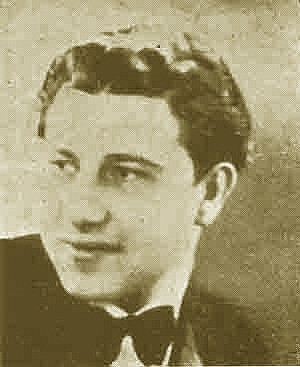
Birth of Kourken Alemshah (May 22, 1907)

Kourken Alemshah was a well-established, even if prematurely disappeared Armenian composer of the Diaspora in the first half of the past century.

He was born in Bardizag (now Bahcecik), an Armenian village near Izmit, in Western Turkey, on May 22, 1907. He studied at the Mekhitarist School in the neighborhood of Pera (now Beyoglu), in Constantinople, and graduated in 1918. Afterwards, he entered the Moorat-Raphael (Mourad-Raphaelian) School of the Mekhitarist Congregation in Venice, graduating in 1923. He had already shown his talent as a pianist at school, and he pursued musical studies at the Milan Conservatory. His professors saw in him an exceptional talent, unique inspiration, and the ability to mix Oriental music and popular motifs to European technique.

Alemshah graduated in 1930 and settled in Paris, where he taught at the Samuel-Moorat (Samuel Mouradian) school of the Mekhitarists in the suburb of Sevres, as well as in Italian high schools. Along his prolific labor as composer, he also organized the “Cilicia” choir, which became a well-known choir in the big Armenian community of France. In 1933, at the age of twenty-six, he was elected member of the Association of Musical Authors, Composers, and Editors of France. In the 1930s, he composed many works of European inspiration under the pseudonym of Jean Valdonne.

It was particularly impressive a concert of the “Cilicia” choir he directed in 1934 at Salle Gaveau, in Paris, with more than 1,000 people in the audience. Along works by Komitas, he premiered his “Oriental Nights,” composed in 1931 and the vocal-orchestral work “The Battle of Avarayr” (1934). In 1936, on the centennial of his alma mater, the Moorat-Raphael School, he took his choir to Venice and gave concerts both in the famed hall of the school and the St. Mark Square, presenting Komitas songs and his own songs on popular motifs. In 1937 his work “Armenian Wedding,” a combination of Alemshah’s music with popular songs, won the second prize at the international competition of People’s Music, with the participation of twenty nations.

He later conducted the choir “Alakiaz” from 1938-1939, and was appointed conductor of the Sipan Komitas choir from 1939 until his death. He conducted Armen Tigranian’s “Anoush” opera and the performances of the Divine Liturgy in a number of French cathedrals.

In the fall of 1947, Alemshah visited the United States for a series of presentations. In October he conducted a concert at Town Hall in New York City, devoted to Armenian orchestral and choral music. He passed away unexpectedly on December 14, 1947, in Detroit, from a heart attack, a day before his scheduled performance. His funeral was held in New York by the Armenian Catholic clergy, with the participation of the choir of St. Illuminator’s Cathedral. His body was sent to France and buried in Paris.
Some of his vocal scores were published in Paris in 1947. His songs, which are still part of musical programs, are characterized by rare emotional intensity.

Sunday, August 12, 2018

Death of Jean Carzou (August 12, 2000)

Carzou was the most famous Armenian painter in France with a unique style of painting.

He was born Karnig Zouloumian on January 1, 1907, in Aleppo (Syria), then part of the Ottoman Empire. He first studied at the school of the Marist Fathers and then, when he moved to Cairo in 1919, he went to the Kaloustian School. His brilliant academic performance earned him a scholarship and he moved to Paris in 1924, after graduation, to study architecture.

He graduated from the School of Architecture in 1929. He created his name from the first syllables of his name and surname, to which he added the French name Jean, but he always kept close to his Armenian roots and Armenian life. However, he abandoned architecture for the fine artist. He started working as a theater decorator but quickly realized he preferred drawing and painting. He worked as a street artist to support himself, and his sketches of politicians and public figures found their way into Parisian newspapers.

Cannes, Le Suquet
In 1930 Carzou had his first exhibition at the Salon des Artistes Independants, which he would continue annually for more than six decades, until 1992. In the 1930s he also participated in the exhibitions of the Union of Armenian Artists “Ani.” He had his first solo exhibition at Galerie Contemporaine in Paris, and from then on he would have more than a hundred personal exhibitions in France and abroad (Belgium, Germany, Lebanon, Cairo, Switzerland, England, and the United States). In 1966 he had his first personal exhibition in Yerevan, followed by a second exhibition in 1983 and a posthumous one in 2007. Following their trip to Armenia in 1966, his wife Nan Carzou would write a celebrated travelogue, Voyage en Arménie (Travel in Armenia), and his son Jean-Marie Carzou, a journalist, would produce the first comprehensive account about the Armenian Genocide in French, Arménie 1915: un genocide exemplaire (Armenia 1915: An Exemplary Genocide), in 1975. In 1980 he was awarded the “Martiros Sarian” prize in Armenia.

Carzou started working in stage designing for the Opera de Paris for several operas and ballets during the 1950s. His designs of settings and costumes made him known to the general public. In 1957 he created his famous antiwar series “The Apolcalypse.” In the 1950s and 1960s he also created book illustrations with his line drawings and engravings (Andre Maurois’ France, Ernest Hemingway’s A Farewell to Arms, Albert Camus’ Notebooks, Edgar A. Poe’s The Murders in the Rue Morgue ), and his sharp graphic style became extremely popular in the 1960s and 1970s. Meanwhile, he earned the coveted Hallmark prize in 1949, and became Knight of the French Legion of Honor in 1956 and Commander of the Order of Arts and Letters two years later. In 1955 the art magazine Connaissance des Arts rated him as one of the ten most important painters of his generation.

L'Apocalypse
Near the age of seventy, Carzou became the first living artist to have his work, “Distant Princess,” appear on a French postal stamp in 1976, and the following year he was elected a member of the French Academy of Fine Arts, succeeding painter Jean Boucheaud. In 1977 he was also awarded the National Order of Merit. However, he garnered a great deal of hostility from the art world with a statement that Pablo Picasso and Paul Cézanne were symbols of the “decadence in painting.”

After a long career as a painter, illustrator, and stage designer, in 1991 he finished the design of a chapel in Manosque (Alpes of Haute-Provence) with more than 600 square meters of paintings of a huge Apocalypse, which was not a literal illustration of St. John’s book of Revelation, but the depiction of the “climate of our times.” The chapel later became the headquarters of the Carzou Foundation.

The prolific French-Armenian artist lost his wife in 1978. He passed away near his son on August 12, 2000, in Perigueux, at the age of ninety-three.  

Monday, April 16, 2018

Birth of Anatole France (April 16, 1844)

Anatole France was a Nobel Prize winner and a member of the French Academy, but he also was a humanist, and as such, a staunch defender of the Armenian Cause.

He was born François-Anatole Thibault on April 16, 1844 in Paris. He was the son of a bookseller, who also became a bibliophile. He studied at the Collège Stanislas, a private Catholic school, and after graduation he worked at his father’s bookstore, specialized in books and papers on the French Revolution, and frequented by many notable writers and scholars. He later secured the position of cataloguer at various libraries, and was appointed librarian for the French Senate in 1876. The next year, he married Valérie Guérin de Sauville. They had a daughter in 1881 and would get divorced in 1893. He would have various relationships and affairs, and finally he married his governess, Emma Laprévotte, in 1920.

He started his literary career in 1867, writing articles and poetry with the pseudonym Anatole France. He became famous with his novel The Crime of Sylvestre Bonnard (1881) , which earned him a prize from the French Academy. Other novels cemented his fame, and he was elected as one of the “forty immortals” of the French Academy in 1896, at the age of fifty-two.

In 1896 the country was rocked by the Dreyfus affair; Alfred Dreyfus was a Jewish army officer who had been falsely convicted of espionage in a case that had anti-Semitic overtones. France fought along another fellow novelist, Émile Zola—the author of a famous piece, “J’accuse” (I Accuse)--in defense of Dreyfus. He wrote about the affair in his 1901 novel Monsieur Bergeret. The scandal ended with Dreyfus being proven innocent.

In the aftermath of the Hamidian massacres of 1895-1896, Anatole France, always an activist for human rights and just causes joined the pro-Armenian movement and raised his voice to condemn Sultan Abdul Hamid II and defend the Armenian rights. In 1901 was one of the co-founders of the periodical Pro-Armenia, sponsored by the Armenian Revolutionary Federation, and continued his speeches and political rallies in favor of Armenian until 1907. Anatole France also had a close friendship with famous writer Arshag Tchobanian and painter Edgar Chahine.

In 1908 France published his novel Penguin Island, which satirizes human nature by depicting the transformation of penguins into humans, after the animals were baptized by mistake by a nearsighted ecclesiastic. It was actually a satirical history of France from the Medieval time to the novelist’s own time, concluding with a dystopian future. Another celebrated novel, The Gods Are Thirst (1912), was a wake-up call against political and ideological fanaticism. It depicted a true-believing follower of revolutionary Maximilien Robespierre and his contribution to the bloody events of the Reign of Terror of 1793-1794, following the French Revolution of 1789. He published his most profound novel, Revolt of the Angels (1914), at the age of eighty. It was loosely based on the Christian understanding of the War in Heaven, and told the story of a guardian angel who fell in love and joined the revolutionary movement of angels.

After the beginning of World War I and the Armenian Genocide, Anatole France returned to the political scene and was one of the keynote speakers at the April 1916 “Homage to Armenia” held at the Sorbonne amphitheater with the assistance of 3,000 people. In his speech, France included the much-quoted passage: “Armenia is dying, but it will survive. The little blood that is left is precious blood that will give birth to a heroic generation. A nation that does not want to die, does not die.”

Anatole France was awarded the Nobel Prize in Literature in 1921 in recognition of his brilliant literary achievements, characterized as they are by a nobility of style, a profound human sympathy, grace, and a true Gallic temperament.” He passed away on October 12, 1924, and his funeral was attended by a crowd of two hundred thousand people. He is buried in the Neuilly-sur-Seine cemetery near Paris. A few days ago, on March 30, 2018, the French International School in Armenia, founded in 2007 in Yerevan, was renamed after him.

Friday, March 2, 2018

Death of Henri Troyat (March 2, 2007)

Prolific and popular French novelist and biographer Henri Troyat, a member of the French Academy for almost half a century, was also of Armenian origin, even though he had little connection to Armenian life.

He was born Lev Aslanovich Tarasov on November 1, 1911, in Moscow. His last name was the Russianized form of Torosian, and his maternal grandfather was of Armenian-Georgian mixed descent. His father was a wealthy Armenian draper who had made a fortune through investment in railways and banking. His privileged environment included a Swiss governess who taught him French. When the Soviet Revolution broke in 1917, the family retreated to their estate in the Caucasus, but the failure of the counter-revolutionary movement forced them to catch the last émigré boat from Crimea to Constantinople in 1920. From Constantinople, they traveled with passports of the Republic of Armenia to France and joined the exiled Russian community in Paris. They settled in the prosperous suburb of Neuilly, where young Lev attended the Lycée Pasteur. The family found exile life difficult and was forced to move to the city, where Lev Tarasov studied law at the Sorbonne. He would once say: “Success means nothing. I know what I'm talking about: at the very beginning of my life, I saw my parents lose everything in a reversal of fortune, and I kept that lesson in mind.”

He would never return to Russia, even after the fall of the Soviet Union, claiming that he wanted to keep alive the imaginary country he had created out of childhood memories and dreams. He acquired French citizenship in 1933, and departed to Metz to complete his mandatory military service. He was still under arms when he published his first novel, False Light, in 1935, which obtained the Prix du Roman Populiste, under the pseudonym Henri Troyat.

After returning from military service, the writer was appointed as a civil servant in the prefecture of the Seine. He continued his literary career, publishing a series of short psychological novels. In 1938 his fifth novel, The Web, earned him both the Prix Max Barthou of the French Academy and the very prestigious Prix Goncourt. He was mobilized with the outbreak of World War II and returned to Paris in 1940.

At this point Troyat’s career took a major shift. He continued with his short psychological fiction--his novel Snow in Mourning (1952) was filmed with Spencer Tracy in 1956 as The Mountain —but his subsequent work was dominated by two major innovations: the long novel cycle and biography. In 1942 he left his civil service job to devote himself entirely to literature. He married twice; he had a son from his marriage, which ended in divorce, and later married a widow, the love of his life, with a young daughter whom he raised as his own.

He initiated a whole series of biographies of Russian writers (Fyodor Dostoevsky, Alexander Pushkin, Leon Tolstoy, Nikolai Gogol, and Anton Chekhov) and tsars (Catherine the Great, Peter the Great, Alexander I, and Ivan the Terrible). These works brought an introduction to Russian literary and political culture to the French public. The historical research became the grounds for a series of historical novels, mostly based in Russia. Troyat devoted the trilogy While the Earth Endures (1947-1950) to prerevolutionary Russia, the revolution, the civil war, and the exile, and then explored France from the same perspective in the tetralogy The Seed and the Fruit (1953-1958), which became a popular French television series in 2001. These cycles of novels were followed by other multivolume novels from the late 1950s to the mid-1970s. He would have more than a hundred literary works in his count, including novels, short stories, biographies, and plays.

Troyat became one the first French best-sellers, combining critical recognition with commercial success. In 1952 he won the Grand Prix Littéraire du Prince Pierre de Monaco. Seven years later, on May 21, 1959, at the age of forty-seven, he was inducted into the French Academy. Intriguingly, he sat on seat number 28, which had previously belonged to Claude Farrere, a novelist well-known for his pro-Turkish stances. He became the most long-standing member of the group of forty “immortals” who safeguard the French language. He would later earn a series of state decorations, including the Grand Cross of the Legion of Honor, the highest ranking in France.

Henri Troyat published his last novel, The Hunt, in 2006, at the age of ninety-five. He passed away on March 2, 2007.

Friday, December 1, 2017

Death of Tigran Yergat (December 1, 1899)

A short-lived and forgotten name of Armenian letters and political struggle in the late nineteenth century, Garabed Bilezikji was born in Constantinople from a Catholic family of amiras (upper class merchants) in 1870. His father died at the age of 28 and his mother, who belonged to the well-to-do Tingir family, returned to her father’s home with her children.

Little Garabed was given private lessons of Turkish and Armenian, and learned Greek through his nanny. In 1880 he moved to Paris with his mother and entered the boarding school of the Dominican fathers in Argueuil. He graduated in 1887 with honors. After spending a year in the United States, where he studied American literature and perfected his English, he came back to Paris in 1889 and took a modest position at a bank, while devoted to literary and political activities, and adopted the pseudonym of Tigran Yergat.

He maintained close relations with Emile Zola, Jean Jaures, Maurice Barres, and other remarkable figures of French intellectual life, which opened the doors of the press to him. He published many articles in French journals about the peoples of the Orient, Oriental life and customs, and the Armenian Question. He contributed to Nouvelle Revue, Le Figaro , and other publications, and was a much-sought lecturer.

In 1893 the Tingir family lost most of its fortune due to the economic crisis in Turkey, and Yergat was forced to return to Constantinople. He taught French and clandestinely contributed to Revue des Revues with patriotic poems by Kamar Katiba in French translation and articles denouncing the anti-Armenian policies of Sultan Abdul Hamid II. He also wrote articles calling for revolutionary action in the newspaper Hairenik of Constantinople. In August 1896, when the Armenian Revolutionary Federation executed the occupation of the Ottoman Bank, Tigran Yergat’s brother, Mardiros Bileziji, a bank employee, was persuaded by the leaders of the group, Armen Garo and Hrach Tiryakian, to write in Turkish the famous warning to the sultan by the Armenian revolutionaries. Yergat would tell his mother: “They entered the bank like heroes, but they should have exploded the building rather than leaving it like that, without any result. Would my brother have been lost there? Who cares, it would have been for the glory of Armenia…” 

Tigran Yergat also showed his capacities for political and lobby efforts. He was in close contact with Patriarch Mateos Izmirlian (1892-1896), who was finally exiled to Jerusalem by Hamid due to his continuous protests against the “Red Sultan.” He also was the subject of persecution, which forced him to leave Constantinople in October 1896 with help from the secretary of the British embassy.

He went to Greece, where he would mostly spend the next years. He actively cooperated with the Crete rebellion of 1897 and the subsequent Greek-Turkish war, becoming a member of the political organization “Eteria” and working to create a rapprochement between Greek and Armenian revolutionaries. In 1898 he took upon himself the organization of a French military expedition to Cilicia, which remained unfinished due to his death. In fact, his health took a fast turn to the worse early that year. He was forced to move to Cairo, near his brothers, looking for a recovery. During his short sojourn in Egypt, he became a member of the A.R.F.

However, in the spring of 1899, upon his mother’s entreaties, Tigran Yergat returned to Constantinople, physically devastated. He was taken to the hospital, where he passed away on December 1, 1899. An obituary published in the A.R.F. organ Droshak stated: “The storm of revolution, the adoration of epic feats existed in Tigran Yergat as an embodiment of protest, framed within a tender smile. Alas! A wild disease, tuberculosis, destroyed that kind and honorable life.”

Sunday, December 25, 2016

Death of Anita Conti (December 25, 1997)


Anita Conti belongs to the category of remarkable people of Armenian origin to be found throughout history. She was known throughout the world as the first French female oceanographer.

Née Anita Caracotchian, she was born on May 17, 1899, in the French town of Ermont (department of Seine-et-Oise) to a wealthy Armenian family. Her father, Levon, was a doctor, originally from Constantinople. She spent her childhood being educated at home by different tutors and traveling with her family, gradually developing a passion for books and the sea.

After moving to Paris, she focused on writing poems and the art of book binding. Her work got the attention of celebrities and she won different awards and prizes for her creativity in London, Paris, New York, and Brussels with the surname “Anita Cara.” Many years later, when asked about her bookbinding talents, she answered: “I inherited the art of book binding from my dear grandfather Oscan. Browse the wonderful Armenian manuscripts; observe their golden and silver-bound covers with precious stones and everything will be clear for you.”

In 1927 she married a diplomat, Marcel Conti, and started traveling around the world, exploring the seas, documenting and reporting what she saw and experimented. “I never feared anything,” she wrote, “since I understood that the road of all pioneers has been always filled with thorns, and you have to bravely fight to achieve your dreams.”

Her journalistic articles made her well-known. In 1935 Anita Conti was hired by the director of the Scientific and Technical Office of Sea Fishing, and contributed to the launching of the first French oceanographic ship, the Président Théodore Tissier. She did research in the Pacific, Indian, and Arctic oceans from 1936-1938.

After a campaign of cod fishing in the Barents and Spitzberg seas in 1939 aboard theViking, with a crew of fifty men, she embarked on the minesweepers active in the English Channel and the Northern Sea, and took active part in the operations of mine clearing in Dunkirk from November 1939-January 1940.

She gained a deeper understanding of the issues faced by fishermen by spending time on fishing boats for days and even months on certain occasions. In the interwar period, she developed the technique of fishing maps apart from the already used navigational charts. For two years, she observed the French fishermen along the coast of Saharan Africa and discovered fish species unknown in France. She published many scientific reports on the negative effects of industrial fishing and the different problems related to fishing practices.


From 1943-1952, she studied in the Mauritian islands, Senegal, Guinea, and Ivory Coast the nature of the seabed, different fish species and their nutritional values in regards of protein deficiency for the local populations. Gradually, she developed better preservation techniques and fishing methods, and installed artificial dens for further studies. She even founded an experimental fishery for sharks. She became more and more conscientious of the misuse of natural resources by the fishing industry and the major waste that could be prevented.
In 1947 Conti met legendary oceanographer Jacques-Yves Cousteau, who later became her good friend and colleague. “Anita is a phenomenon in the history of world oceanography,” he wrote. “This woman with beautiful Armenian traits, endowed with ‘male reasoning,’ is so attractive and sentimental at the same time. . . . The seamen simply worship her for her kind, blithe, and brave nature, and delicately call her ‘La Dame de la Mer’ (The Lady of the Sea).”

She was the only woman among the sixty men of the ship “Bois Rose,” which spent six months on the ocean in 1952. It came back with 1,100 tons of cured fish, as well as 5,000 precious photographs by Anita Conti and the manuscripts of her first book, Racleurs d’océans (Scrapers of Oceans, 1953). The book won the Prix des Vikings in 1954 and was the basis for a documentary film by the author. Encouraged by the literary success of her book, she gathered her notes on Africa and published her second volume, Géants des mers chaudes (Giants of Hot Seas), in 1957. In 1958 she participated in a historic event: the trial in the Mediterranean Sea of the first bathyscaphe at 600 meters of depth.

In 1971 Anita Conti published L’Ocean, Les Bêtes et L’Homme (The Ocean, the Animals, and the Man), to denounce the disaster that men create and its effects on the oceans. Through many conferences and forums and for the rest of her life, she advocated for the improvement of the marine world. She continued her indefatigable traveling and studying well passed her eightieth anniversary.

She died in Douarnenez on December 25, 1997. According to her will, her ashes were spread in the Sea of Ireland in 1998. Two lyceums in France are named after her.

Friday, November 11, 2016

Birth of Antoine Meillet (November 11, 1866)

Antoine Meillet was one of the most influential French linguists of the early twentieth century. He made important contributions to Armenian Studies, particularly in the linguistic field, but also was well acquainted with other areas of Armenian culture.
Meillet was born in Moulins on November 11, 1866. He studied at the Sorbonne from 1885-1889, where he was a disciple of Ferdinand de Saussure, the pioneer of semiotics, and Michel Breal. He was appointed professor of comparative linguistics of Indo-European languages at the École Pratique des Hautes Etudes until 1931. One of his students was Hrachia Adjarian, the foremost name of Armenian linguistics in the twentieth century. He completed his doctoral dissertation in 1897. In 1905 he was elected to the Collège de France, where he taught comparative and general linguistics until his death. He was the mentor of a generation of linguists and philologists, among them names related to Armenian Studies like Émile Benveniste and Georges Dumézil.
His approach, quite novel for his time, took into account historical grammar, philological evidence, and facts of cultural history such as language contacts and sociolinguistic influences. He covered nearly all branches of the Indo-European family in his enormous output of about two dozen books, more than 500 articles, and many book reviews. In 1903 he published his most important work, Introduction à l’étude comparative des langues indo-européennes (Introduction to the Comparative Study of the Indo-European Languages), which explained the relationships of Indo-European languages to one another and to the parent Indo-European tongue.
Meillet became engaged in learning the Armenian language and in elucidating its origin from the beginning of his studies. He studied Modern Armenian with Auguste Carrière, then the holder of the Armenian chair at the Ecole des Langues Vivantes (now the Institute Nationale des Langues et Civilisations Orientales, INALCO). He went to Vienna and studied Classical Armenian at the Mekhitarist Congregation from 1890-1891. As member of a research group in the Caucasus, in 1891 he visited Armenia and researched the manuscripts at the library of the monastery of Holy Etchmiadzin. He went back in 1903, while he was the holder of the Armenian chair (1902-1905). He was well acquainted with the ancient literary tradition of Armenian, as well as with its philological aspects. He dealt with textual problems of Armenian manuscripts, not least with the problems of the spelling in several ancient manuscripts of the Armenian Gospels and with the study of particular passages in works of Armenian authors.
In a great number of articles, Meillet treated various problems of Armenian etymology and historical phonology and morphology. The fact that he is still considered one of the founders of comparative studies of the Armenian language is primarily the result of his pioneering work on Armenian syntax, which had been more or less ignored by all Armenian linguists before him. The result of all his studies was distilled in two monographs: his authoritative Esquisse de la grammaire comparée de l’arménien classique (Outline of a Comparative Grammar of Classical Armenian, 1902), a fundamental historical phonology and morphology of the language, and a short introductory description of Armenian in his Altarmenisches Elementarbuch (Elementary Course of Old Armenian, 1913), with some emphasis on syntax. Meillet also devoted several minor studies to the influence of Iranian on Armenian vocabulary.
An engaged scholar and citizen, Meillet raised his voice in 1903-1905 against the confiscation of the properties of the Armenian Church in the Russian Empire and in 1915-1918, in the years of the Armenian Genocide. In 1919 he founded the Society of Armenian Studies with Frederic Macler and others, and was instrumental in the launching of the oldest Armenian Studies journal in Western languages, the Revue des études arméniennes, in 1920. A year later, he founded the Revue des études slaves.
Meillet’s scholarly merits were acknowledged with the French Legion of Honor. He was appointed member of the Académie des Inscriptions et Belles-Lettres in 1924 and elected as member of more than a dozen foreign academies of sciences. He received honorary doctorates from the universities of Berlin, Padua, Dublin, Oxford, and Brussels.
The great French linguist passed away on September 21, 1936, in Châteaumeillant, France.

Sunday, July 31, 2016

Death of Jean Jaures (July 31, 1914)


The pro-Armenian movement in Europe at the end of the nineteenth and beginning of the twentieth century had French politician Jean Jaures as one of its most remarkable figures.

Jaures, born in Castres (Tarn) on September 3, 1859, was the son of an unsuccessful businessman and farmer. He was a brilliant student, and after being graduated from the famous Lycée Louis-le-Grand of Paris, he was admitted first at the École normale supérieure in 1878. He obtained a degree (agrégation) in philosophy (1881) and taught for two years at a lyceum, before lecturing at the University of Toulouse. In 1885 he was elected deputy from Tarn on the ticket of the Republican Party. In the late 1880s he veered towards socialism.

After losing in the elections of 1889, he returned to Toulouse, where he was actively involved in municipal affairs and helped found the medical school of the University. He also prepared two theses for his doctorate in philosophy; one was about the first expressions of German socialism in the writings of important theologians and philosophers Martin Luther, Immanuel Kant, Johann Fichte, and Georg Hegel. He became a highly influential historian of the French Revolution after the publication of his book Histoire socialiste (1901). His articles and speeches were collected in several other books.

In 1893 Jaures returned to the National Assembly as socialist deputy for Tarn and retained his seat until his death, except for the period 1898-1902.

After the summer of 1894, when the Hamidian massacres started, the young socialist deputy would become a central name in the condemnation of Ottoman policies. He first published an article in January 1895 in the periodical La Petite République. His intervention in the parliamentary debate on the Armenian massacres, on November 3, 1896, however, left a deep mark on public awareness.

Jaures spoke after the interventions of conservative deputies. He took everyone by surprise, because nobody expected him to enter the fray of foreign policy. His vibrant and implacable speech had considerable impact on public opinion. He directly charged the French government for its four year-long obsequious policy towards the Ottoman Empire. As historian Raymond Kevorkian has noted, his 90 minute-long speech marked the actual beginning of the pro-Armenian movement in France. The Parisian newspapers, which were generously subsidized by Ottoman agents, changed their pro-Turkish tune afterwards. Jaures solemn discourse established that justice had no boundaries and that democratic moral was bound to fight against tyranny. He would intervene on behalf of Armenians several other times. He would show the same civic courage in his defense of Alfred Dreyfus during the infamous Dreyfus Affair.

After Jaures returned to the National Assembly in 1902, three socialist parties merged in 1902 to form the social-democratic French Socialist Party, which would become the United Socialist Party in 1905 with the incorporation of the revolutionary socialists. In 1904 he founded the daily L’Humanité, which he edited until his death (it would become the organ of the French Communist Party after 1920). He also became a member of the editorial board of Pro Armenia, a French periodical published to defend the Armenian cause (1900-1908, 1912-1914).

Jaures hailed the Ottoman Revolution, believing that the coming to power of the Young Turks would regenerate the empire. After the massacres of Adana, however, he maintained his trust that the revolutionary regime would end the Armenian persecution. He placed the solidarity of progressive movements above the imperatives of humanity and protection of minorities, historian Vincent Duclert has written. As a result, he opposed any military intervention in Cilicia during the parliamentary debate of May 1909 and asked for diplomatic action in Constantinople.

Jaures, as a committed antimilitarist, tried to use diplomatic means to prevent a general European war. On July 28, 1914, exactly a month after the assassination of Archduke Franz Ferdinand, heir to the Austrian throne, and his wife in Sarajevo by a Serbian nationalist, Austria declared the war on Serbia and mobilized its troops. This obliged Russia and France to mobilize, according to the secret treaty of 1892. World War I was on its way. Jaures addressed the Chamber of Deputies in an impassioned speech, pleading for social justice and peace. Shortly thereafter, on the night of July 31, 1914, while dining in a restaurant he was assassinated by French nationalist Raoul Villain. His remains were transferred to the Paris Panthéon in November 1924.