Showing posts with label Germany. Show all posts

Sunday, March 3, 2019

The Treaty of Brest-Litovsk (March 3, 1918)

The Treaty of Brest-Litovsk, signed between Soviet Russia and the Central Powers, marked Russian defeat and the end of her participation in World War I.

The Bolshevik government had come to power in Russia after the October Revolution, but was in a desperate situation a few months later. The revolutionary government, as a first step in foreign affairs, released a decree about peace during the second All-Russian Congress of the Soviets on October 26, 1917. The decree, authored by Vladimir Lenin, proposed all belligerent countries to start negotiations to create a “fair democratic world.”

The Entente (Great Britain, France, United States, and Italy) rejected the decree and Soviet Russia went forward to sign a separate peace with the Central Powers. The negotiations started in Brest-Litosvk on December 9, with the participation of Russia, Germany, Austria-Hungary, Bulgaria, and the Ottoman Empire. The Soviet delegation, headed by Adolph Joffe, brought as conditions the evacuation of troops from occupied territories, freedom to nations enslaved during the war, relinquishing to all war compensations and penalties, et cetera.

The German delegation countered with its own plan, which included the annexation of the Baltic region to Germany and the division of Poland. Germany, besides, wanted to keep the Russian occupied regions in order to exploit their resources.

The Allies did not agree to negotiate peace, and Soviet Russia started separate negotiations with Germany on December 27. One month later, the Central Powers came to an agreement with the Central Rada (the all-Ukrainian revolutionary parliament) to obtain food from Ukraine in exchange for military aid. On the same night, Germany submitted an ultimatum to Russia to comply with German conditions, which entailed to take the German border to Narva, Pskov, and Dvinya. The next day, Lev Trotsky, who had taken over the Soviet delegation, answered that Russia would not sign the agreement, ceased the hostilities, and evacuated its troops. The Central Powers went on the offensive on February 18 in the entire Eastern front. The Russian armies could not resist and consented to an agreement on February 19. However, the Germans continued their offense and only stopped on February 22, dictating even harsher conditions.

The Central Committee of the Communist Party agreed to the signature of a peace treaty. The Treaty of Brest-Litosvk was signed on March 3, 1918. The harsh conditions of the treaty were humiliating. Russia lost the Baltic lands and part of Belorussia; Ukraine and Finland were declared autonomous republics, with the subsequent evacuation of the Red Army. More importantly, it also ceded to the Ottoman Empire the regions of Kars and Ardahan, which were Armenian territories, and Batum (Georgian territory) in the Caucasus. It is important to remember that, after the October Revolution and the retreat of the Russian troops, Turkey had gone on the offense and reoccupied the territories of Western Armenia lost to Russia in 1916, later invading the Caucasus. Interestingly, Russia no longer had effective presence in the region, and maintained a purely nominal attachment after the revolution.

The end of the hostilities allowed Germany to concentrate its forces on the southern front and start an offense from March 21 to June 17, 1918, but this was unsuccessful, as the Allied forces countered with a tactic of continuous attacks that finally ended in German defeat.

It is important to note that the Bolsheviks were not the legal and recognized authority of Russia in 1918, and therefore had no legal right to sign a treaty on behalf of the country. However, this signature allowed the Bolshevik government to keep the power and dismiss their opponents, particularly the Socialist Revolutionaries. In the end, this would also become a motive for the beginning of the bloody civil war in Russia that would last four years.

A supplementary agreement signed in Berlin on August 27 established the payment of six billion German marks by Russia to Germany as war compensation. However, the Treaty of Brest Litovsk was declared null and void by Russia on September 20 and after the end of the war, by Turkey on October 30, and by Germany on November 13.

Wednesday, March 28, 2018

Birth of Nelson Stepanian (March 28, 1913)

Armenians had an important participation in the Soviet army during World War II. One of the most remarkable names in the Soviet air force was Nelson Stepanian.
Stepanian was born in Shushi (Artsakh) on March 28, 1913. He moved to Yerevan with his parents shortly thereafter and attended Maxim Gorki School. He was a fifth grader when he got interested in aviation and aeromodelism. He won competitions of aeromodelism in Moscow, Kiev, Tbilisi, and Baku.
In 1932 he graduated from the Sergo Orjonikidze preparatory military school of Baku, and three years later finished the school of Military Aviation in Bataysk, where he worked as a flight instructor until 1938. He continued his service in the city of Mineralniye Vodi, in the Northern Caucasus, until 1941.
On June 23, 1941, the day after Germany invaded the Soviet Union, Stepanian was called to service in the offensive aviation of the Black Sea fleet. He entered the 46 th attack squadron and got familiarized with the Il-2 fighter, participating in the defensive combats in Poltava, Zaporozhye, and Odessa. He was wounded by shrapnel flak in his twentieth sortie.
In August 1941 Stepanian was transferred to Leningrad (now St. Petersburg) as a member of the second air squadron of the 57 th division and participated in the defense of the city. He was designated ring commander. By decision of the Presidium of the USSR Supreme Soviet, on October 23, 1942, he was decorated as Hero of the Soviet Union, and in November of the same year, Capt. Stepanian became commander of the squadron of the 57 th Assault Regiment. As of November 1942, he was reported to have destroyed 78 German trucks, 67 tanks, 63 anti-aircraft guns, nineteen mortars, 36 railroad cars, twenty merchantmen and warships (including a destroyer), thirteen fuel tankers, twelve armored cars, seven long-range guns, five ammunition dumps, and five bridges.
After he was promoted to the rank of major in 1943, he became the commander of the 47th Fighter Division. He executed about 60 battle flights in the positions of Leningrad and destroyed, together with his men, eight tanks, some 90 vehicles, and more than 60 cannons and machine guns.
During the Crimean offensive in April 1944, Stepanian became commander of the 47 th air battalion, which was fighting in Crimea and Kuban. Under his command, the battalion participated in the fights near Feodosia, Sebastopol, and Sudak. On April 16, 1944 Stepanian, who headed a group of 12 Il-2 fighters, had personally destroyed three landing barges. He participated in the elimination of a German convoy on May 22, although his plane suffered important damage. Prior to the offensive, the 47th Division had destroyed 8 transports, 12 barges, 9 patrol boats, and more than 3,000 soldiers and officers.
In May 1944, after the liberation of Crimea, Stepanian returned to the Baltic Sea with his 47th Fighter Division, where they were involved in the battles of the Gulf Finland. He was awarded the Order of the Red Banner on July 22.
On his final sortie against Liepaja in Latvia, on December 14, 1944, the assault group was attacked by German fighters. Stepanian’s plane was hit by anti-aircraft fire and, though wounded, he rammed his own plane into a German warship. The 31-year-old Armenian pilot died along with navigator Captain Alexander Rumyantsev. The devastating loss hit the rest of the squadron harshly. His fellow pilots sent the following letter to his parents after his death:
“[A] simple and modest man, close and beloved by all; he was a father and teacher to all of us, a friend and a commander....We all wept when Nelson Gevorgovich failed to return on that fateful day. They say that tears bring comfort. But the few tears of a soldier, like the red-hot drops of metal, burn the heart and call for vengeance.”
Stepanian was posthumously awarded the Hero of the Soviet Union title for a second time for his sacrifice. According to Soviet sources, Stepanian undertook no less than 239 combat sorties, sunk 53 ships (thirteen alone), destroyed 80 tanks, 600 armored vehicles, 105 cannons, 130 machine guns, 27 aircraft, and 5,000 soldiers.
Four statues of Stepanian were inaugurated in Liepaja, Yerevan, Stepanakert, and Shushi. The latter was destroyed by Azerbaijanis during the Gharabagh war. The statue of Liepaja was moved to Kaliningrad in the 1990s.
Stepanian’s name is also remembered by school No. 71 of Yerevan, named after him on the tenth anniversary of his death in 1954.

Thursday, December 15, 2016

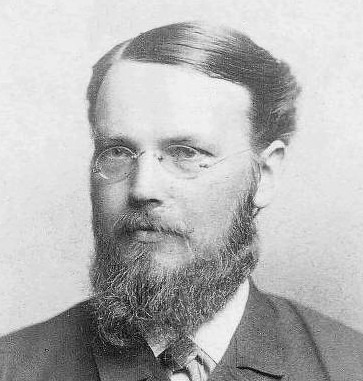
Birth of Johannes Lepsius (December 15, 1858)

In the fateful years that led to the end of the Ottoman Empire, Johannes Lepsius was the one personality who tried to raise Armenian issues among German public, especially a voice of alarm to document the genocide of 1915-1916 from its very beginning.

Protestant missionary and Orientalist, Lepsius was above all a humanist. He was the younger son of Carl Richard Lepsius, the founder of Egyptology in Germany. His siblings also become prominent personalities in science and art. He was born on December 15, 1858, in Berlin (Germany). He studied mathematics and philosophy in Munich, and earned a Ph.D. in 1880. He was trained as a Lutheran pastor and was on the board of the Syrian Orphanage of Jerusalem from 1884-1886, where he met his wife Margarethe Zeller. She passed away in 1898, leaving six children.

Lepsius became a missionary in the Ottoman Empire in the 1890s. He came to public attention when he traveled in disguise to gather evidence on the Turkish massacres of 1895-1896. His report on the pogroms, Armenien und Europa (1896), stirred considerable controversy and significantly affected international relations with the empire. He also helped found the Deutsche Orient Mission (German Mission for the Orient) to operate orphanages and schools for Armenian children.

Lepsius traveled to Constantinople in 1915 and gathered information about the ongoing massacres and deportations, while he unsuccessfully appealed to Turkish authorities to stop them. He also tried to lobby the German government. In 1916 he published privately Bericht über die Lage des armenischen Volkes in der Türkei (Report on the Situation of the Armenian People in Turkey; French edition, 1918), where he meticulously documented and condemned the annihilation. Lepsius was forced to secretly publish the report due to official military censorship. However, Lepsius managed to distribute more than 20,000 copies after the book was forbidden and before censorship was enforced. In the second edition, Der Todesgang des armenischen Volkes (The Death Walk of the Armenia People), he included an interview with Enver Pasha, held in June 1915.

Shortly after the publication of his report, Lepsius left Germany for the Netherlands to escape pursuit by the German police, and later brought his family. In June 1917 he resigned from the Deutsche Orient Mission because of disagreements with the committee. In an article published in 1925 in the magazine of the Mission, Der Orient, he disclosed his collaboration with the German Foreign Office, of which even top officials were unaware: “Soon after I resigned from my old mission, a circle of political friends suggested that I should stay in Holland and report regularly on the Dutch and British press. It becomes clear that I was serving patriotic interests from the fact that, during my three-year stay in Holland, I sent press reports daily to the military office of the Foreign Office, which were sent to Berlin through the embassy courier in The Hague.”


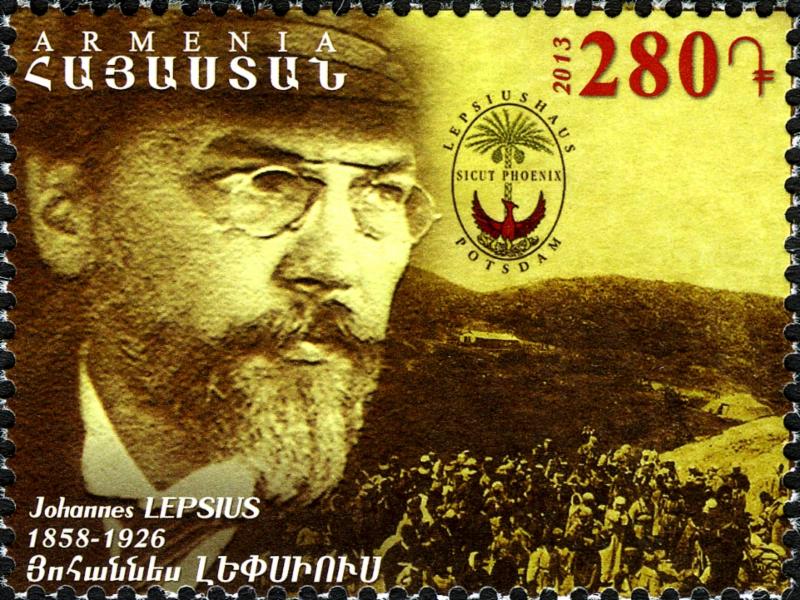
A stamp in homage to Johannes Lepsius issued in Armenia in 2013

The German responsibility in the Armenian genocide was a subject often discussed during World War I. In the first months following the defeat of Germany and Turkey, Germany faced allegations of war crimes in Europe and sought to avoid responsibility for crimes within Turkey. For his part, Lepsius was committed to unearthing the most comprehensive record possible of the genocide. Thus, while still in the Netherlands, he readily agreed to the foreign ministry's offer to let him prepare a series of books based on formerly secret German diplomatic records, beginning with a volume documenting German activities in Turkey and Armenia between 1914 and 1918: Deutschland und Armenien 1914–1918: Sammlung diplomatischer Aktenstücke (Germany and Armenia 1914–1918: Collection of Diplomatic documents) (1919). Although German officials claimed that they had released a copy of the complete record, they actually supplied Lepsius with censored versions of many documents. A systematic comparison of the published documents with the originals revealed that there were a great number of abridgements or even forgeries, and that important references to German policy with regard to the genocide, joint responsibility, as well as involvement of German officers in repressions against the Armenians had been systematically held back. In addition, the names of important Turkish people involved in the genocide were generally omitted. In the end, Lepsius’ collection presented frank and detailed evidence of the Young Turks’ genocidal campaign, but tended, unwittingly, to absolve Germany of any responsibility. The uncensored version of the German documents was published in 2005 by researcher Wolfgang Gust (also available in English translation).

In June 1921 Lepsius testified for the defense in the trial of Soghomon Tehlirian, the assassin of former Turkish Interior Minister Talaat Pasha.

Lepsius passed away on February 3, 1926, in Merano (Italy). Franz Werfel, who used his publications for his novel The Forty Days of Musa Dagh, portrayed him as a “guardian angel of the Armenians.” The “Johannes Lepsius Archive,” initially collected and organized by theologian Hermann Goltz at the Martin Luther University of Halle-Wittenberg, was moved in 2011 to the newly opened Lepsius House Museum, set in the house in Potsdam where Lepsius lived from 1908 and 1925, which also functions as a research center for genocide studies. A street in Potsdam is named after the German humanist, as well as a school in Yerevan.