Showing posts with label Turkey. Show all posts

Friday, March 16, 2018

Treaty of Moscow (March 16, 1921)

The Treaty of Moscow was signed between Soviet Russia and Kemalist Turkey on March 16, 1921. The Russian side yielded to most Turkish demands, and signed a document that was utterly damaging to Armenia for the sake of Russian-Turkish “friendship and brotherhood.”

The treaty was the outcome of the second Russian-Turkish conference, held in Moscow from February 26-March 16, 1921, with the participation of two Russian (Georgi Chicherin, the Commissar of Foreign Affairs, and Jelal Korkmasov) and three Turkish representatives (Yusuf Kemal bey, Riza Nur bey, and Ali Fuad pasha). Stalin, the Commissar of Nationalities, lobbied against any claim from Turkey that could put the Russian-Turkish alliance in risk. In a letter to Lenin on February 12, 1921, he had written: “I just learned yesterday that Chicherin really sent a stupid (and provocative) demand to the Turks to clean Van, Mush, and Bitlis (Turkish provinces with enormous Turkish supremacy) to the benefit of Armenians. This Armenian imperialist demand cannot be our demand. Chicherin must be forbidden to send notes to the Turks suggested by nationalist-oriented Armenians.” The Bolsheviks sought to halt further Turkish advance into the region. Weary from the ongoing Russian Civil War, which was winding down, they had no intent of starting a new war.

Not surprisingly, Chicherin refrained from his pro-Armenian position, and declared during the conference that Russia would not insist about passing the border to the west of the Akhurian (Arpachay) and the south of the Arax rivers. This meant that the entire province of Kars and the district of Surmalu (Igdir), which had never belonged to the Ottoman Empire, would go to Turkey. The Turkish delegation additionally claimed for the province of Nakhichevan, which historically had belonged to the Armenian Province and then to the governorate of Yerevan under the rule of the Russian Empire, to be put under Azerbaijani administration.

Thus, the treaty of “friendship and brotherhood” between Soviet Russia and Turkey recognized Turkish control over Artvin, Ardahan, Kars, and Surmalu. The region of Adjara, with the port of Batum, was returned to Soviet Georgia on the condition that it would be granted political autonomy due to its largely Muslim Georgian population. (Adjara became an autonomous republic within Georgia.) Turkey withdrew from Alexandropol (nowadays Gumri) and a new border was established between Turkey and Soviet Armenia, defined by the Arax and Akhurian rivers. According to these new boundaries, Mount Ararat and the ruins of Ani remained within Turkey.

The treaty also stipulated that Nakhichevan would become an autonomous entity under Azerbaijani protectorate. Azerbaijan obliged not to transfer the jurisdiction to a third party, namely, Armenia. Additionally, Turkey later acquired a small strip of territory known as the Arax corridor, which had also been part of the governorate of Yerevan. This corridor was located east of Surmalu, limited by the Arax River to the north and the Lower Karasu River to the south. It was a strategic strip of land that allowed Turkey to share a common border with Nakhichevan and, consequently, Soviet Azerbaijan.

Both signatory parties were internationally unrecognized, and thus were not subject of international law, which made the treaty illegal and invalid. The RSFSR, now under the guise of the Union of Soviet Socialist Republics, was legally recognized for the first time in 1924 by Great Britain. The Great National Assembly of Turkey was a non-governmental organization led by Mustafa Kemal, which did not have any legal grounds to represent the Turkish state in international relations. According to the Ottoman Constitution, only the sultan had the right to engage other states, be it personally or through a representative. The Kemalist movement was actually a rebellion against the legal authorities of the country, and Kemal was a criminal fugitive who had been sentenced to death by a fatwa signed by the Sheikh-ul-Islam, the highest religious authority of the Ottoman Empire, on April 11, 1920, and a court-martial on May 11, 1920.

The section of the Treaty of Moscow related to Armenia was a violation of international law, since treaties can only refer to the signatory parties and do not create any obligation to third parties that are not bound by treaty without the latter’s agreement. At the time of the Treaty, the Soviet regime had been thrown out from Armenia by the popular rebellion of February 1921.

The treaty was reaffirmed in October 1921 with the Treaty of Kars and the borders it established have been maintained ever since. However, this did not mean that Soviet policymakers necessarily accepted the terms of the treaty as permanent. After World War II, when the Soviet Union was at the zenith of its power, its leader Stalin reopened the issue on behalf of Armenia and his native Georgia. Supported by Moscow, both republics began to assert territorial claims against Ankara. According to Soviet leader Nikita Khrushchev, Stalin made this move at the insistence of Lavrenti Beria, the deputy premier and a fellow Georgian. Indeed, Ankara sought the support of Washington, which had become suspicious of Soviet intentions with the onset of the Cold War. The issue was eventually dropped by Moscow and by 1952 Turkey joined NATO, precluding any further discussion on border revisions.

The frontiers established by the 1921 treaty remained unaltered and were maintained by the newly-independent states of Russia, Georgia, Armenia, and Azerbaijan after the dissolution of the U.S.S.R.

Following the shoot down of a Russian plane over the Syria–Turkey border in November 2015 and the rise of Russo-Turkish tensions, members of the Communist Party of Russia proposed the nullification of the Treaty of Moscow. Initially, the Russian Foreign Ministry considered this action in order to send a political message to Turkey.   However, Moscow ultimately decided against it in its effort to de-escalate tensions with Ankara.

Wednesday, September 6, 2017

The Istanbul Pogrom (September 6-7, 1955)


Nazi Germany had its state-sponsored Kristallnacht (“Crystal Night”) against its Jewish citizens in 1938, and the Turkish government repeated the feat against its Greek, Armenian, and Jewish citizens less than two decades later, on September 6-7, 1955. The riots were orchestrated by an array of Turkish security organizations, both official and clandestine, with the active participation of extreme nationalist groups shepherded by the governing Democratic Party (1950-1960) and government-controlled trade unions. 
 
The process of Turkification that started at the turn of the twentieth century had entered the economic field after genocide and ethnic cleansing had been executed in 1915-1922, during the last years of the Ottoman Empire. The forcible population exchange between Turkey and Greece (1924) exempted the Greek population of Istanbul. In the Republican period, discriminatory policies against non-Muslim citizens included laws excluding non-Muslims from certain professions, campaigns to impose the Turkish language, the anti-Jewish pogrom in Eastern Thrace (1934), the Wealth Tax of 1942, and the recruitment of army work battalions during World War II. In a report on minorities, the Republican People’s Party (which ruled from 1923-1950) stated in 1946 that its goal was to leave no Greek in Istanbul by the 500 th anniversary of its conquest (1953).‎

Turkish-Greek relations soured after 1953, when Greek Cypriots began their armed struggle for Enosis , the annexation of Cyprus—under British mandate—by Greece. Greece appealed to the United Nations to demand self-determination for Cyprus in 1954, while Great Britain wanted to solve the dispute without taking it to the U.N. Security Council, and leaned on Turkey to counter Greek claims.

An anti-Greek propaganda campaign started in 1955, with the main Turkish newspapers agitating public opinion along nationalist organizations. The British convened a tripartite conference in London with Turkey and Greece (August 29-September 6, 1955), which fell apart when news broke of the bombing of the Turkish consulate in Salonica (Greece), adjacent to the house where Mustafa Kemal Atatürk was born.

The bombing was organized by the Turkish consulate with the ‎knowledge of the Turkish Foreign Affairs Ministry.‎ Oktay Engin, a university student in Salonica, carried out the explosion. He was arrested on September 18, but after his alibi the initial charge of executing the attack was dropped to incitement. After spending nine months in detention, he escaped to Turkey in September 1956, before the Greek courts sentenced him to three and a half years in prison. He would be later promoted by the Turkish Interior Ministry.‎

News reports of the bombing were first announced by radio in Istanbul in the early afternoon of September 6, and the daily İstanbul Ekspres , associated with the Democratic Party and the National Security Service, repeated them in print. The insinuations that the Greeks were behind the bombing became the trigger for a protest rally on the night of September 6 as cover to gather the rioters, most of who had been trucked into Istanbul in advance. The homes and workplaces of Greeks and other non-Muslim communities had been identified beforehand. Owners of Turkish shops had been told the day before to put Turkish flags on their windows; the shops without flags were destroyed or damaged. According to witnesses, the mob was furnished with a list of ‎addresses. ‎

The riots started in Taksim Square by 5 pm, and rippled out through Beyoğlu (Pera) during the evening, with smashing and looting of non-Muslim property. A correspondent for the French daily France-Soir wrote: “Everything happened as if the agitators had divided one by one the neighborhoods of the minorities, even the streets. I followed the arsonists for hours. When they arrived in front of a store, they asked for the owner. When the latter appeared, they asked: ‘Where’s your passport?’ If the owner of the passport was Greek, or even Armenian or Jewish, the looting started. Through the whole night, I heard from this frenzied mob a word that seemed to have been forgotten for a long time, giaour ” ( giaour “infidel”).

The police was ordered to hold a passive stance and leave the mob to roam the streets freely. The function of the Turkish militia and police was not to protect the lives and properties of the victims, but to preserve adjacent Turkish properties, except in a few cases where police officers prevented criminal activity. The fire brigade, whenever it reached a fire, claimed that it was unable to deal with it. According to a cable to the U.S. Department of State by the American consul general, “the destruction was ‎completely out of hand with no evidence of police or military attempts to control it. I ‎personally witnessed the looting of many shops while the police stood idly by or cheered on ‎the mob.”‎ The riot died down by midnight with the intervention of the army and the declaration of martial law.

On the morning of September 7, a mob overran the İzmir National Park, where an international exhibition was taking place, and burned the Greek pavilion. Next, it completely destroyed the church of Saint Fotini. The homes of the few Greek families and officers were then looted.

After the events, a total of 5,000 people were arrested, some nationalist leaders were taken to court, but nobody was convicted. There was an attempt to implicate Turkish Communists in the riots, which fired back. Attempt by Greece to bring the issue to the U.N. and NATO fizzled due to the lenient attitude of Great Britain and the United States towards Turkey within the context of the Cold War.

Estimations of victims are varied, with a number of 30 to 37 Greeks as most likely. Moreover, 32 Greeks were severely wounded. The mobs beat and injured many people, destroyed and vandalized cemeteries, dragging the dead in the streets. Some 200 Greek women were raped. It was also reported that Greek boys were raped and that a priest was burned alive. Many Greek men, including at least one priest, were ‎exposed to forced circumcision. ‎

The material damage was considerable, including 5,317 properties (4,214 homes, 1,004 businesses, 73 churches, 2 monasteries, 1 synagogue, and 26 schools). According to the Istanbul police, 3,836 Greek (2,572), Armenian (741), and Jewish (523) businesses were destroyed. The American consulate estimated that 88% of the businesses were non-Muslim (59% Greek, 17% Armenian, and 12% Jewish), as well as 92% of the homes (80% Greek, 9% Armenian, and 3% Jewish). ‎

Estimates of the economic cost of the damage varied from the Turkish government's estimate of 69.5 million Turkish liras (equivalent to 24.8 million dollars) to the Greek government's estimate of 500 million dollars. The Turkish government paid 60 million Turkish lira of restitution to those who registered their losses.

The pogrom greatly accelerated the emigration of Greeks and Armenians from Turkey. The Greek population of Istanbul decreased from 65,108 to 49,081 between 1955 and 1960. Overall, the Greek population of Turkey declined from 119,822 persons in 1927 to about 7,000 in 1978, and some 2,500 according to current estimates. 

Thursday, December 15, 2016

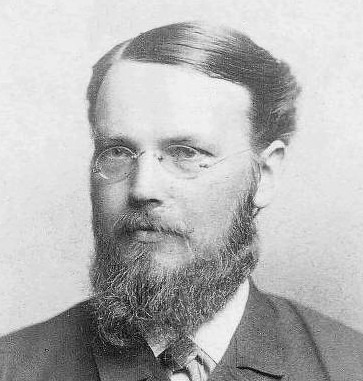
Birth of Johannes Lepsius (December 15, 1858)

In the fateful years that led to the end of the Ottoman Empire, Johannes Lepsius was the one personality who tried to raise Armenian issues among German public, especially a voice of alarm to document the genocide of 1915-1916 from its very beginning.

Protestant missionary and Orientalist, Lepsius was above all a humanist. He was the younger son of Carl Richard Lepsius, the founder of Egyptology in Germany. His siblings also become prominent personalities in science and art. He was born on December 15, 1858, in Berlin (Germany). He studied mathematics and philosophy in Munich, and earned a Ph.D. in 1880. He was trained as a Lutheran pastor and was on the board of the Syrian Orphanage of Jerusalem from 1884-1886, where he met his wife Margarethe Zeller. She passed away in 1898, leaving six children.

Lepsius became a missionary in the Ottoman Empire in the 1890s. He came to public attention when he traveled in disguise to gather evidence on the Turkish massacres of 1895-1896. His report on the pogroms, Armenien und Europa (1896), stirred considerable controversy and significantly affected international relations with the empire. He also helped found the Deutsche Orient Mission (German Mission for the Orient) to operate orphanages and schools for Armenian children.

Lepsius traveled to Constantinople in 1915 and gathered information about the ongoing massacres and deportations, while he unsuccessfully appealed to Turkish authorities to stop them. He also tried to lobby the German government. In 1916 he published privately Bericht über die Lage des armenischen Volkes in der Türkei (Report on the Situation of the Armenian People in Turkey; French edition, 1918), where he meticulously documented and condemned the annihilation. Lepsius was forced to secretly publish the report due to official military censorship. However, Lepsius managed to distribute more than 20,000 copies after the book was forbidden and before censorship was enforced. In the second edition, Der Todesgang des armenischen Volkes (The Death Walk of the Armenia People), he included an interview with Enver Pasha, held in June 1915.

Shortly after the publication of his report, Lepsius left Germany for the Netherlands to escape pursuit by the German police, and later brought his family. In June 1917 he resigned from the Deutsche Orient Mission because of disagreements with the committee. In an article published in 1925 in the magazine of the Mission, Der Orient, he disclosed his collaboration with the German Foreign Office, of which even top officials were unaware: “Soon after I resigned from my old mission, a circle of political friends suggested that I should stay in Holland and report regularly on the Dutch and British press. It becomes clear that I was serving patriotic interests from the fact that, during my three-year stay in Holland, I sent press reports daily to the military office of the Foreign Office, which were sent to Berlin through the embassy courier in The Hague.”


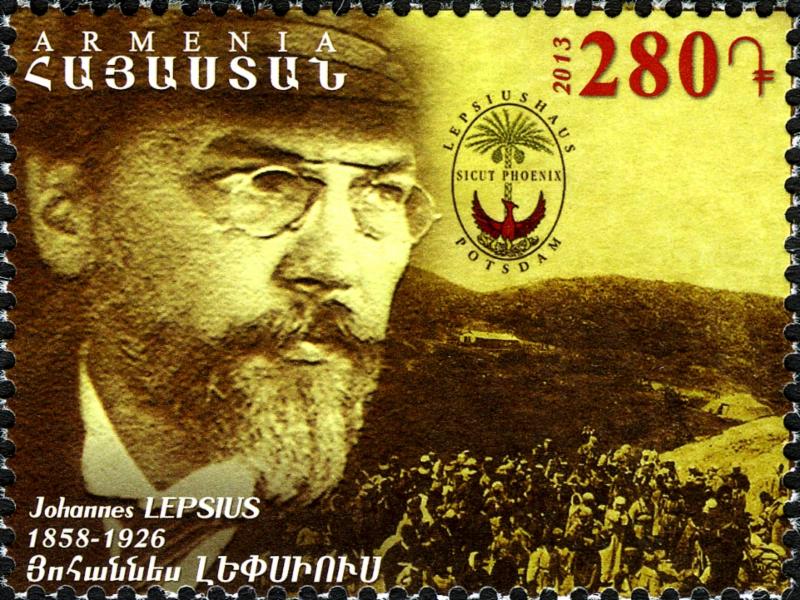
A stamp in homage to Johannes Lepsius issued in Armenia in 2013

The German responsibility in the Armenian genocide was a subject often discussed during World War I. In the first months following the defeat of Germany and Turkey, Germany faced allegations of war crimes in Europe and sought to avoid responsibility for crimes within Turkey. For his part, Lepsius was committed to unearthing the most comprehensive record possible of the genocide. Thus, while still in the Netherlands, he readily agreed to the foreign ministry's offer to let him prepare a series of books based on formerly secret German diplomatic records, beginning with a volume documenting German activities in Turkey and Armenia between 1914 and 1918: Deutschland und Armenien 1914–1918: Sammlung diplomatischer Aktenstücke (Germany and Armenia 1914–1918: Collection of Diplomatic documents) (1919). Although German officials claimed that they had released a copy of the complete record, they actually supplied Lepsius with censored versions of many documents. A systematic comparison of the published documents with the originals revealed that there were a great number of abridgements or even forgeries, and that important references to German policy with regard to the genocide, joint responsibility, as well as involvement of German officers in repressions against the Armenians had been systematically held back. In addition, the names of important Turkish people involved in the genocide were generally omitted. In the end, Lepsius’ collection presented frank and detailed evidence of the Young Turks’ genocidal campaign, but tended, unwittingly, to absolve Germany of any responsibility. The uncensored version of the German documents was published in 2005 by researcher Wolfgang Gust (also available in English translation).

In June 1921 Lepsius testified for the defense in the trial of Soghomon Tehlirian, the assassin of former Turkish Interior Minister Talaat Pasha.

Lepsius passed away on February 3, 1926, in Merano (Italy). Franz Werfel, who used his publications for his novel The Forty Days of Musa Dagh, portrayed him as a “guardian angel of the Armenians.” The “Johannes Lepsius Archive,” initially collected and organized by theologian Hermann Goltz at the Martin Luther University of Halle-Wittenberg, was moved in 2011 to the newly opened Lepsius House Museum, set in the house in Potsdam where Lepsius lived from 1908 and 1925, which also functions as a research center for genocide studies. A street in Potsdam is named after the German humanist, as well as a school in Yerevan.

Thursday, October 13, 2016

The Treaty of Kars (October 13, 1921)

As a result of the Russo-Turkish war of 1877-1878, the regions of Kars, Ardahan, Artvin, and Batum, at the time in the Ottoman Empire, went to Russia. 

The next conflict between Russia and the Ottoman Empire was during World War I. The Caucasian expedition of Enver Pasha in late 1914-1915 was soundly defeated in the battle of Sarikamish. Enver covered his defeat by accusing the Armenians of treason. As a result, the Armenian soldiers in the Ottoman Empire were disarmed and killed en masse, and the subsequent massacres and deportation of Armenians would soon turn into genocide. The Russian forces occupied an important section of Western Armenia (Van, Erzerum, Bitlis and Mush, Trebizond, and Erzinga) in 1915-1916.

After the October Revolution, the Russian forces abandoned the front. The Armenian battalions formed in a hurry were insufficient to stop the Ottoman advance and the territories of Western Armenia were lost between February and April 1918. The Treaty of Brest Litovsk (March 3, 1918) between Soviet Russia and the Ottoman Empire recognized the transfer of Kars, Ardahan, and Batum to the latter. After the armistice of Mudros (October 30, 1918), the Republic of Armenia established its sovereignty over most of the region of Kars, and the Treaty of Sevres recognized the region of Kars and most of Western Armenia as part of Armenia (August 1920).

However, as a result of the Armeno-Turkish war of September-November 1920, the region of Kars and Alexandropol (nowadays Gumri) was occupied by the Turkish forces, which threatened once again the existence of Armenia. The invasion of the XI Red Army on November 29 forced the government of the Republic of Armenia to transfer the authority to the Communists on December 2, which turned the country into a Soviet republic. 

Meanwhile, the representatives of the Republic signed the Treaty of Alexandropol with the Turks on the night of December 2 to 3. This treaty recognized the occupation of the region of Kars by Turkey. However, its legal validity was dubious, because it had been signed on behalf of a government that was already out of office. The next step was the signature of the Treaty of Moscow between Kemalist Turkey and Soviet Russia on March 16, 1921. Turkey received the region of Kars, and the southern portion of the region of Batum. Probably as a compensation for the north of the region of Batum, the Bolsheviks transferred the Armenian province of Surmalu to the Turks. 

At the time, the February rebellion had expelled the Communist government from Armenia, while Georgia was still an independent republic. After Armenia and Georgia were finally occupied by the Red Army, the signature of the Treaty of Kars was meant to confirm the terms of the Treaty of Moscow by the representatives of Armenia, Georgia, and Azerbaijan.

The treaty was signed on October 13, 1921, and ratified in Yerevan on September 11, 1922. Signatories included four Turkish representatives, Russian ambassador Yakov Ganetsky, and two representatives from Armenia, Azerbaijan, and Georgia. Minister of Foreign Affairs Askanaz Mravian and Minister of Interior Poghos Makintsian signed it on behalf of Armenia.

The treaty confirmed the division of the region of Batum, with the north ceded by Turkey to Georgia and the south, with the city of Artvin, annexed by Turkey, which was also guaranteed free transit through the port of Batum.

It also created a new boundary between Turkey and Armenia, defined by the Akhurian and Arax rivers. Turkey annexed most of the region of Kars, including Surmalu, with Mount Ararat and the cities of Igdir and Koghb, the cities of Kars, Ardahan, and Olti, and the ruins of Ani.

The region of Nakhichevan became an autonomous territory under the protection of Azerbaijan, which was turned into the Autonomous Soviet Socialist Republic of Nakhichevan in 1924, as an exclave subordinate to Soviet Azerbaijan and sharing a fifteen kilometer boundary with Turkey. 

The Soviet Union attempted to annul the Treaty of Kars and regain the lost territories of Kars, Ardahan, and Artvin after World War II on behalf of Armenia and Georgia. However, British Prime Minister Winston Churchill objected to those territorial claims, and in 1947 the Soviet Union gave up its claims from Turkey.

The validity of the Treaty of Kars has been questioned on the basis that the sides that signed it did not have authority. The Turkish Grand National Assembly, which was represented by the Turkish signatories, had no authority to sign international treaties, which still rested with the legal ruler of the Ottoman Empire, the Sultan, as established by its Constitution. The Republic of Turkey was proclaimed in 1923. On the other hand, the Soviet republics were under strict control of Moscow and the Soviet Union was established in December 1922.

After the dissolution of the Soviet Union in 1991, the Treaty of Kars was accepted by Turkey, Georgia, and Azerbaijan. However, the government of Armenia has made no such ratification.

Tuesday, February 16, 2016

The Fall of Erzerum (February 16, 1916)

In 1915-1916 Western Armenia was mostly emptied of its native population, massacred and deported during the execution of the genocide planned by the Ottoman government. There was a moment during the war, when Armenians felt that the gigantic sacrifice of human lives had not been in vain. That moment came in February 1916 with the battle for Erzerum.

The Ottoman Empire had entered World War I in November 1914 on the side of the Central Powers (Germany and Austria-Hungary, later joined by Bulgaria), which considered it a valuable ally for two reasons: first, it could threaten British interests in the Middle East, and second, it could divert Russian troops from the front in Europe to the Caucasus.

The Turkish offensive in the winter of December 1914-January 1915 had ended with the disastrous battle of Sarikamish, where the Armenian volunteer units had also had a share in the victory of the Russian army. It became the pretext for disarming the Armenian soldiers in the Ottoman army and turning them into labor battalions, to be later massacred. The subsequent invasion of the Russian army in May 1915, when the Armenian Genocide had already started, was able to save the population of the city of Van, but the Russian troops retreated in July. The annihilation of the Armenian population disrupted the supplying of the Ottoman forces. However, the front remained quiet until the end of the year.

The end of the Gallipoli campaign and the retreat of the Allied forces from the surroundings of Constantinople would free up considerable Turkish soldiers. General Nikolai Yudenich, one of the most successful and distinguished Russian commanders of the war and commander of the Caucasus army, was aware of this and prepared to launch an offensive. His aim was to take the strategic fortress of Erzerum, followed by Trebizond. It would be a difficult campaign, since Erzerum was protected by a number of forts in the mountains and was considered the second best defended town in the Ottoman Empire. Its fortress was defended by 235 pieces of artillery and the fortifications covered the city on a 180 degree arc in two rings. There were eleven forts and batteries covering the central area.

The Russians had 130,000 infantry and 35,000 cavalry. Further, they had 160,000 troops in reserve, 150 supply trucks, and 20 planes of the Siberian Air Squadron. On the other side, Ottoman forces were 126,000 men as of January 1916, only 50,539 being combat soldiers, with inadequate armament and food. They were big on paper, but not on the ground.

Citizens of Erzerum in their national costumes.
It seems that after the disastrous end of the Turkish winter offensive of 1914-1915, the Ottoman High Command did not expect the Russians to make operations during winter. Ottoman High Command did not expect any Russian operations during winter. Mahmut Kamil Pasha, commander of the Third Army, was in Constantinople, and his chief of staff, Colonel Felix Guse, was in Germany. General Yudenich launched a major winter offensive. In the middle of January, there was heavy snow, which often came up to four feet.

The Russian plan was to break through a weak part of the line. The initial offensive managed to break through the XI Ottoman Corps, which suffered high losses after a four-day engagement from January 10-14. The Ottoman defensive formation was dissolved within one week, by January 23.

Mahmut Kamil returned from Istanbul on January 29. He could feel that the Russians would not only attack Erzerum, but also renew the offensive on the southern flank around Lake Van. Khnus, located further south, was taken on February 7 to prevent reinforcements from Mush from coming in. Turkish reserves were diverted from the northern front, but Russian forces captured Mush, seventy miles from Erzerum.

Citizens of Erzerum in their national costumes.
The attack on Erzerum started on February 11 from the south. Once the Russian forces broke through the Turkish lines to the south and began to attack other Turkish positions, the fall of the city seemed inevitable. In three days, the Russians managed to reach the heights overlooking the plain of Erzerum. The Turkish units began to retreat from the fortified zones at the front and also evacuate the city. On February 14 the Russians penetrated through both rings of Erzerum defenses and the remaining forts surrounding the city were evacuated the next day, avoiding encirclement. Russian Cossacks were among the first to enter the city in the early morning of February 16, 1916.

The Ottoman army lost a total of 17,000 soldiers during the campaign, including 5,000 prisoners. The Russians had 1,000 casualties, 4,000 wounded soldiers, and another 4,000 affected with frostbite.

The Russians gained the upper hand in the battle for control on the Caucasus front with the capture of Erzerum. This one victory, followed by the occupation of Trebizond in April 1916, enabled them to capture or control all the roads leading to Mesopotamia and Tabriz (Iran), and in essence, to control most of Western Armenia. The Russian victory allowed Armenian refugees and survivors from the Caucasus to return to their homes, and for the next year and a half, until the Bolshevik Revolution of November 1917, the liberation of Western Armenian from Ottoman yoke was a reality.

In the wake of the Bolshevik Revolution and the subsequent armistice between Russia and the Central Powers, Erzerum was returned to Turkish control. The transfer of power was made official under the terms of the Treaty of Brest-Litovsk in March 1918, when an Ottoman offensive on the Caucasus, against Eastern Armenia, was already on its way.