Showing posts with label Armenian history. Show all posts

Friday, April 26, 2019

Birth of Leo (April 26, 1860)

Leo was the pseudonym of an Armenian intellectual who produced an amazing output of historical and literary scholarship at the turn of the twentieth century.

Arakel Babakhanian was born on April 26, 1860, in the village of Karintak, near the town of Khankend (nowadays Stepanakert, the capital of Artsakh). In 1878 he graduated from the diocesan school of Shushi. This was the extent of his formal studies, which he would complement with self-teaching. After graduation, he worked in Shushi and Baku as a scribe for notary work, telegrapher, and manager of the “Aror” printing house. 

He was still a student when he started collaborating with the influential daily Mshak of Tiflis in 1877. His views were shaped by the ideological tenets maintained by Raffi, the novelist, and Grigor Artzruni, the founding editor of Mshak. Over the years, he would contribute to a number of publications from the Caucasus to Europe. Initially, he wrote commentary and prose (short story and novel). His most notable literary work was The Daughter of the Melik (1898). He even wrote a historical play, Vartanank, published in 1916.

In 1895 he moved to Tiflis, becoming secretary and contributing editor of Mshak until 1906 . Afterwards, he gradually shifted to scholarship and produced hundreds of articles and dozens of books. First he entered the field of literary criticism, with essays about many contemporary writers, and condensed his views in his monograph The Literary of Russian Armenians from the Beginnings to Our Days (1904). On the other hand, he offered fresh interpretations of many historical issues. He produced a spat of book of history: Armenian Printing (2 vols., 1901-1902), Catholicos Hovsep Arghoutian (1902), Grigor Artzruni (3 vols., 1902-1905), Saint Mesrop (1904), The Armenian Question (1906). After a year of teaching at the Gevorgian Seminary of Holy Etchmiatzin (1906-1907), Leo returned to Tiflis and dedicated himself to scholarship. He produced new books: The Feast of the Armenian Book (1912), The Kingdom of Van (1915), The Documents of the Armenian Question (1915), and the posthumously published Ani (1946). His most ambitious work, which remained unfinished, was the three-volume History of the Armenians, of which he only saw the first volume published in 1916 (the other two volumes were posthumously published in 1946 and 1947). This work of almost 2,000 pages introduced Armenian history from prehistory until the end of the eighteenth century (excluding the 12 th -15 th centuries). While his views were both fresh and sometimes not exempt of controversy, Leo’s works were characterized by an encyclopedic use of Armenian and foreign sources, archaeological, epigraphic, linguistic, and philological materials, travelogues and memoirs, secondary sources, et cetera.

In 1924 Leo moved to Yerevan by invitation of the government of Soviet Armenia and became a lecturer of Armenian history at Yerevan State University until his death. His classes became the first university textbooks of Armenian history, toge
ther with those of professional historian Hakob Manandian. He was given the title of professor in 1925 and became a full member of the Institute of Science and Art of Soviet Armenia (renamed Institute of Sciences in 1930).

While in his pre-Soviet writings Leo gave primacy to the role of the individual and spiritual and geographical factors, in the 1920s he tried to accommodate himself to the new ruling ideology and reversed many of his positions. The genocide appeared to have crushed his views. His work From the Past (1925) offered a picture of the Armenian liberation movement that was completely at odds with his positive approach of his formative years. He repeated his negative evaluation in the two-volume The Ideology of the Turkish Armenian Revolution (1934). In his work The Khoja Capital (1934) he regarded the commercial capital as the moving force of Armenian modern history. 
Leo passed away in Yerevan on November 14, 1932, and was buried in the Yerevan Pantheon. A street and a school in the Armenian capital have been named after him. Leo’s bust has been placed at the central building of Yerevan State University.

Saturday, February 4, 2017

Death of Hakob Manandian (February 4, 1952)

Historian and philologist Hakob Manandian was one of the most respected names in the field of Armenian Studies during the first half of the twentieth century.
He was born in Akhaltskha (Javakhk, nowadays Georgia) on November 22, 1873. He had his elementary education in the Karapetian School of his birthplace (1880-1883). In 1883, after the death of his father, he moved to Tiflis, where he continued his education in the first gymnasium of the city.
In 1893 twenty-years-old Manandian went to Germany to pursue higher education. He entered the School of Philosophy of the University of Jena, while following the courses of Oriental studies and linguistics at the universities of Leipzig and Strasbourg. He studied with the best scholars of the time, including well-known names in Armenian Studies like Heinrich Hübschmann and Heinrich Gelzer. In 1897 he defended his doctoral dissertation in philosophy  about the identity of the author of History of Aghvank, the earliest source on the history of the region between Artsakh and the right bank of the river Kura. This dissertation was published in Leipzig in the same year (Beiträge zur albanischen Geschichte, 1897).
Manandian moved to St. Petersburg in the fall of 1897 and finished his studies in one year at the School of Oriental Studies of the local university with a diploma of doctoral candidate in Armenian and Persian philology. After a year spent researching Armenian manuscripts in the libraries and museums of London, Paris, Vienna, and Venice, in 1899 he accepted an offer from the Gevorgian Seminary of Holy Etchmiadzin and started a thirty year career as an educator. He became a teacher of classical Greek and German, Greek literature, and history of philosophy until 1905. Meanwhile, he was one of the editors of the short-lived Armenological journal Zeitschrift für armenische Philologie (1901-1903).
In 1905 Manandian settled in Tiflis, where he taught German, Armenian, Armenian literature, English literature, and other subjects in the Russian gymnasia (1905-1907) and the Nersesian School (1906-1907). In 1909 he graduated from the Law School of the University of Dorpat (Tartu, nowadays Estonia). In the 1910s he moved to Baku and taught at the Popular University (1911-1913) and the Commerce School (1915-1919).
When Armenia declared its independence in 1918, Manandian was not only a seasoned teacher with two decades of experience, but also a well-reputed scholar. He was invited by the University of Yerevan in December 1919 (officially opened in Alexandropol) and became acting dean of the School of History, Linguistics, and Literature. After the establishment of the Soviet regime, he remained at the university. In the next ten years, he became rector (1921-1922), dean of the schools of Oriental Studies and History and Literature (1921-1924), head of the chair of Armenian history (1921-1925), and professor of the same chair (1925-1931). He left the university in 1931 to devote himself to scholarship.
Among his more than 150 works in Armenian, Russian, and German, Manandian produced a string of Armenian books in the last twenty-five years of his life, which cemented his lasting contribution to Armenian Studies. The first one was his monograph The Philhellenic School and Its Periods of Development (Armenian, 1928), followed by The Trade and Cities of Armenia in Relation to Ancient World Trade (Russian, 1930, translated by Nina Garsoian into English, 1965), Weights and Measures in the Oldest Armenian Sources (Armenian, 1930), Feudalism in Ancient Armenia (Armenian, 1934), The Main Roads of Ancient Armenia (Armenia, 1936), and others. However, his main works in this regard were the seminal monograph Tigranes II and Rome (Armenian, 1940, translated by George Bounoutian into English, 2007), and his masterwork, the three-volume Critical Survey of the History of the Armenian People (Armenian, 1945, 1952, 1957). The latter was meant to be a comprehensive history of Armenia from the sixth century B.C. to the sixteenth century A.D., which nevertheless remained unfinished.
Manandian’s scholarly and educational work was recognized in his lifetime. He became an emeritus scientific figure of Armenia in 1935, and received a second doctorate in history, without defense of a dissertation, in 1938. A year later, he was elected member of the Academy of Sciences of the Soviet Union and, in 1943, member of the newly founded Academy of Sciences of Armenia. His contribution was also recognized by the Soviet Armenian government with the order of the Red Banner of Labor. He passed away on February 4, 1952. A street in Yerevan was named after him in the 1990s.

Tuesday, January 10, 2017

Birth of Nicholas Adontz (January 10, 1871)


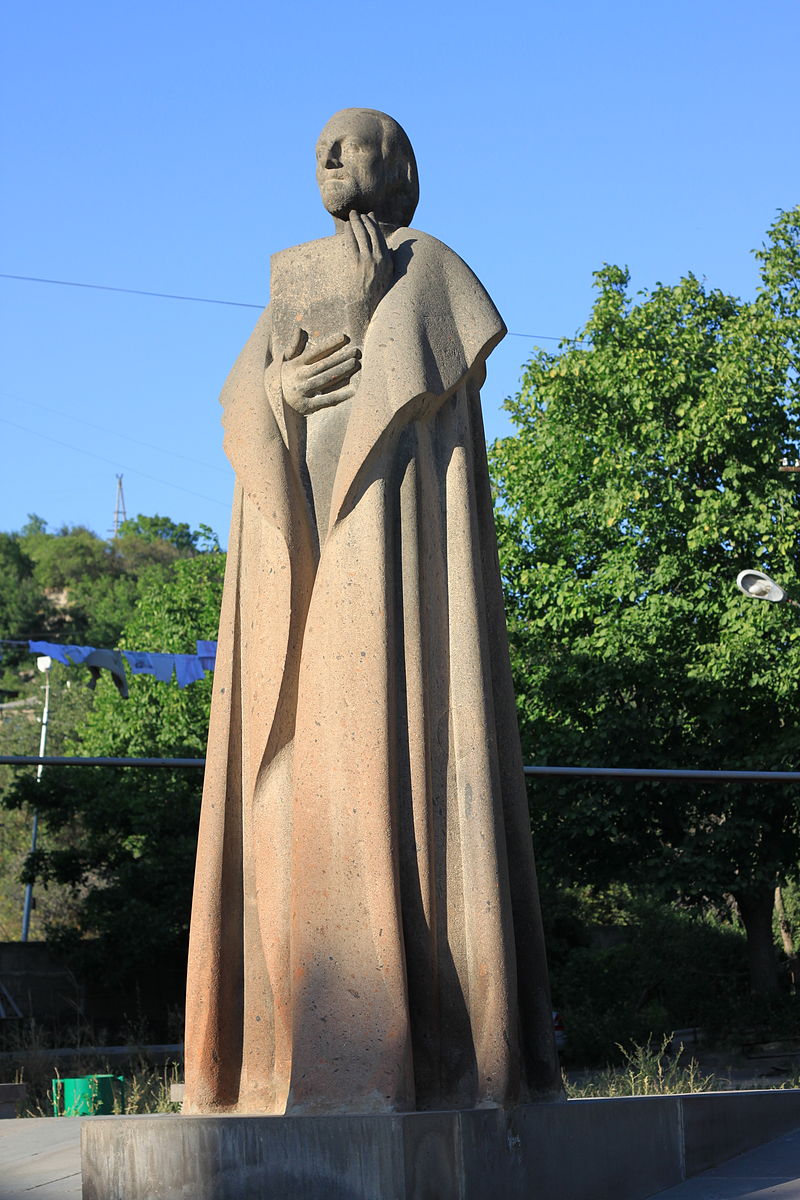
A statue of Nicholas Adontz near the
museum of history of Sisian, named after him.

Nicholas Adontz was one of the most influential Armenian historians and philologists in the first half of the twentieth century at an international level. Poet Mushegh Ishkhan, one of his students in Brussels, wrote about him: “Nicholas Adontz seemed to be Armenia, the embodiment of its better qualities, its human image. He was the Armenian man, in the traditional, modern, and noble sense of the word; the living fortress of Armenian ancient culture, heroic history, beauty, and virtues of the Armenian character, who knows how to instill joy and pride.”

He was born Nikoghayos Ter-Avetikian in the village of Brnakot (Sisian, region of Siunik/Zangezur) on January 10, 1871. He traced his roots to Ter Avetik, a priest who was a close ally to David Bek, the hero of the Armenian rebellion of Siunik from 1722-1728. He studied for a very short period at the monastic school of Tatev and then at the Gevorgian Seminary of Holy Echmiadzin (1882-1891). He interrupted his studies and moved to Tiflis, where he studied Russian for a year and then entered the second year of the Russian gymnasium (1892-1894). He adopted the last name Adontz, derived from an ancestor of their family, to avoid being called “Ter-Avetikov.”

Adontz’s dreams to pursue higher education were fulfilled thanks to the sponsorship of benefactor Alexander Mantashov (Mantashiants). He first studied at the School of History and Philology of the University of St. Petersburg (1894-1899), where he had among his teachers the famous Orientalist Nikolai Marr. After graduating from the university, Mantashov sponsored his three-year sojourn in Europe, where Adontz studied and researched in Munich, Paris, Oxford, and Venice. In 1902, once the agreement was finished, he returned to St. Petersburg, where he passed his examinations for a master’s degree. Then he went to the Caucasus, where he studied the manuscripts of Echmiadzin and Tiflis. He also published a journal of Armenian literature, Banber grakanutian yev arvesti (1903-1904).

In 1908 Adontz published Armenia in the Period of Justinian in Russian, a remarkable study on the social and political structures of early medieval Armenia. He defended it as his master’s thesis in April 1909 and was appointed assistant professor at the University of St. Petersburg. His second monograph in Russian, Dionysus of Thrace and the Armenian Commentators, published in 1915, was an edition, along with the Greek original, of the early medieval Armenian translation of the grammar of Dionysus Thrax (a Greek grammarian of the second century B.C.), based on 30 manuscripts. He defended it as his Ph.D. dissertation and was appointed professor of the chair of Armenian and Georgian philology in 1916.

Also in 1916, Adontz first participated in the works of an archaeological expedition to Mush and Erzerum, and later headed an expedition to Van, at a time when Western Armenia was mostly occupied by Russia. In 1917-1918 he became honorary trustee of the Lazarian College of Moscow. After the October Revolution, he successfully fought to avoid that the Armenian manuscripts from Echmiadzin, and the Armenian libraries of the Lazarian College and the Moscow churches were incorporated into the “Alexander III” library of Moscow. In the spring of 1920 the Russian Academy of Sciences decided to send him abroad in a six-month study trip. The Armenian scholar did not wait for the documentation to be completed and left Russia on his own.

Adontz, who had actively participated in political activities about the Armenian Question in the 1910s, first settled in London and published the book Towards the Solution to the Armenian Question (in English, 1920). The next year he moved to Paris, where he had been named consultant for the Armenian National Delegation. He married singer Olga Hovnatanian and lived in the French capital for the next ten years. He continued publishing and lecturing, supported by benefactor Abraham Ghoukassiantz.

In 1931 an Armenian Studies chair, funded by millionaire Robert Werner; Eva-Zarouhi Nubar, Countess d’Arschot Schoonhoven (daughter of Boghos Nubar Pasha, founding president of the Armenian General Benevolent Union), and the Armenian community of Brussels, was founded within the Center of Oriental Studies at the Free University of Brussels (Belgium). Adontz was appointed to the position. He would teach an array of courses on Classical and Modern Armenian, as well as subjects of Armenian and Byzantine Studies, while continuing his publications and lectures.

However, Brussels did not offer him peace of mind. After a long illness, his wife passed away in 1935. He was deeply affected by this loss, and its impact took a strong toll from his body. In May 1940 Belgium was occupied by Nazi Germany. Adontz’s health problems became worse and he was diagnosed with pulmonary tuberculosis. He was admitted to a hospital in October 1941 and passed away on January 27, 1942. He was buried in the cemetery of Brussels. Adontz left more than 120 scholarly articles and monographs on the history and literature of Medieval Armenia, Armenian-Byzantine relations, Armenian-Greek philology, mythology, religion, and linguistics, in Armenian, Russian and French. In the last years of his life, he worked on a history of Armenia from the beginnings to the twentieth century, but he only completed the first volume (Paris 1946; Armenian translation, 1972). A collection of his most important Armenian-Byzantine studies was published in French (1965). The importance of his works for scholarship is evidenced by the fact that Armenia in the Period of Justinian was translated into English and published by historian Nina Garsoian in 1970 with revisions, a bibliographical note, and appendices (an Armenian translation appeared in 1987), while Dionysus of Thrace and the Armenian Commentators was published in French in 1971. Many of his works have appeared in Armenian since 1989, including a six-volume collection published in Yerevan from 2006-2011.

Sunday, July 12, 2015

Death of Yervant Ter-Minasian (July 12, 1974)

Yervant Ter-Minasian had a short and eventful ecclesiastic career (he left the Church at the age of 31), when he was already an important name in Armenian scholarship. He would still be active for the next six decades and leave a prolific legacy.

He was born in the village of Harich, now in the province of Shirak (Republic of Armenia), on November 19, 1879, into a family of priests. He graduated from the school of the local monastery in 1892 and entered the Kevorkian Seminary of Holy Etchmiadzin. After his graduation in 1900, Catholicos Mgrdich Khrimian sent him to Germany, where he studied theology and ancient languages at the universities of Berlin and Leipzig with famous theologian Adolf Harnack among other professors. He defended his dissertation in 1904 with a study of the relations between the Armenian and Syriac Churches, published in German in the same year, which became the cornerstone of this field.

Back in Etchmiadzin, Ter-Minasian was consecrated celibate priest (vartabed) in 1905 and taught at the Kevorkian Seminary, becoming also the director of the printing house of the Holy See. He published a revised version of his doctoral dissertation in Armenian (1908), as well as half a dozen books, including several textbooks, between 1906 and 1909. An ongoing polemics between conservative and liberal members of the congregation about reform in the Armenian Church ended with an article by the young vartabed, published in the monthly Ararat of the Catholicosate, being publicly burned by order of the locum tenens, Archbishop Kevork Surenian (later Catholicos Kevork V), in 1909. This polemics led him to leave the Church in February 1910. He would later marry and have five children. Nevertheless, his relations with the Holy See soon returned to normalcy. In 1944 he even declined an offer from Catholicos Kevork VI to return to the Church and become a bishop.

Ter-Minasian devoted himself to his pedagogical vocation. He taught in schools at Alexandropol (Gumri, 1910-1917) and Tiflis (1918-1919). In late 1919 he was entrusted by the government of the Republic of Armenia to become one of the organizers of the University of Yerevan, and was a professor there in 1920. After the fall of the independent republic, he became scientific secretary of the Scientific Institute of Etchmiadzin (1921-1922) and then principal of the school of second degree of Vagharshapat (1922-1928) and teacher until 1930.

Ter-Minasian’s past both as a former ecclesiastic and as researcher in ecclesiastic history was not politically correct in the Soviet regime. He took as many precautions as he could to avoid unpleasant surprises: after 1930, when he moved to Yerevan, he earned his living as one of the most authoritative experts of the German language in the country. Furthermore, he would be one of the foremost translators and editors of Marxist classics (Marx, Engels, Lenin) from German and Russian. He initially taught at the Pedagogical Technical School (1930-31) and the Agricultural Institute (1940-1947) as German teacher and chair of the foreign language department. He also taught at Yerevan State University with the same positions from 1943-1948.

In 1945 Ter-Minasian was invited by the Academy of Sciences to deliver a lecture on “The Armenian Literature of the Golden Age,” which was published as a booklet in 1946. The word vosgetar (ոսկեդար, “Golden Age”), commonly used to describe Armenian literature of the fifth century A.D., became a pretext for political attacks, and the almost seventy-year-old scholar was fired from his position at the university in 1948.

Two years later, he was able to take a part-time job as a teacher at the Institute of Foreign Languages, and in 1951 he got a position as senior researcher in the Institute of Linguistics of the Academy of Sciences. He became head of the section of dictionary writing in the same institute from 1955-1970.

Ter-Minasian left an important work in the field of bilingual dictionaries, but most importantly as a scholar of Armenian-Syriac relations, the origin of Christian sects, the doctrinal position of the Armenian Church in the 5th-7th centuries, and other related issues. He also prepared the critical edition of Yeghishe’s On Vartan and the War of the Armenians (the history of the war of Vartanantz), as well as its translation into Modern Armenian.

In his last years, Ter-Minasian wrote his memoirs, which remained unpublished until 2005. He passed away on July 12, 1974, at the age of 95.

Monday, July 6, 2015

Death of Sirarpie Der Nersessian (July 6, 1989)

Sirarpie Der Nersessian, an art historian, and specialist in Armenian and Byzantine studies, became a pioneer in the field of Armenian art history.

She was born in Constantinople on September 5, 1896, in the family of a businessman. Her maternal uncle was the renowned ecclesiastic and scholar, Archbishop Maghakia Ormanian, who two months later would become Armenian Patriarch of Constantinople (1896-1908). Her mother passed away in 1905, and her father, in 1914). Sirarpie Der Nersessian received her elementary education at the Esayan School, followed by studies at the English High School for Girls (1908-1913). In July 1915, upon the advice of friends, she left for Europe with her maternal aunt and her sister. They initially settled in Geneva, where Der Nersessian studied at the college and the university from 1916-1919.

The Der Nersessian sisters, Araxie (Arax) and Sirarpie, moved to Paris in 1919. Sirarpie Der Nersessian was admitted to the École Pratique des Hautes Études, where she studied under noted Byzantinist Gabriel Millet, and also followed the courses of another Byzantinist, Charles Diehl, and art historian Henri Focillon at the Sorbonne. She graduated in 1926. Encouraged by Millet, in 1927 she extended her field of research to Armenian manuscripts, which were still little known.

Sirarpie Der Nersessian with His Holiness Vazken I during his visit to the United States in 1960.

In 1930 Sirarpie Der Nersessian accepted an offer from Wellesley College, in Massachusetts, to give courses on ancient and medieval art, as well as seminars on Byzantine art. She also became a lecturer of Fine Arts at New York University in 1931. In 1936 she gave a series of fifteen lectures at the Pierpont Morgan Library in New York, with the subject “Armenian Illuminated Manuscripts.” This was the first course on Armenian art ever given in the United States. At the end of the same year, she defended her two theses to obtain her Ph.D. from the Sorbonne. In 1937 she became chair of the Art Department at Wellesley, and in 1944, the first woman to be invited to Dumbarton Oaks as senior scholar. In 1946 she was named Professor of Byzantine Art and Archaeology for life at the same institution, as well as member of the School of Art and Sciences at Harvard University, and moved to Washington D.C. She would retire in 1963 and return to Paris, where she lived for the rest of her life. She was the first woman to be decorated with the St. Gregory the Illuminator medal by Catholicos of All Armenians Vazken I in 1960, the year of her first visit to Armenia. In 1965 she was elected corresponding member of the Armenian Academy of Sciences, and would also become member of the British Academy (1975) and the Académie des Inscriptions et Belles-Lettres (1978).

Sirarpie Der Nersessian, a pioneer of Armenian Studies in the United States and an authority on Armenian art during her lifetime and afterwards, passed away on July 6, 1989 in Paris. Her studies of church architecture, illuminated manuscripts, miniatures, and sculpture, included a score of articles and books such as Armenia and the Byzantine Empire (1945), Aght'amar: Church of the Holy Cross (1964), L’art arménien (1965), The Armenians (1969), Armenian Manuscripts in the Walters Art Gallery (1973), Byzantine and Armenian Studies (1973), Armenian Miniatures from Isfahan (1986), Miniature Painting in the Armenian Kingdom of Cilicia from the Twelfth to the Fourteenth Century (1993), etcetera.

Wednesday, June 24, 2015

Assembly of Shahabivan (June 24, 444)

In a period when the kingdom had fallen (428) and the country was divided between Persia and Byzantium, the Armenian Church rose as the main unifying force. Victim of various accusations, after the fall of the kingdom Catholicos Sahak Partev was retained in Persia, and Surmak, from the house of Aghbianos—rival to the house of St. Gregory of Illuminator—became Catholicos, supported by the Persian king Vram V, although he never enjoyed the support of the Armenian Church. After his death in 443, Hovsep I Hoghotsmetsi, a student of Mesrop Mashtots, was elected Catholicos and was recognized both by the Church and by new Persian king Yazkert II.

Catholicos Hovsep and governor of Armenia Vasak Siuni agreed to convene a national-ecclesiastical assembly in the town of Shahabivan, in the district of Dzaghkotn of the province of Ayrarat (Great Armenia), which was the headquarters of the Armenian royal army. The assembly was attended by 40 bishops and other ecclesiastics, as well as many laymen, including princes, members of the military, etcetera. It started on June 24, 444.

The assembly was convened, mainly, to confirm the rules established by the Apostles and the Council of Nicea, which many ecclesiastics had broken, and to reaffirm the internal order and moral norms of the Armenian Church, as well as to give its judgment upon various heresies and wrongdoings.

The assembly of Shahabivan was canonical, but its resolutions, unlike other cases, were the only ones that established punishment for various transgressions. For these reason, its resolutions took the character of a judicial code. Only one of the 20 rules had an advisory character. Otherwise, ten rules (six of them fully, and four partly) were devoted to ecclesiastics, and they established canonical and criminal punishments for canonical violations and transgressions. Nine rules in their totality and four of them partly were about princes and villagers, with different punishments. Interestingly, while villagers received corporal punishment (beating), the princes were only sentenced to advice, fine, and repentance.

However, some transgressions had the same punishment for both villagers and princes. The fines established for villagers were half or less than half of the fines for princes. The rules took into consideration the economic situation of both social classes.

According to the resolutions of the assembly, all fines would go to the churches and homes for the aged, and in certain cases a portion of the fines would be distributed among the poor. In the canons of the assembly, women and men were equal before the law: “Whether male or woman, the canon applies.”

The assembly passed severe resolutions against the heresy of the Messalians. This heresy, which had originated in the fourth century, denied that the Sacraments gave grace, including baptism, and declared that the only spiritual power was constant prayer that led to possession by the Holy Spirit. The adult members of heretical families were confined to leper colonies, while the children were delivered to the Church, which took their spiritual education in its hands.

The assembly of Shahabivan was very important in the consolidation of the grounds of the Armenian Church and the formation and development of a corpus of Armenian law. It might also be said that its momentum was still felt a few years later, when the attempt of Persia to impose Zoroastrianism met a fiery Armenian resistance symbolized by the battle of Avarair in 451.

Monday, May 25, 2015

Opening of the Monument of Sardarabad (May 25, 1968)

Sardarabad, located 25 miles to the west of Yerevan, became the last Armenian stance against the advance of the invading Third Ottoman Army in May 1918. A defeat would not only open the door for their penetration to the rest of Eastern Armenia, but also the follow-up to the genocide of 1915-1916. Major General Otto von Lossow, German delegate to the Caucasus, had reported to his government on May 15, 1918 that the Ottomans intended to advance the border further to the east, monopolize the economy of the region, and bring about “the total extermination of the Armenians in Transcaucasia also.” Two days before his departure from Tiflis, on May 23, he wrote in his final report: “The aim of Turkish policy is, as I have always reiterated, the taking of possession of Armenian districts and the extermination of the Armenians.”

The Armenian victory in Sardarabad, from May 22-28, 1918, became the cornerstone of the foundation of the first Republic of Armenia. However, the victories of May 1918 and the first republic remained taboo issues in Soviet Armenia until the national awakening of the 1960s that led to the commemoration of the fiftieth anniversary of the genocide in 1965. Afterwards, there would be a historical reassessment, although within the ideological constraints imposed by the regime.

Part of that reassessment would be the construction of the monument dedicated to the battle, inaugurated on May 25, 1968. Its author was talented architect Raphael Israelian (1908-1973), who had already built popular memorials such as the arch of Charents (1957) on the road to Garni and the first monument to the genocide, built in the courtyard of Holy Echmiadzin (1965). Other projects would be completed during his lifetime and posthumously.


The entrance of the impressive complex, which extends over some 50 acres, is guarded by gigantic winged bulls, which symbolize the victory obtained by the people. The steps take the visitor to a wide square, dominated by the 115-foot high bell tower. The nine-bell structure, built from red-orange tufa stone, is the focus of the monumental complex. It reflects the critical moment that the entire country lived and that called the people to the fight. As it is well known, Catholicos Gevorg V ordered all church bells in Armenia to sound day and night in the days of the three battles of Sardarabad, Gharakilise, and Pash Abaran. The bells sound every year on the day of the victory.

The bell tower square marks the beginning of the avenue, flanked by a series of eagles, leading to the 180-foot long Victory wall, which depicts the images of the battle, sculpted by Ara Harutunian and other artists. In 1978 the State Ethnographic Museum of Armenia was built on the end side of the complex, with an impressive collection. It also includes a section dedicated to the first Republic.

As the refrain of the famous song written by poet Paruyr Sevak exhorts, “Generations, know yourself in Sardarabad.” The monument to the battle is one of those mirrors that have helped know history for almost half a century.

Friday, May 15, 2015

Death of Tovma Medzopetsi (May 15, 1446)

Tovma Medzopetsi was the last noteworthy name in the long chain of Armenian medieval historians. As many others before him, his historical works have become a unique source for the study of a certain period of Armenian history, in this case, his own times.

Medzopetsi was born in 1378 in the village of Aghi, near the city of Arjesh, in the region of the Lake Van (Vaspurakan). He studied in the nearby monastery of Medzopavank, built in the eleventh century, between 1386 and 1393. The monastery was headed at the time by Hovhannes Medzopetsi, a vartabed who was a graduate of the University of Datev, in the region of Siunik. He later continued his studies in the monastery of Kharabastavank, as a student of the master vartabeds Sargis Aprakunetsi and Vartan Hokotsvanetsi. Afterwards, he went to the University of Datev in 1406 and studied with St. Grigor Davtevatsi himself, who had been the teacher of Hovhannes Medzopetsi decades before.

After studying for almost a quarter of a century, in 1410 Tovma Medzopetsi returned to his alma mater and became the abbot and the school master of Medzopavank for more than thirty years. During his tenure, the monastery became an active center of manuscript copy and illumination. Textbooks and commentaries were written by specialists who had been invited to teach there.

Besides works in the field of exegesis, music, and ritual, Medzopetsi is particularly noted for his historical work History of Tamerlane and His Successors, devoted to the period 1386-1440. The historian was a contemporary of the devastating invasions of the Turkic-Mongol conqueror Tamerlane, who laid waste of much of Armenia in successive campaigns between 1387 and 1402. He described the ruinous campaigns, the massacres and slavery of the population, the harsh tributary regime, and the few attempts to oppose the enemy.


In 1441, together with other high-ranking ecclesiastics of Armenia, Medzopetsi was among the organizers of the ecclesiastical assembly held in Holy Echmiadzin to elect a new Catholicos. The assembly elected Kirakos I Virapetsi (1441-1443), who installed its seat in Holy Echmiadzin, while Grigor IX Musabekiants (1439-1446) was Catholicos of Cilicia. Thus, from 1441 onwards, the Armenian Church had two Catholicosates.

Medzopetsi passed away in 1446 in the village of Akori, near Mount Ararat, and was buried in the monastery of Medzopavank, which would be destroyed in 1915.

Tuesday, April 14, 2015

Beginning of the Adana Massacre (April 14, 1909)

The massacres of 1894-1896 organized by Abdul Hamid II had spared the Armenians of the region of Cilicia. The revolution of July 1908, headed by the Young Turks with the support of non-Turkish minorities of the Ottoman Empire (including Armenians), forced the Sultan to restore the Constitution of 1876. The principles of equality and freedom proclaimed by the Ottoman Revolution created hope for the Armenians that their political and social situation would improve. The Adana massacre in April 1909 crushed those hopes.

A military revolt by supporters of the Sultan staged a counterrevolution on April 13, 1909 and Constantinople was briefly seized. The leaders of the Young Turks were initially forced to find refuge elsewhere, some of them among Armenians. The next day, the massacre started in Adana. False rumors of an Armenian insurrection, fueled by the instigation of Muslim clergy and the publications of the newspaper Ittidal (organ of the Young Turks), and the organization by notables, the gendarmerie, and highly-placed officials, including the vali of Adana, Jevat Bey, drove the development of the events. The plundering of Armenian shops in the first day was followed by the attack on the Armenian quarter of Shabanieh in the second day, led by the Turkish gendarmerie and mob, which had been armed with weapons from the official deposit, with the Armenians trying a desperate defense. The attack and the massacre came to a stop on April 16, while the surrounding Armenian villages and farms had been practically wiped out.

Armenian quarter of Adana before the massacre and looting.
Armenian quarter of Adana after  the massacre and looting.
Ittidal and Jevat Bey (who was dismissed on April 18, but continued in his position for two weeks) spread false news of Armenian provocations that had created the Turkish attack. Meanwhile, the “liberation army” from the European section of the empire had marched onto Constantinople and put an end to the counterrevolution. A battalion was dispatched to Cilicia, which arrived on April 25. Turkish provocations created a new repression, this time by the “liberation army,” and further Armenian massacres were enacted from April 25-27 in Adana, which was half-razed, and the surrounding area. The Armenians of two cities, Hajen and Dort-Yol, were able to fend off the Turkish attacks from April 14-28.

While reactionary elements were suspected of instigating the massacres to discredit the Young Turks, the latter were also implicated in both waves of killings. The number of casualties was variously counted. An official committee established in July 1909 gave a number of 4,196 Christians and 1,487 Muslims, with a total estimate of 15,000, including unregistered people. The government reevaluated the numbers in August, which became 5,243 Christians and 1,186 Muslims. The new vali made another investigation and came to a more accurate number of 19,400 Christians (including 655 Evangelical Armenians, 210 Catholic Armenians, 418 Jacobite Syrians, 163 Chaldeans, and 99 Greeks) and 620 Muslims for the vilayet of Adana. According to the British journalist Ferriman, an investigative committee sent by the Armenian Patriarchate of Constantinople came to a figure of 21,361 Christians killed (18,839 Armenians, 1,250 Greeks, 850 Syrians, and 422 Chaldeans) only for the vilayet of Adana. There were several thousands of dead in the following months, due to wounds, epidemics, and other reasons.

The material losses were considerable. Only in the vilayet of Adana, according to the government committee, 4,823 houses, farms, schools, churches, factories, agricultural enterprises, inns, mills, and shops were entirely destroyed, of which just 386 belonged to Muslims. The value of the losses was estimated to be 5.6 million Ottoman liras.

The investigation opened by the government failed to prosecute and to indict, and dashed Armenian expectations of liberal reforms. As Armenian novelist and commentator Yervant Sermakeshkhanlian (Yerukhan, 1871-1915) wrote in November 1909, “The last crimes that have filled with blood the soil of Armenia, alas, are called not to be the last ones, as long as a superior example does not terrorize the implacable and indefatigable criminals, who are still roaming unpunished.”  The Adana massacre became a rehearsal for the Young Turks to measure the depth of Turkish animosity in the Ottoman Empire toward Christian minorities. Yerukhan’s words were prophetic. He would be among the first victims of the next crime: the Medz Yeghern of 1915-1916.

Wednesday, April 1, 2015

Death of Gregorio Sciltian (April 1, 1985)

As it has frequently happened with painters born in Russia, Italian Armenian painter Gregorio Sciltian (Grigor Shiltian) has been sometimes considered an “artist of Russian birth.”

He was born on August 20, 1900 in Nakhichevan-on-Don, the Armenian suburb of Rostov-on-Don (today within the town) that was the birthplace of many important Armenian figures from the last  two centuries such as Mikayel Nalbandian or Simon Vratzian. His father was a lawyer, and his mother, the offspring of a family of prosperous Armenian industrialists.

After studying at a Russian gymnasium in Moscow, Sciltian returned to Rostov and later left for St. Petersburg, where he studied art at the Academy of Fine Arts. After the October Revolution, he fled to Georgia with the aim of going to Europe. However, he was unable to get a visa and temporarily settled in Tiflis. Here he was in contact with various Russian avant-garde painters and writers.

In 1919 he finally left Georgia and, after a short sojourn in Crimea, in 1920 he moved to Constantinople and then to Vienna, where he studied the works of the Italian Renaissance in the Academy and the Museum of Fine Arts. He married Elena Boberman in 1923 and moved to Italy, settling in Rome. He participated in the Biennale of Rome in 1925 and the Biennale of Venice in 1926. 

Afterwards, he moved to Paris, where he lived, worked, and exhibited from 1927 to 1932. He returned to Italy in 1933 and established himself in Milan from 1934 to 1941. After living six years in the area of the Garda Lake, he returned to Milan in 1947. He participated in many exhibitions in Italy, France, Belgium, Germany, and England, and founded a group called “Modern Painters of Reality” with Italian artists Pietro Annigoni, Antonio Bueno, and others in 1947. From the 1950s he also worked on costumes and set designs, and illustrated books. He published five books in Italian, including “My Adventure” (1963) and “The Reality of Sciltian” (1968).

A French critic, Waldemar George, published a work in Italian about him, “Sciltian: The Magic of Reality” (1950). Interestingly, the same critic would publish a book in French on Soviet Armenian painter Yervand Kochar in the early 1970s. 

Sciltian is well known for his portraiture and his trompe-l'oeil compositions. He represented the long-standing tradition of illusionistic painting that dates back to the Middle Ages. However, he added a measure of metaphysics, which links his compositions to the Italian branch of magic realism.
He passed away in Rome on April 1, 1985, and was buried in the Catholic cemetery of the Italian capital. The inscription on the tombstone is an aphorism by him: “The only true and supreme purpose of the art of painting has been and will always be that of obtaining the illusion of reality.”

Monday, March 23, 2015

Massacre of Shushi (March 23-26, 1920)

The city of Shushi, capital of Karabagh and the third Armenian center in the South Caucasus after Tiflis and Baku, had a population of 43,869 inhabitants, according to the Kavkaskii Kalendar (Caucasus Calendar) published in Tiflis in 1916. Fifty-three per cent of the population (23,396 people) was Armenian, while 44% was Tatar (later called Azerbaijani).

After the independence of Armenia, the situation of Karabagh remained in a sort of limbo due to the Azerbaijani pretentions over the region and the pro-Azerbaijani attitude of the British representatives in the region, interested in securing the oil of Baku. Clashes between Azerbaijanis and local Armenians in 1919, as well as Armenian massacres incited by Azerbaijani Governor-General Khosrov Bek-Sultanov, ended with a British-brokered temporary agreement on August 22, 1919 that lasted a few months.

Sultanov broke the terms of the agreement in the beginning of 1920 and tightened the Azerbaijani blockade around Karabagh. He gathered armed forces in strategically important locations and armed the local Turkish population. Well-aware that the Armenian population was much less armed, he made preparations for “the final resolution of the Nagorno Karabagh issue,” as he wrote in one dispatch to the Azerbaijani government. On February 19, 1920, Sultanov issued a demand to the Armenian National Council of Karabagh "to solve urgently the question of the final incorporation of Karabagh into Azerbaijan." At their eighth congress held from 23 February to 4 March, the Armenians responded that Azerbaijan's demand violated the terms of the temporary agreement of August 1919 and warned that "repetition of the events will compel the Armenians of Nagorno-Karabagh to turn to appropriate means for defense."

The commanders of the Armenian self-defense tried to anticipate Sultanov’s movements. A small Armenian detachment entered Shushi in the early morning of March 23, 1920, when the Turkish population was celebrating the festivity of Novruz, and tried to take over the barrack, according to an uprising plan previously developed. The exchange of fire served as a signal for Shushi’s armed Turkish population, the Azeri army soldiers, and Kurdish gangs abounding in the town to attack the Armenian district, plunder and set everything on fire, and start a horrible massacre of the Armenian population. According to historian Richard Hovannisian, "Azerbajani troops, joined by the city’s Azerbaijani inhabitants, turned Armenian Shushi into an inferno. From March 23 to 26, some 2,000 structures were consumed in the flames, including the churches and consistory, cultural institutions, schools, libraries, the business section, and the grand homes of the merchant class. Bishop Vahan (Ter-Grigorian), long an advocate of accommodation with the Azerbaijani authorities, paid the price of retribution, as his tongue was torn out before his head was cut off and paraded through the streets on a spike. The chief of police, Avetis Ter-Ghukasian, was turned into a human torch, and many intellectuals, including Bolshevik Alexander Tsaturyan, were among the 500 Armenian victims."

The Armenian quarters of city of Shusha destroyed by Azerbaijani armed forces in 1920 with the defiled Cathedral of the Holy Saviorin the background.
Much of the population fled, and the Armenian section of the city was completely destroyed. According to data of 1921, some 8,000 Azerbaijanis lived in Shushi, and the number of Armenians was about 300. The Armenian section remained in ruins for several decades.

The historical Armenian city became an Azerbaijani city during the Soviet period, until the Armenian forces of self-defense liberated Shushi on May 9, 1992, in one of the most crucial moments of the Karabagh war.

Sunday, March 8, 2015

Birth of Alan Hovhaness (March 8, 1911)

Armenian American composer Alan Hovhaness is said to be one of the most prolific composers of the 20th century.

He was born Alan Vaness Chakmakjian in Somerville (Massachusetts), on March 8, 1911. His father, Haroutioun Chakmakjian (1878-1973), was a professor of chemistry at Tufts College and author of a popular English-Armenian dictionary, as well as onetime editor of Hairenik. His mother, Madeleine Scott, was of Scottish ancestry, and did not especially approve that he learned about Armenian culture from his father. Until her death in 1931, the composer would sign his earliest music as Alan Scott Vaness.

Alan Hovhaness was a precocious composer who already penned operas by age 14. After initial studies at Tufts College, he studied composition at the New England Conservatory of Music, in Boston. In the 1930s, he composed mostly chamber music in Western modes of expression.

He would shift to a fusion of Western and Eastern music in the 1940s, starting with his job as organist at St. James Armenian Church in Watertown, where he was exposed to the Armenian liturgy and the works of Komitas Vartabed. “It was through Komitas that I got the idea of saying as much as possible with the fewest possible notes,” he would write later. He got rid of most of his earliest music, and started anew to seek out his Armenian heritage. His “Armenian period” lasted from 1943 to 1951, and was benefited from the performances of important works and rave reviews in the mainstream press. The Friends of Armenian Music, a committee headed by pianist Maro Ajemian and her sister, violinist Anahid Ajemian, were instrumental in supporting him in various capacities. Maro Ajemian performed and recorded many of his works. 

Alan Hovhaness conducts the Ani Symphony.
Alan Hovhaness conducts the Ani Symphony at the Metropolitan Museum of Art in New York City on April 21, 1989, in one of several events sponsored by the Prelacy on the occasion of the 1000th anniversary of the Great Cathedral of Ani.

After a three-year stint at the Boston Music Conservatory (1948-1951), while he had married for the third time, Hovhaness gradually acquired considerable reputation. He received academic honors and a steady flow of commissions. He embarked on a more Western phase of writing and devoted himself to full-time composing. His Symphony No. 2 (Mysterious Mountain ) that premiered in 1955, brought him national recognition. MGM Records released 8 long-plays of all-Hovhaness records from 1955-1957. “Mysterious Mountain” was recorded in 1958 by Fritz Reiner and the Chicago Symphony Orchestra, and became his most famous recording and most-performed orchestral work. To this day it is considered to be one of the best recordings ever made.

After a Fulbright research scholarship in India (1959-1960), Alan Hovhaness also visited and studied in Japan and Korea. He also visited the former Soviet Union in 1965, including Soviet Armenia. He shared his time between New York and Switzerland in the mid-1960s, while steadily maintaining his prolific output. He settled in Seattle, Washington, in the early 1970s. At this time, his music veered towards a more Western neo-romantic expression. In 1977 he married his sixth wife, Japanese soprano Hinako Fujihara. In the same year, he was elected to the American Academy of Arts and Letters.

In 1991 the American Composers Society and the Eastern Prelacy, by initiative of Archbishop Mesrob Ashjian, celebrated the 80th birthday of Alan Hovhaness at Carnegie Hall. He directed his own works, including the premiere of his symphony No. 65 “Artsakh,” dedicated to the heroic fighters for the liberation of Karabagh and commissioned by the Prelacy.

The composer continued to be active until his 85th birthday. In 1996 his health suffered a marked decline. He passed away on June 21, 2000 at the age of 89. His official catalogue includes 67 symphonies and 434 works.

Tuesday, January 13, 2015

January 13, 1990: Baku Pogrom

Baku, the capital of Azerbaijan, which had a large Armenian community since the late nineteenth century, was the theater of anti-Armenian massacres in 1905 and 1918. In January 1990, the local community was persecuted, massacred, and forced to leave the city forever.

The beginning of the Karabagh conflict, followed by the pogrom of Sumgait in February 1988, was marked with a violent Azerbaijani response to the peaceful Armenian demonstrations and claims. Exchange of population started. However, while Armenians were expelled by force from Kirovabad (currently Ganja, the second city of Azerbaijan) in the fall of 1988, as well as from other locations, Azerbaijanis were able to sell their properties and leave Armenia without being disturbed.

Azerbaijani mass media, and particularly television, were flooded with anti-Armenian propaganda, which paved the way for violence. The Popular Front of Azerbaijan, a nationalist and anti-communist movement, called to expel Armenians from Baku and take up their homes. Killings and robbery became frequent throughout 1989.

On December 1 of that year, the Supreme Councils of the Armenian SS Republic and the Mountainous Karabagh Autonomous Region passed a joint resolution on the formal unification of Armenia and Karabagh. This resolution triggered the anti-Armenian massacre of Baku from January 13-19, 1990 as a direct response.

The violence was preceded by demonstrations of the Popular Front, which called for the defense of Azerbaijan’s sovereignty from Armenian demands. Groups of young Azerbaijanis roamed the streets, terrorizing Armenians and warning them to leave Baku. Azaddin Gyulmamedov, a young Azerbaijani who attended the rally in Baku on January 13 and witnessed the outbreak of anti-Armenian violence, gave the following testimony: “We went to see what was happening. We saw these guys in the streets. I don't know who they were - drug addicts, maybe. They had sticks and clubs, and lists of Armenians and where they lived. They wanted to break down the doors of Armenian apartments and chase them out. The police didn't do anything. They just stood and watched. Same with the soldiers, who had weapons. We asked them to help. There were about a dozen soldiers and ten of us, and there were about twenty in the gang, but the soldiers wouldn't help. They said: 'You can do it yourself, Blackie. We're not getting involved.’”

At nightfall of January 12-13, attacks started; Armenian homes were set on fire and looted, while Armenians were killed or injured. The homes of Armenians had been previously identified and mapped, while law enforcement bodies stood idle, and ambulance people made fake medical certificates, according to which the deaths of Armenians were caused by circulatory injury and not by the violence.

An elderly Armenian woman is one of many evacuees that escaped Baku after the massacres of Armenians by Azeris began in mid-January of 1990.
According to Radio Liberty, on the night of January 14 alone, 25 people were killed in the Armenian district. The Russian daily Izvestia reported on January 18 and 19 that 64 cases of pogrom had been identified, with Armenians as victims, on January 16, and 45 pogroms and arsons of residential houses on January 17. The New York Times wrote on January 19: “Nationalists in Lithuania are struggling to wrest independence from Moscow by nonviolent, political means. Nationalists in Azerbaijan also talk of independence, but their protest includes bloody pogroms against their Armenian neighbors.”

One of the leaders of the National Front of Azerbaijan, Etibar Mamedov, testified about the cruelties and the lack of official intervention: “I myself witnessed the murder of two Armenians near the railway station. A crowd gathered, threw petrol on them and burned them, whereas the regional militia division was only 200 meters away with some 400-500 soldiers of the internal forces. The soldiers passed by the burning bodies at a distance of some 20 meters, and nobody attempted to circle the area and dissolve the crowd.”

Central authorities in Moscow did little to stop the violence until January 20, when Soviet troops entered Baku and declared the state of emergency. As Moscow News wrote on February 4, “the troops entered the town seized with pogroms not to stop them, but to prevent the final seizure of power by the People’s Front of Azerbaijan, which was planned for January 20.” Most Armenians fled Baku. Former world chess champion Garry Kasparov and his family was among the evacuees. Kasparov later testified: “No one would halt the Armenian pogroms in Baku, although there were eleven thousand soldiers of internal troops in the city. No one would intervene until the ethnic cleansing was carried out. The pogroms were happening not in a random place but in the huge capital city with blocks of flats. In such a megapolis as Baku the crowd simply cannot carry out targeted operations like that. When the pogrom-makers go purposefully from one district to another, from one apartment to another this means that they had been given the addresses and that they had a coordinator.”

The number of victims of the Armenian massacres in Baku is not clear yet, with estimates going up to 400. The events were never assessed from a legal point of view and the damages were not repaid.

Sunday, January 4, 2015

January 4, 1915: Russian Victory in the Battle of Sarikamish

The alignment of the Ottoman Empire with the Central Powers (Germany and Austria-Hungary) and its declaration of war against Russia brought inevitably a winter campaign in the Caucasus. Russia had taken Kars during the Russo-Turkish War in 1877 and feared a campaign aimed at retaking Kars and the port of Batum in Georgia.

An initial Russian offensive in the first half of November was stopped 25 kilometers inside Turkish territory along the Erzerum-Sarikamish axis. War Minister Enver Pasha devised an operation plan and decided to take personal charge and execute his plan through a winter offense. The Turkish Third Army included 83,000 regular troops, reserves, and personnel of the Erzerum fortress added to 118,000. The Russian Caucasus Army was a well-equipped 100,000 troops. It included two battalions of Armenian volunteers, commanded by Hamazasp (Servantzdian) and Keri.

The Turkish plan was two-step: a sudden initial attack and a second step with two corps (Ninth and Tenth) of the army proceeding at full speed. After a very hard march under heavy snow in the mountainous territory, and various delays, the Turkish army started its attack on Sarikamish on December 29, instead of December 25 as planned. The troops were worn out, half-starved, and short of guns and ammunition. Enver thought that the Russians, who had initially evacuated Sarikamish, were retreating to Kars, when they were actually executing an encircling movement.

The IX and X Turkish Corps, totaling 12,000 men, began to attack Sarikamish. At the end of the day, they were driven off, losing 6,000 troops. Enver's positive mood was replaced with disappointment when he received information that the Russians were preparing to encircle his forces with a force of five regiments. On January 1, the commander of the XI Corps pressed a frontal attack on Sarikamish lasting for the next 4 days; after that the heavy fighting began to lose momentum. Snow hindered advancing forces which were supposed to bring the relief. 

On January 2, Russian artillery fire caused severe casualties. Enver Pasha received two reports; both were saying that they did not have any capacity to launch another attack. The Russians were advancing now and the circle was getting narrower. On January 4, Turkish Brigadier General Hafız Hakkı Pasha toured the front line and saw that the fight was over.

Afterwards, Turkish divisions started to surrender. Hafız Hakkı ordered a total retreat on January 7. The Ottoman Third Army started with 118,000 fighting power and was reduced to 42,000 effectives in January 1915. Russian losses were 16,000 killed in action and 12,000 who died of sickness, mostly due to frostbite. 

Enver was the strategist of the operation and the failure was blamed on him. Beyond his faulty estimate on how the encircled Russians would react, his failure was on not keeping operational reserves that matched the needs of the conditions. He did not have enough field service to factor the hardships faced by the soldiers and analyzed the operational necessities theoretically rather than contextually. Carrying out a military plan in the winter was not the major failure of the operation, but the level of its execution.

The Armenian detachment units are credited no small measure of the success which attended by the Russian forces, as they were natives of the region, adjusted to the climatic conditions, familiar with every road and mountain path, and had real incentive to fierce and resolute combat.

On his return to Constantinople, Enver Pasha blamed his failure on the actions of the local Armenians, initiating the repressive measures against the empire's Armenian population that were an early stage of the Armenian Genocide.

Sunday, December 21, 2014

December 21, 1917 - Closure of the Kevorkian Lyceum

In the nineteenth century, the Armenian Church did not have an institution that provided superior religious education and prepared its future members. At the beginning of his tenure, Catholicos Kevork IV (1866-1882) met Russian czar Alexander II (1855-1881) and asked for permission to found such an institution. The construction of the lyceum (jemaran) started on May 25, 1869 and the grand opening was held five years later, on September 28, 1875. The bylaws approved by the Ministry of Education of the Russian Empire in the same year established that the lyceum would have two sections: a six-year school and a three-year auditory, and would provide higher religious education. After the death of the Catholicos, the lyceum was named in his honor.

Despite many efforts, Kevork IV did not see any graduate becoming a celibate priest during his tenure. A secularist spirit predominated in the lyceum. His successor Magar I (1885-1891) played an important role to redirect the institution into its actual purpose. He invited a qualified faculty, which included Bishop Maghakia Ormanian, future Armenian Patriarch of Constantinople. The latter became the teacher of theological subjects, and thanks to his efforts, four graduates were consecrated celibate priests in 1888.

The level education at the lyceum was quite high. At the school level, the following subjects were taught: Armenian history and geography, general history and geography, ancient Armenian literature, Armenian and foreign (Russian, French, German) languages, natural sciences, astronomy, mathematics, the Bible, religious music, logics, etc. The auditory section included Armenian language (Classical and Modern), Armenian history, religious literature, Armenian literature, European literature, philosophy, psychology, pedagogy, political economy, history of the Armenian Church, Armenian religious law, ritual studies, ancient Greek, etcetera.

The graduates presented final essays, which were defended before an examining committee and then they became clerics or continued their higher studies in Russian and European universities.


At the beginning of the twentieth century, the lyceum had 20 paying students and 230 others with scholarships. It was maintained through the incomes of the monastery of Holy Etchmiadzin, as well as fundraisers and donations. The Catholicos was the principal, who followed the activities of the lyceum through the Educational Council and the dean. The deans included Bishop Gabriel Ayvazovsky (brother of the famous painter), Rev. Garegin Hovsepiants (future Catholicos of Cilicia), Rev. Mesrop Ter-Movsisyan, and other names, generally but not exclusively ecclesiastics. Among the teachers of the Kevorkian lyceum were such luminaries of Armenian culture as Manuk Abeghian, Hrachia Ajarian, Leo, Stepan Lisitsian, Gomidas, Hakob Manandian, and many others. Those teachers were partly graduates of the same lyceum.

Within the frame of the lyceum there was an intensive intellectual activity: preparation of Armenian schools programs, writing of textbooks and handbooks, as well as many historiographic, philological, pedagogical, and theological works. The faculties of the Armenian schools of the Caucasus were filled by graduates of the Kevorkian lyceum for more than half a century.

Due to the political and military unfavorable conditions at the end of 1917, Catholicos Kevork V (1911-1930) decided to cease temporarily the activities of the lyceum on December 21, 1917. Attempts to reopen the Kevorkian Lyceum during the first independent Republic did not succeed. The unique and rich collection of its library (45,000 volumes) became one of the starting points of the collections of the National Library of Armenia and the Matenadaran.

The Etchmiadzin lyceum was finally reopened in 1945 and continues its activities until today.

Thursday, December 4, 2014

December 4, 1738: Birth of Mikayel Chamchian


Fifth century historian Movses Khorenatsi has been commonly labeled as the Father of Armenian History. It is not unfair to call Father Mikayel Chamchian the Father of Modern Armenian Historiography.

Chamchian was born in Constantinople. He was initially homeschooled and then attended the local Catholic school. He later studied jewelry with Mikayel chelebi Diuzian, imperial jeweler and a distant relative. The young Garabed (that was Chamchian’s baptismal name) was so famous in town for his talent as a jeweler that a contemporary wrote: “Not even one was found like him.” Diuzian thought of turning him into his business partner and even arranging marriage with his daughter. However, in 1757, barely eighteen, Chamchian left his promising career and went to the island of San Lazzaro, in Venice, to enter the Mekhitarist monastery and satisfy his thirst for knowledge. His elder brother Hagopos was a member of the Mekhitarist Congregation.

After graduating from the island’s school in 1762, Chamchian joined the congregation and became a teacher at the school. His scholarly studies were interrupted in 1769, when he was consecrated vartabed and sent to serve the Armenian Catholic community of Basra (Iraq). He traveled through the Armenian communities of the Middle East (Alexandria, Beirut, Damascus, Aleppo, Baghdad, etcetera) and collected manuscripts for the library of the monastery. In the 1770s he wrote a four-volume polemical work (each volume contained 800-900 pages) entitledShield of Orthodoxy. This work was destined to demonstrate “the orthodox doctrine of the Armenian Church.” His enemies robbed this work from his room, and the Vatican called him for an interrogation, since his defense of Catholicism seemed to have been accompanied with some sympathy for the “schismatic” Armenian Apostolic Church.

He returned to the monastery in 1775 and taught at the seminary for the next fourteen years. Many of the best scholars of the congregation in the next several decades were his students. He produced a remarkable grammar of Classical Armenian in 1779, which he abridged in 1801 and became the main textbook of Armenian schools in the nineteenth century (eleven reprints).

Between 1780 and 1788, Chamchian dedicated himself to write the first comprehensive history of Armenia from the origins to his days. The author was an enormously fastidious writer and made countless changes and additions in his volumes until they went into printing. The thick three volumes, which had the publishing dates 1784-1786, were actually published between 1785 and 1788. Chamchian’s History of Armenia would become a reference work for Armenian Studies scholars for over a century and, besides, it would offer a full picture of the past for a people that were trying to construct their national identity.

Afterwards, he devoted himself to religious and theological works. Due to his poor health, the congregation sent him back to Constantinople as its resident representative. He would remain in the capital of the Ottoman Empire and he would continue producing with incredible fecundity; among other works, he published a ten-volume commentary of the Psalms, more than 6,000 pages (1815-1823). He also worked on a project to create a school of Armenian higher education in any European university town. Besides a history of the Ottoman Empire that remained unpublished, he produced an abridged version of his History of Armenia, both in Armenia (1811) and in Turkish (1812). The Armenian version was translated into English and published in Calcutta in 1827.

Following the ecumenic orientation that had been the focus of the founder of the congregation, Mekhitar of Sepastia, Chamchian dedicated himself also to solve the disputes among Armenian Apostolics and Catholics in Constantinople, in the understanding that the Armenian Church was not heretic, as it was frequently portrayed at the time, and there was no need to shock the Armenian nation with new quarrels. He even tried to unify both communities. During four decades (1776-1815), he wrote a theological work of some 900 pages, Shield of Faith, Which Confirms the Orthodoxy of the Armenian Church from St. Gregory, the Illuminator of Armenia, until Today. Another Catholic priest robbed the book and took it to Rome, where it had the impact of a bomb. After four years of discussions and debates, the book was destroyed by order of the Propaganda Fide and only an abridged version was published half a century after Chamchian’s death (Calcutta, 1873).

Chamchian passed away on November 30, 1823 and was buried in the Armenian cemetery of Pera (today Beyoglu). His History of Armenia still remains as a classic, and has been the foundation of his intellectual fame.