Showing posts with label Armenian poetry. Show all posts

Monday, September 30, 2019

Birth of Gevorg Emin (September 30, 1919)

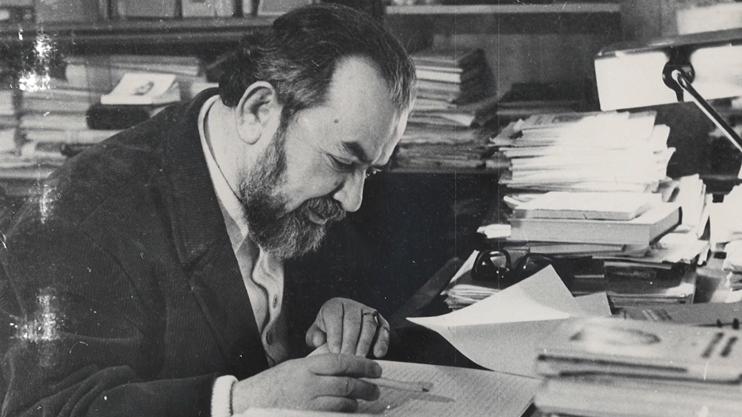
This year is the hundredth birth anniversary of Gevorg Emin, one of the fine names of the poetry of Armenia in the second half of the past century, along with Hamo Sahian, Hovhannes Shiraz, Silva Kaputikian, Hrachia Hovhannisian, and especially Paruyr Sevak, who took the mantle after the death of Yeghishe Charents during the Stalinist purges.

He was born Gevorg Muratian on September 30, 1919, in the town of Ashtarak. He was forced to adopt the name Karlen in the 1930s, at a time when there was the so-called “Communist baptisms.” In 1940 he graduated from the school of Hydrotechnics of the Polytechnic Institute “Karl Marx” of Yerevan (now the State Engineering University of Armenia). However, he soon shifted to literature and in the same year published his first book of poetry, Initial Path, in 1940, which he signed Gevorg Emin. He worked from 1940-1942 at the Matenadaran and in the district of Vardenis. He was wounded during his participation in World War II from 1942-1944.

Emin went to study at the studio of Armenian writers, which was attached to the Literary Institute of Moscow, from 1949-1950. He returned to Armenia and became the Yerevan correspondent of the Moscow literary weekly Literaturnaya Gazeta (1951-1954). In 1951 he won the State Prize of the Soviet Union for his collection New Road, published two years before. In 1954 he was back to the Soviet capital and studied until 1956 in the higher literary courses adjunct to the Writers Union of the Soviet Union.

In the Stalin years, Emin had started finding his own voice amid ideological restraints and criticism. His poetry, where the reflections on humanity, his people, and the homeland were matched with a more free style in composition, gained critical attention from the 1960s. Between 1968 and 1972 he was the editor in chief of the monthly Literaturnaya Armenia, published by the Writers Union of Armenia in Russian. Afterwards, he entered the Institute of Art of the Academy of Sciences as a senior researcher. In 1976 he won the State Prize of the Soviet Union for the second time after the publication of his book Land, Love, Century, and in 1979 he won the prize “Charents” in Armenia.

Besides a steady flow of poetry, published in some two dozen books, Emin was also a prolific author of essays, which were collected in several volumes, including Seven Songs about Armenia (1974), the most popular. The latter was derived from his script for the homonymous film, shot in 1967 by Grigor Melik-Avakian, which earned prizes in festivals in Yerevan and Leningrad (St. Petersburg). He was a prolific translator and gathered his best works in Book of Translations (1984). At the same time, his poetry was translated into many languages, including English (Land, Love, and Century, 1988).

Gevorg Emin was always a non-conformist writer, and his essays published in the twilight of the Soviet regime and in the first years of independence brought new elements to understand the immediate past. He passed away on June 11, 1998, at the age of seventy-eight.

Sunday, December 16, 2018

Death of Nigoghos Sarafian (December 16, 1972)


Nigoghos Sarafian is considered the first poet of the Diaspora in the sense that his creation reflected, from his first book, the aesthetic renewal and the issues of identity and rupture with the past that characterize diasporan sensitivity. He was a leading representative of the generation of French Armenian writers known as the “Paris school.”

Sarafian was born on April 14, 1902, aboard a ship going from Constantinople to Varna (Bulgaria). His parents had emigrated from the village of Lichk, in the district of Akn (Kharpert), after its population was decimated in the massacres of 1896. In Varna, Nigoghos—the youngest child in the family—first went to the “Jierjian” and National Armenian schools, and then to the St. Michel French lyceum. During World War I, he left with his elder brother first to Romania and then started a wandering life from Bucharest to Galatz, and then to the Russian cities of Odessa, Rostov, and Novorossisk until the Russian Revolution started. He crossed Romania on foot and returned to the family home in Varna. However, after the war ended, like many other Armenians, in 1919 the future writer moved to Constantinople, where he continued his education at the famed Getronagan School with such important writers as Hagop Oshagan and Vahan Tekeyan as teachers, and graduated in 1922.

Like several of his future colleagues in Paris, he rushed to flee Constantinople before the Kemalist army occupied the Ottoman capital in November 1922. After spending a few months in Bulgaria and Romania, in 1923 he settled in Paris, where he lived for the rest of his life. After trying different jobs, he became a typesetter. He would personally type several of his books.

His first book, The Conquest of a Space (1928), already revealed the originality of his poetry and his departure from the aesthetic canon that ruled over Western Armenian poetry. He would join the group of “Menk” gathered around the homonymous journal from 1931-1933, while contributing poetry and essays to the main literary journals of the Diaspora. His thoughtful style, however, would remain far from the emotional outbursts of Shahan Shahnour and the passionate rebukes of Vazken Shoushanian. After his second book of poetry, 14 (1933), he published the short novel The Princess (1934), and would incursion in the novel with several works published in various journals during the 1930s and 1940s, which were never turned into books.

His poetry, published in limited editions, would not gain public favor, because it was ahead of his time, as the volume Ebb and Flow (1939) showed. Armenian institutional culture ignored him for decades, especially because his poetry was hardly understandable to traditionalist circles in the Diaspora and incompatible with the official criteria of Soviet Armenia. It combined elements reflecting European literary movements with the natural function of thinking that it is part of poetical art, which led to his classification as a “cerebral” poet, somehow leaving him on the margin of the literary canon.

Sarafian published two more volumes of poetry in his lifetime, Citadel (1946) and Mediterranean (1971). His rediscovery started in the sixties, when a generation born and nurtured with diasporan sensitivity had reached the majority of age. He passed away in Paris on December 16, 1972.

In a famous piece about Easter, he wrote:

“We wait for something.
“We reach little by little to a truth above intelligence. As a matter of fact, it is not possible to find a bigger force than the piety of the one who looked with compassion at the armored and burly horsemen surrounding his cross, at the high priests believing themselves to be wise and brave, and at the judges who just carried a stone instead of a heart, a stone that, however, is destroyed soon.
“It is not possible to find something stronger in man than that noble selfishness, which rejects vulgar egotism and injustice, jealousy and malice, tyranny and judgment, arrogance and savagery.
“The Armenian has the heart capable to feel all these, although that heart is fatigued from clashing with the stones, it is grievous and wandering. He waits for all that. We know that we cannot answer to evil with goodness anymore. But all those are the needs burning our intestines.
“We know that all beautiful words pass. But we love all beautiful things.”

Several volumes of Sarafian’s writings, both of poetry and prose, have been collected and published since the 1980s. One of his most influential essays, The Bois of Vincennes, first published in the monthly Nayiri of Aleppo in 1947, was posthumously reprinted as a book in 1988. Since then, it was first translated into French (1993) and recently into English (2014) by Christopher Atamian. 

Wednesday, October 17, 2018

Death of Avetik Isahakian (October 17, 1957)

Avetik Isahakian was and remains a popular name in Armenian literature, particularly for the folkloric style of his poetry. Many of his poems have become songs.

He was born in Alexandropol (nowadays Gumri) on October 30, 1875. He spent his childhood and adolescence in the surrounding village of Ghazarapat, now called Isahakian after him. He studied at the Kevorkian Seminary of Holy Etchmiadzin, and from 1893-1895 he was an auditor at the University of Lepzig, in Germany.

He started writing in his youth years, while he also delved into political activities. He returned to Alexandropol in 1895 and became a member of the local committee of the Armenian Revolutionary Federation. He was arrested by the Russian police in 1896 and spent a year imprisoned in the fortress of Yerevan.

He left the country after coming out of prison. In 1897 he went to the University of Zurich as auditor of history of literature and philosophy. A year later, he published his first book of poetry, Songs and Wounds. In 1902 he came back to the homeland and then settled in Tiflis. He published a second book of poetry, Poems, in 1903, followed by an enlarged edition of Songs and Wounds in 1908.

In 1908 the Russian government launched a repressive campaign against the revolutionary movements throughout the empire. Isahakian was among the 158 intellectuals arrested in the “A.R.F. case” and, after remaining for half year in the prison of Metekh, in Tiflis, he was liberated with a huge bail. The atmosphere was irrespirable and perhaps was one of the reasons besides the writing of the long poem Abu-Lala Mahari from 1909-1910. In 1910 the poet married Sofia Kocharian in the ruins of Ani. They moved first to Constantinople, where he published the poem in 1911, and then to Europe with their newly-born son, Vigen.

They settled in Berlin, where Isahakian would become one of the founders of the German-Armenian Society in 1914 together with a group of Armenian and German intellectuals. In 1916 the Isahakians moved to Geneva. The poet would actively follow the Armenian cause and reflect it in his writing, journal notes, and articles. He started writing a novel, Usta Garo, where he intended to present Armenian political life in the late nineteenth and early twentieth century, which remained unfinished despite working on it for many years. He published two collections of poems in 1920 and 1922, as well as the first version of his poem Mher of Sassoon, based on the final cycle of the Armenian epic.

Isahakian moved to Paris in 1924 and, after fifteen years in exile, he visited Soviet Armenia in 1926 and remained there for four years. He returned to Europe in 1930 and lived in the French capital for the next six years, where he was an activist on behalf of Soviet Armenia until 1936. In this year, he returned definitively to the homeland with his family.

In Armenia, where he was familiarly known as varpet (“master”), a title that he only shared with painter Martiros Sarian, Isahakian was the dean of Armenian literature in the hard times of Stalinist repression. He continued writing and publishing. He became a member of the Academy of Sciences of Armenia in 1943. He earned the State Prize of the USSR in 1946, and in this same year he was appointed president of the Writers Union of Armenia, a position he held until his death on October 17, 1957 in Yerevan.

Avetik Isahakian was buried in the “Komitas” Pantheon of Yerevan. His house-museum in Yerevan was opened in 1963 and another was later opened in Gumri. There are statues of him in both cities, as well as schools, streets, and libraries carrying his name in different towns of Armenia.

Tuesday, January 16, 2018

Birth of Mateos Zarifian (January 16, 1894)

Armenian literature in the nineteenth and twentieth century had a host of names who were victims of a disease that was considered incurable until a vaccine was introduced in the 1920s: tuberculosis.

Poetry and tuberculosis had a link of sorts. Four talented Armenian poets, among others, died from the disease without reaching the age of forty: Bedros Tourian (1851-1872), Vahan Terian (1885-1920), Misak Medzarentz (1886-1908), and Mateos Zarifian (1894-1924).

Zarifian, the less known of the four, was born on January 16, 1894, in the neighborhood of Gedik Pasha (Constantinople). He spent his childhood and youth in Scutari. He studied at the school of Ijadieh, the Robert College, and the Berberian School, which he finished in 1913. He was an active sportsman and earned prizes in the Armenian Olympic games organized in Constantinople (1912-1913)

He went to Adana to work as a teacher of English and physical education at the local Armenian school. The first symptoms of tuberculosis, a strong chest pain, appeared at that time. In 1914 he interrupted his work and went to Lebanon, hoping that the mountainous air would help cure him. At the beginning of World War I, he was drafted into the Ottoman army. While studying at the school of non-commissioned officers, his unruly behavior landed him before a military tribunal, which sentenced him to exile. However, some influential interventions helped commute this sentence to long-term prison. Some months later, he was freed and started serving at the military hospital as a male nurse.

After the armistice of Mudros (1918), Zarifian went to the interior as translator for the British army to participate in the task of gathering Armenian survivors. Between 1919 and 1921 he worked at his alma mater, the Berberian School, as teacher of English and physical education. His illness prompted him to pour his life experience into literature. In 1919 he started publishing poems in the daily Jagadamard. His poetry reflected a hopeful approach to life and death, and his love poems disclosed the melancholic overtones of his soul, “Ah! The superb poem of my soul,/ Of my ruined, destroyed soul…”

He published two volumes of poetry, Songs of Grief and Peace (1921) and Songs of Life and Death (1922), which were critically acclaimed. His long battle with tuberculosis came to a critical point after 1922. Zarifian, the last representative of Western Armenian poetry, passed away on April 9, 1924, at the age of thirty.

Wednesday, December 13, 2017

Birth of Valery Bryusov (December 13, 1873)

Valery Bryusov was one of the leading names of Russian poetry at the beginning of the twentieth century, and he would become especially involved with Armenia and the Armenians in the 1910s.

The future poet was born on December 13, 1873, into a merchant’s family in Moscow. His parents had little to do with his upbringing, and Bryusov was largely left to himself as a child. He was a voracious reader of everything that fell into his hands, including the works of Charles Darwin and Jules Verne, as well as various materialistic and scientific essays. He received excellent education and studied in two Moscow gymnasia from 1885-1893. Then he went to Moscow State University from 1893-1899.

Bryusov was still a university student when he started his literary career in the early 1890s. He translated poetry by the French Symbolists (Paul Verlaine, Maurice Maeterlinck, and Stéphane Mallarmé) and Edgar Allan Poe. He also began publishing his own poems, which were influenced by the literary movements then in fashion in Europe, Decadentism and Symbolism.

In order to give Russian Symbolism a dimension that it still did not have, Bryusov made recourse to a mystification. Thus, he published three volumes of his own poetry, entitled Russian Symbolists: An Anthology (1894-1895), with different pen names. The trick proved successful and attracted several young poets to the ranks of Symbolism.
Bryusov became an authority after the appearance of his fourth collection of poetry (1900). The celebration of sensual pleasures and the mastery of a wide range of poetic forms characterized his poetry, which he published in several more collections until 1921. His editorship of Vesy (The Balance), an influential literary magazine, from 1904-1908 consolidated his position in the Russian literary world. Among his eighty books, he also had historical novels, short stories, plays, essays, and translations.

As a translator, Bryusov was the first to render the works of Belgian poet Emile Verhaeren into Russian. He also translated works by Victor Hugo, Jean Racine, Lord Byron, Oscar Wilde, Johann Goethe, Virgil, and others. On this basis, in June 1915 the Armenian Committee of Moscow approached him with a proposal to work on an anthology of Armenian poetry. Bryusov researched all bibliography available in several European languages, and fell enamored of Armenian literature. In his superb introduction to Armenian poetry from the Earliest Times until Our Days , published in 1916, he wrote: “While studying Armenia, I found an inexhaustible source of spiritual and sublime pleasures… As a historian, as a man of science, I saw in the history of Armenia a whole original world, whose thousands of interesting, complex questions raised scholarly interest, and as a poet, as an artist, I saw a similarly original world in Armenian poetry, a new and yet undiscovered universe, where high-valued productions of true literary creation glittered and shone.” He also studied the Armenian language for several months and wrote a monograph, The Annals of the Historical Fate of the Armenian People. In January 1916, once the preparations for the anthology were basically finished, Bryusov departed to the Southern Caucasus to get acquainted with Armenian reality and introduce his work to the public. He sojourned in Baku, Tiflis, Yerevan, and Etchmiadzin, where he gave very successful lectures about Armenian history and poetry, and read from among his more than 170 translations from more than 40 Armenian poets.

Bryusov would become the first author to introduce Armenian poetry in such a comprehensive way to the Russian audience. Most of his translations still keep their freshness a century later. He also wrote a series of poems dedicated to Armenia, and even planned to prepare an anthology of Armenian prose from the fifth to the twentieth century. In 1923 he was named popular artist of Soviet Armenia for his work on the anthology.

In the 1910s, Bryusov’s reputation gradually declined, as his poetry began to seem cold and strained to many of his contemporaries. Unlike many fellow Symbolists, he remained in Russia after the revolution of 1917. He supported the Soviet government and earned a position in the cultural ministry of the Soviet Union. He helped draw up the proposal for the Great Soviet Encyclopedia. He became the head of the Chamber Book of Moscow, and later of the scientific libraries and the literary section of the Commissariat (ministry) of Education of Soviet Russia. In 1921 he founded the Higher Institute of Literature and Art, which was named after him in 1923, and was its rector. There, he also taught various subjects: history of Russian and ancient literatures, metrics, comparative grammar of Indo-European language, and even history of mathematics. His collections of poetry published after the Soviet revolution marked him as one of the founders of Soviet literature.

Bryusov passed away on October 9, 1924, in Moscow. The Yerevan State Pedagogical Institute of Russian and Foreign Languages (now Linguistic University), founded in 1935, was named after him in 1962.

Friday, August 26, 2016

Death of Roupen Sevag (August 26, 1915)

Two of the most gifted poets of their generation, Taniel Varoujan and Roupen Sevag, were almost the same age (Varoujan was a year older), and were friends in life and in death.

Roupen Chilingirian was born in Silivri, a city in Eastern Thrace (European Turkey) 37 miles from Constantinople, on February 28, 1885. He belonged to a well-to-do family, and had two sisters and three brothers. He studied at the local Askanazian School and then went to the American lyceum of Bardizag from 1899-1901. Then he entered the renowned Berberian School of Scutari, in Constantinople, which he graduated with highest grades in 1905. Reteos Berberian, a famous pedagogue and founding director of the school, noticed his interest in science. He advised him to go to Switzerland and pursue a career in medicine. Thus, he entered the medical school of the University of Lausanne, where he studied for the next six years. 

In 1905 the medical student published his first poem in the newspaper “Masis.” Two years later, he adopted the pseudonym Roupen Sevag (sevag = “black eyes”) and published his first piece in prose.
In the same year (1907) he met Helene (Jannie) Apell, a seventeen-year-old student at the girls’ lyceum of Lausanne, who was from an influential German military family. They fell in love, but they had to overcome the resistance of both of their families. Finally, they married in Lausanne in 1910, while the religious ceremony was held in the Armenian Church of Paris. 

Sevag published prolifically in the period between 1908-1914 in newspapers and literary journals of Constantinople and Smyrna, as well as in the publications of the Mekhitarist Fathers of Venice. During a vacation in Constantinople, he founded the short-lived newspaper Surhantag (1908) with a group of friends. He was also involved in political activities, and became a member of the Armenian Revolutionary Federation. In 1910 he published his first book of poetry, The Red Book, where the echoes of the Adana massacres of 1909 were noticeable. He planned to gather many other lyrical and patriotic poems in three more books, but this would never happen.

From 1911-1914 Sevag worked as an assistant physici
an at a hospital and a clinic in Lausanne. His medical experience would lead him to publish a series of fine short stories under the general title of Pages from the Doctor’s Journal, which would be posthumously published. His poetry and prose made him well-known in Armenian literary circles.
He settled with his wife and their two-year old son Levon, in Constantinople in May 1914. Their daughter Shamiram would be born a few months later. He was conscripted in November 1914, when the Ottoman Empire entered World War I, and began to serve as a military physician in Chanakkale and Istanbul. After the roundup of April 24, 1915, he was arrested on June 22 and exiled to Chankiri, where he arrived six days later. His wife, supported by her parents in Switzerland, started a frantic round of correspondence and interviews with the German embassy and the Ottoman authorities to secure his liberation. Efforts by the family and the embassy, which were a matter of discussion between Germany and the Ottoman government from July-August 1915, would be fruitless.

When in Cankiri, Sevag continued his medical activities. He cured the daughter of a Turkish chete (bandit), Arabaji Ismail. The latter asked him to save himself by converting to Islam and marrying his daughter, but Sevag refused the offer.

On August 26, 1915, Roupen Sevag, Taniel Varoujan, and three other prisoners who had been victims of the roundup by sheer chance were dispatched to Ayash. Six hours away from Cankiri, in a place called Tuney, a group of Kurdish bandits organized by the local secretary of the Committee of Union and Progress, Oghuz, savagely killed the five unfortunate prisoners. Documentation from the Ottoman Interior Ministry, recently published by historian Taner Akcam, shows that Talaat Pasha himself was involved, if not the killing itself, but the subsequent release of the criminals and the care for their welfare. 

The efforts of Janni Chilingirian-Apell to save her husband had not been welcome either by the Ottoman government or, more importantly, the German embassy. On September 11 the Interior Ministry conveyed information about the murder to the embassy and suggested that Sevag’s widow be sent to Germany with her children. They actually left for Switzerland. She continued to pursue justice, but to no avail. Her final letter to the Germany embassy from Lausanne, on November 27, 1915, contained a strongly-worded appeal for the crimes that were committed against Armenians and her husband: “Try to save whatever you can save by using the most definite resolve. If you do not make use of every possibility within your possession, the blood of innocent women, children, the sickly, and the elderly will ascend to the heavens and damn Germany.” Her anger against the betrayal of her country was so deep that she would refuse to teach her children a word of German, and she would keep and pass Roupen Sevag’s memory to them until her death in 1967. Levon Chilingirian passed away at the age of 93, in 2005, and Shamiram Folco-Sevag is still alive at the ripe age of 102. 

In 1942 the editor of the journal Sovetakan Grakanutiun of Yerevan, Rouben Zarian, published three poems of an eighteen-year-old unknown poet, Paruyr Ghazarian. In memory of Roupen Sevag, he decided to use his last name and create a pseudonym for the promising poet. The career of one of the luminaries of Soviet Armenian poetry, Paruyr Sevak (1924-1971), had started.

In the 1980s Roupen Sevag’s nephew, Hovhannes Chilingirian, founded the Roupen Sevag house-museum in Nice (France), which was moved to Holy Etchmiadzin in 2013. A school was named after Sevag in Yerevan (1995). 

Previous entries in “This Week in Armenian History” are on the Prelacy’s web site (www.armenianprelacy.org).

Sunday, March 13, 2016

Birth of Yeghishe Charents (March 13, 1897)

The most famous names of Armenian poetry in the twentieth century were victims either of genocide (Taniel Varoujan and Siamanto), political repression (Yeghishe Charents), or car accident (Paruyr Sevak). Among them, Charents was probably the brightest star in the Armenian literary sky.

Portrait of Yeghishe Charents by Martiros Saryan.
A memorial sculpture of Charents in central Yerevan.


Yeghishe Soghomonian, the future poet, was born in Kars, on March 13, 1897. His parents had moved there from Maku, in Iran, and had seven children. After his elementary studies at the Russian or Armenian parochial school, he studied in the royal school of the city from 1908-1912, but he did not graduate. The young Yeghishe published his first poem in 1912 and his first book, Three Songs to the Sad Girl, dedicated to his girlfriend Astghik Kondakjian, in 1914. Here he adopted the pseudonym of Charents (Armenian char “bad”), for which there are various contradictory explanations.

In August 1915, at the age of eighteen, Charents enrolled himself in the Armenian volunteer corps of the Russian army, and fought in the Caucasian battlefront against the Ottoman army until the end of the year. His war experiences gave birth to his first relevant work, the poem Dante-esque legend, published in 1916.

In 1916-1917 Charents was in Moscow, where he studied at the Shaniavski Popular University. After the October Revolution, he returned to the Caucasus and first participated in the civil fights in the Northern Caucasus. His experiences were the basis for one of his most important poems, The Frenzied Masses, published in 1918. After the liberation of Kars from Turkish occupation, he became a teacher in one of the villages of the Kars district in 1919.

Nikol Aghbalian, Minister of Education of the first Republic of Armenia and a well-known literary critic, lectured in October 1919 on Charents with a very positive outlook. In January 1920 he became an official at the ministry until June, when he left after participating in the Bolshevik demonstrations of May 1. After the establishment of the Soviet regime, he entered the Communist Party and was designated head of the Art section of the Commissariat of Education. During the February 1921 rebellion, he fought as a soldier in the Red Army.

In June 1921 he married Arpenik Ter Astvatzatrian and they departed together for Moscow, where they studied at the University for Workers of the Orient. In 1922 he published his collected works in two volumes and returned to Yerevan, where he would become a leading name in the efforts to modernize Armenian poetry and in the different literary movements, while publishing poems and collections of poetry. From 1921-1924 he also wrote his novel Land of Nayiri, first published serially and then as a book (1926). In 1924-1925 he traveled abroad and visited Istanbul, Rome, Venice, Paris, and Berlin.

In September 1926 Charents was involved in a criminal incident when he shot and slightly wounded a young girl whom he had fallen in love with. In November he was sentenced to eight years of imprisonment, later reduced to three, in the House of Correction (prison) of Yerevan, and previously he was expelled from the Communist Party. This situation coincided with the death of his wife Arpenik on January 2, 1927, at the age of twenty-eight, due to an extra-uterine pregnancy. Charents was freed on humanitarian grounds, given his extremely fragile psychological condition, and sent to mandatory treatment at a sanatorium.

From 1928-1935 the poet worked at the Armenian State Publishing House and developed a prolific editorial program, including the publication of new writers and Armenian classics, as well as translations. After a kidney surgery in Moscow (1929), he developed the use of morphine, which he would continue until the end of his life.

In 1931 he married Isabela Niazova, and they would have two daughters, Arpenik and Anahit. Literary and political pressure over him, as well as on the best representatives of the Armenian intelligentsia was mounting. In 1933 Charents’ most important collection of poetry, The Book of the Road, was forbidden before publication. It was released in 1934 only after the poet excluded several works that had been questioned. In this year, he participated in the First Congress of Soviet Writers, held in Moscow.

His downfall started in 1935, when he was fired from his job, expelled from the Writers Union of Armenia, and interrogated several times at the Ministry of Internal Affairs on trumped-up charges of being a terrorist. The assassination of Aghasi Khanjian, First Secretary of the Armenian Communist Party and his friend and protector, on July 9, 1936, covered up by Joseph Stalin’s henchman Laurenti Beria, First Secretary of the Party in Transcaucasia, as a “suicide,” unleashed the political persecution against Armenian intellectuals. Many writers and intellectuals were arrested on July and August 1936, and they would be shot, exiled to Siberia, or sentenced to years in a wave of terror that continued until 1938-1939. Charents was subjected to house arrest in September 1936, his books were retired from libraries and bookstores, and the publication of his works was stopped.

The poet was finally imprisoned on July 1937. His wife would follow the same fate (she was deported to Kazakhstan for five years in 1938), and their children would be placed in an orphanage as “enemies of the people.” Charents, gravely ill, passed away in the hospital of the Yerevan prison on November 27, 1937. His body was buried in an unmarked grave and the exact place of his tomb remains unknown.

Charents was rehabilitated after the death of Stalin, and his name became extremely popular among youngsters and adults. His works have been published many times, and statues, streets and a museum perpetuate his name in Armenia.

Charents is featured on the 1000 dram bill of the Republic of Armenia's currency.

Sunday, July 19, 2015

Death of Yeghia Demirjibashian (July 19, 1908)

Yeghia Demirjibashian was born in Khasgiugh (Haskoy), a suburb of Constantinople, on May 8, 1851. He completed his education at the local Nersesian and Nubar-Shahnazarian schools, and graduated with distinction. From early youth he was a solitary person and an avid reader, with an encyclopedic mind. He was principally captivated by books that represented the sadder aspects of life, its vanity, and the reality of death, which seemed to suit his melancholic disposition.

He worked for a while at the Printing Office of the government, and as a secretary of the administrative assembly of the ministry of Public Works, but he quit his job with the intention of going to Paris. Family situation shook his delicate psyche and his physical health, and the project failed. He was in love with a young lady who had decided to marry a wealthy man. Out of desperation, he attempted to commit suicide in 1874, but failed. Deeply concerned about his condition, his family found the means to send him to Marseilles with the advice to studying economics. Instead, he spent his time reading voraciously and even trying to publish a newspaper in French, Le Moniteur littéraire et financier de Marseille.

He returned to Constantinople in 1876 and became involved in the dispute over the grammar and spelling rules of Modern Armenian that his classmate Minas Cheraz (1852-1929) had suggested, and that ultimately met the rejection of the Armenian Education Council.

In 1879 he began publication of the Philosophical Dictionary, with the aim of introducing a critical spirit and freedom of thought into literature. He published critical articles and book reviews in the periodical Masis from 1880. He also launched two newspapers, Kragan yev imasdasiragan sharjum (1883) and Yergrakunt (1884); while the first was filled with his own articles, the second had contributors such as Krikor Zohrab, Reteos Berberian (another of his classmates), and Yervant Odian. Both papers ceased publication in 1888. He also briefly edited other publications. Besides the Philosophical Dictionary, his only other books would be two bilingual dictionaries, Armenian-French (1894) and French-Armenian (1896).

By 1889 Demirjibashian’s health started to deteriorate, and he sank into despondency. His main desire became to die and to attain Nirvana, to which he frequently referred in his writings. The pessimistic mood that engulfed him was aggravated by the loss of his mother in 1890, following the death of his young brother. His father had passed away years before. He continued his work as teacher and editor until 1893, when he attempted suicide again, but a boatman saved him from the sea. He frequently changed his place of residence, driven by a persecution complex. In 1895, during one of those moves, he rang the bell of a house in Pera. The landlady, a Hungarian woman called Mrs. Ellen Nisen, took pity on him, gave him a room in her house, and eventually became his guardian angel, as Demirjibashian himself recognized more than once. The financial support of an aunt allowed him to travel to Geneva, Vienna, and Budapest in 1897, but this did not help his situation. He returned to the hospitality of Mrs. Nisen, who compassionately took care of him. After a year spent in the National Hospital (1901-1902), the illness practically confined him to his home, and then, to his bed. In the end, on July 19, 1908, he hanged himself during his hostess’ absence with a scarf that she had given to him as a present.

A talented but eccentric figure, Demirjibashian reflected his psychological turmoil in his writings. His artistic sensitivity produced moments of deep emotion, but his poetry was not balanced enough to become a finished product. He would leave hundreds of poems, but not a single literary work finished. Several collections of his poetry were published posthumously. The library of the Armenian Cultural Foundation in Arlington, Massachusetts, carries his name.

Sunday, February 8, 2015

February 8, 1885: Birth of Gostan Zarian

The life span of Gostan Zarian, one of the foremost names of twentieth century Armenian literature, covered eight crucial decades. He was active in Constantinople with the Western Armenian generation before the genocide, then lived forty years in the Diaspora, and finally went to die in Soviet Armenia. He was a sort of “wandering Armenian,” not only physically, but also spiritually. His literature was at the crossroads of many influences.

Zarian was born in Shamakhi (Azerbaijan) on February 8, 1885. His father, a general in the Russian army, died when he was four, and he was sent to Baku, where he attended a Russian school. In 1895 he moved to France, where he continued his studies in Asnieres and Saint-Germain-en-Laye, two suburbs of Paris. After finishing high school, he went to the Université Libre of Brussels and obtained a doctorate in literature and philosophy in 1909. 

Zarian initially wrote poetry and essays in Russian and French, until the famous Belgian poet Emile Verhaeren advised him to write in his mother tongue. The Armenian poet, who already spoke Armenian, went to Constantinople in 1910, where he started to participate in the renewal of literary life. In mid-1911 he left the Ottoman capital and went to Venice, where he studied Armenian with the Mekhitarist Fathers until the end of 1912. He married Rachel (Takuhi) Shahnazarian in December 1912, from whom he would have three children, and the newlyweds moved back to Constantinople. Zarian would actively participate in Western Armenian literary life until the beginning of the war. He was one of the leading voices of the group “Mehian,” together with Hagop Kufejian (Oshagan), Kegham Parseghian, Taniel Varoujan, and Aharon (Dadourian), and editor-in-chief of the homonymous journal Mehian, which was published from January-July 1914.

Zarian escaped with his family to Bulgaria in late October 1914, the day before Turkey declared war and joined the Central Powers, and thus he avoided the genocide. After living for a year in Bulgaria, he moved to Italy, where he lived for the next six years in Rome and Florence. In 1916 he published his poem “Three Songs,” translated from Armenian into Italian, which was widely critiqued. His literary activities were matched with an active engagement for the Armenian Cause. In 1919 he went to the Caucasus as a special reporter for several Italian newspapers.

Zarian moved back to Constantinople in late 1921, when the remnants of the Western Armenian intelligentsia were starting again a cultural and literary movement. He published the monthly Partzravank, together with Oshagan, Vahan Tekeyan, Shahan Berberian, and Kegham Kavafian, which lasted from January-July 1922. He also published his first book in Armenian, a collection of poems entitled The Crown of the Days. At the end of the year, when the Kemalist forces were about to occupy Constantinople, the writer accepted an invitation of the Soviet Armenian government and moved to Yerevan. For the next two years, he taught European literature at Yerevan University. However, he returned to Europe in June 1924 and would spend the next four decades on the move. He lived in Paris, Venice, Milan, Corfu, Florence, New York (1942-1947), Amsterdam, Ischia, Beirut, Aix-en-Provence, Vienna, Rapallo, Oakland, California (1960-1962), and in 1963 he repatriated to Soviet Armenia.

In the 1920s and 1930s, Zarian published his major works of prose in the monthly Hairenik of Boston, such as The Traveler and His Road, Bancoop and the Bones of the Mammoth, and Countries and Gods, among others. He also published as a book his poems The Bride of Dadrakom in 1930 and Three Songs (1931), and his masterpiece, the novel The Ship on the Mountain (1943). He contributed prose, poetry, essays, and commentary to a variety of Armenian and non-Armenian publications, writing in Armenian, French, Italian, and, later, English. He published two short-lived journals, the literary monthly La Tour de Babel in French (1925), and the pioneering journal of Armenian Studies in New York, Armenian Quarterly (1946). He was friends with various noted European writers, such as English novelist Lawrence Durrell and others. He taught at the American University of Beirut and at the University of California at Berkeley.

His return to Armenia was somewhat controversial, because he had criticized the Soviet regime in several works. His novel The Ship on the Mountain was about the period of the first independence. It was reissued in a heavily censored way (1963) and this created a heated polemics. In any case, Zarian was almost ignored in the last years of his life. He died on December 15, 1969 and was almost totally forgotten by literary circles in Armenia until the end of the regime. Several of his works were printed in book form in the 1970s and 1980s in the Diaspora. His rediscovery in Armenia started with the twenty-first book century, and several works scattered in the press and also unpublished have also been published.

Friday, November 14, 2014

November 14, 1829: Birth of Mikael Nalbandian

Francis Scott Key is just remembered as the author of the lyrics of the U.S. national anthem. It is not the same in the case of Mikael Nalbandian, who was an influential intellectual of the nineteenth century and is an important name in the history of Armenian culture, besides being the author of the lyrics of the Armenian anthem.

Nalbandian was born on November 14, 1829, in Nor Nakhichevan, the town close to Rostov-on-Don founded in the late eighteenth century by Armenian emigrants from Crimea, in the family of a craftsman. He studied in his hometown at the school of Gabriel Patkanian, and for a while he was classmate of his son, the future poet Rafael Patkanian (Kamar Katipa). He worked as a secretary in the Armenian diocese of Nor Nakhichevan and Besarabia from 1848-1853. Then he left his post and went to Moscow, where he taught Armenian language at the Lazarian College for a short while, and took classes at the Medicine School of Moscow University as an auditor (1854-1858).

Similar to Khachatur Abovian, Nalbandian championed the introduction of Modern Armenian (ashkharhapar) instead of Classical Armenian (krapar), and confronted the opposition of ecclesiastics and conservatives. He translated poems of Alexander Pushkin, Mikhail Lermontov, Heinrich Heine, and others. Among his own poetry, three poems became favorites of the public: “The Song of the Italian Girl” (Idalatsi aghchga yerke), “Freedom” (Azadutiun), and “Days of Childhood” (Mangootian orer). The first, better known as Mer Hairenik (“Our Fatherland”), would become the anthem of the first Republic of Armenia in 1918, and was adopted again after the new independence of 1991.

Nalbandian published the journal Hiusisapayl (Aurora Borealis) with another influential intellectual, Stepanos Nazarian (1812-1879), in Moscow. During its five years of existence (1859-1864), the journal became a leading name in the cultural awakening of Eastern Armenians. Nalbandian had already made a name for himself since the 1850s due to his progressive and liberal views, as well as his outspoken and ironic style. Reform and renewal were his main ideas, as he espoused them in his writings on different issues. He published various political tracts, of which the most important was Agriculture as the Right Way (1862), where he criticized the peasant reform of 1861 in Russia.

The writer made two trips to Europe (1859 and 1860-1862), and he also visited India. In London he became friends with various famous Russian revolutionaries, such as Alexander Herzen and Mikhail Bakunin. After his return in 1862, he was arrested by the Russian secret police and spent three years in prison in St. Petersburg. He was accused of inciting anti-government sentiments and exiled to the fortress of Kamyshin, in the province of Saratov. He passed away at the age of 37, victim of tuberculosis, on April 12, 1866. He was buried in the Armenian monastery of Holy Cross, in Nakhichevan-on-Don. An important street in central Yerevan and a statue remember him.

Monday, June 2, 2014

Death of Vazken Shoushanian - June 2, 1941

Vazken Shoushanian, a talented young writer of the “School of Paris,” was also one of the orphans of the Armenian Genocide.
He was born in Rodosto (nowadays Tekirdag), a city of Eastern Thrace, on February 9, 1902. His birth name was Onnig. He studied and graduated from the local elementary schools. In September 1915 the Shoushanian family was deported to Asia Minor, from where they continued on the exile routes. Onnig lost his father, mother, brother, and sister on the deportation routes between 1915 and 1917. Meanwhile, he had reached Aleppo in February 1916. The young orphan, deprived of any family support, managed to survive doing various menial work in Aleppo and elsewhere until the end of the war, when he went to Constantinople and then to Rodosto.
In 1919, Shoushanian entered the Agriculture School of Armash, and moved to the Republic of Armenia with the rest of his schoolmates in September 1920. Caught in the whirlwind of the end of the independence and the beginning of the Soviet regime, the students finally left the country and returned to Constantinople in May 1921.
In July 1922, Shoushanian came to the United States, but he was not admitted in Ellis Island due to trachoma and he had to return to Constantinople. Months later, he managed to travel to France. He became a factory worker, and in the meantime, he studied agronomy from 1923-1926 in Valabre, near Marseilles. Meanwhile, he had started to write poetry, prose, and essays in the Armenian press of the Diaspora under the name Vazken Shoushanian, including Hairenik daily and monthly, in Boston. He had also become a member of the Armenian Revolutionary Federation and in his twenties he represented the party at the Socialist International. He would pursue studies of Social Sciences in Paris and graduate in 1930.
From 1931-1932 he was part of the literary group Menk, which published the homonymous journal and gathered, for a short while, the most promising names in Armenian literature in the Diaspora, such as Shahan Shahnour, Zareh Vorpouni, and others.
Shoushanian was already a noted writer when in 1932-1933 he became entangled in the internal struggles of the A.R.F. and was left outside the party. However, as he wrote in a journal entry of 1939, he considered himself a member, “whether I have a party card or not.”
In the last years of his life, Shoushanian remained on the margin of Armenian life. He worked at a French boarding school in Rouen from 1933-1939. The school was closed due to the war in 1940 and Shoushanian made a dangerous trip to bring the students to their homes. After a seven-year absence, he then returned to Paris.
He caught pneumonia in the spring of 1941 and died practically alone, forgotten by almost everyone, in a Paris hospital. He did not have a tomb and was buried in an unmarked grave.
Few of his books were published in his lifetime; some remained scattered in the press, while others were left unpublished. His archives, in the end, went to Armenia, and some of his work started to be published in the 1950s, with publication still continuing until this day. A famous passage in his Journal was a testimony of his love for the Armenian language: “Armenian language, how much I love you! No girl on earth can brag that has received so much warm affection, so much love, so much entreaties from me. The fidelity that I feel towards you is more powerful than this miserable life of ours. I would like to study you until my last moment, your ultimate accents and your ultimate words, your internal music and the road you have traced in history. You are our prayer and our pleasure, Armenian language, I love you.”

Friday, April 4, 2014

April 4, 1945: Death of Vahan Tekeyan


Poet and public figure, Vahan Tekeyan belonged to the surviving generation of the Armenian Genocide and during the last three decades of his life he influenced an entire generation.

Tekeyan was born in Constantinople on January 21, 1878. He was the youngest of five children, fourteen years younger than his closest brother. His father passed away when he was eleven. He attended Nersesian, Berberian, and Getronagan schools, but did not finish his secondary schooling and was self-taught for the most part.

He went to work with an insurance firm as a secretary at the age of sixteen. Two years later, in 1896, he was transferred to Liverpool, England, just before the massacres of Armenians in Constantinople ordered by Sultan Abdul Hamid II. In 1897 he was sent to Marseilles, where he stayed for four years, and then to Hamburg (Germany). In 1901 he published his first volume of poetry, Burdens, in Paris. In 1904 he was in Egypt and the following year he began publishing the literary monthly Shirag with Mikayel Gurjian (1878-1965). After the restoration of the Ottoman Constitution in 1908, Tekeyan returned to Constantinople and resumed publication of Shirag for a short while. He was elected a member of the National Church Council. In 1911 he visited Armenia for the first time for the election of Catholicos of All Armenians Gevorg V Sureniants.

He published his second book, Miraculous Rebirth, in 1914, which was received with unanimous praise. It was on the eve of World War I, and Tekeyan would escape the fate of Armenian intellectuals during the genocide by chance. He was sent to Jerusalem to settle a church dispute as a representative of the Armenian National Assembly. At the outbreak of the war, he went to Cairo and followed the developments from there.

Tekeyan had been originally a member of the Social Democrat Hunchakian Party, and after its split in 1896 he entered the Reorganized Hunchakian Party. He went back to Yerevan in 1919 to lead negotiations on behalf of the Armenian National Delegation headed by Boghos Nubar Pasha with representatives of the Republic of Armenia. Then he participated in the Armenian Congress held in Paris in the same year.

He published his third book in 1919 (From Midnight to Dawn). The next year he returned to Constantinople after an absence of six years. In 1921 he was instrumental in the fusion of four parties that gave origin to the Democratic Liberal Party (Ramgavar Azadagan). Tekeyan became the editor of its organ, Joghovurti Tzayne, and in 1922, together with four other noted intellectuals (Gostan Zarian, Hagop Oshagan, Shahan Berberian, and Kegham Kavafian), founded the short-lived literary monthly Partzravank. From 1921-1922 he was also principal of Getronagan School.

After the occupation of Constantinople by Kemalist forces, Tekeyan left the city, and went to Bulgaria, Greece, Egypt, and Syria to supervise Armenian refugee and orphan care. He was particularly helpful to one of those orphans, future Armenian American writer Leon Surmelian (1906-1998), and encouraged and collected his Armenian poetry, which he published in a book in 1924, Joyful Light.

From 1926-1932 he became editor of Arev, his party’s publication in Cairo. He moved to Paris, where he published his fourth collection of poetry, Love (1933). After a stint at the Melkonian Educational Institution in 1935-1936, he became the founding editor of the daily Zartonk of Beirut in 1937. Then he returned to Cairo to resume editorship of Arev.

He published his last two books in 1943 (Song of Armenia) and 1944 (Odes). His poetry, be it lyrical, patriotic, or philosophical, would always reflect the sobriety of its author. By the time of his death, some of his poems had become classics, and had earned him the title of “Prince of Armenian poetry.” His literary style had already created a numerous following, which would be active for several decades after him.

After a long life of service, Tekeyan died in Cairo on April 4, 1945. The Tekeyan Cultural Association, founded in 1947, bears his name.

Sunday, January 26, 2014

Birth of Paruyr Sevak - January 26, 1924

Paruyr Sevak was the successor of Yeghishe Charents in Soviet Armenian poetry, and was widely admired during his lifetime. Both had a short life, tragically cut off, although under different circumstances.

Paruyr Ghazarian was born in the small village of Chanakhchi (now Zangakatun), in the district of Ararat, in Armenia. His parents were humble villagers. He attended the local school and graduated with honors in 1940, moving to Yerevan to study at the philological faculty of Yerevan State University. He had written his first poetry at the age of thirteen, and three of his poems appeared for the first time in the monthly Sovetakan Grakanutiun in 1942, with the signature Paruyr Sevak. The editor of the monthly, Ruben Zarian, was a literary scholar fond of Rupen Sevag, a fine poet who had been killed together with Taniel Varoujan in the Armenian genocide, and thought of perpetuating his memory by using his name as a pseudonym for the 18-year-old beginner.

Sevak graduated in 1945 and started postgraduate studies of Armenian literature at the Manuk Abeghian Institute of Literature of the Armenian Academy of Sciences. However, he had to cut his studies short in 1948. In the same year, he published his first book, The Immortals Command. He married linguist Maya Avagian and had a son, Hrachia.

In 1951 he moved to Moscow to study at the Maxim Gorky Institute of World Literature. There he met his future second wife, Nelly Menagharishvili, who would give him two more sons, Armen and Koriun. He graduated in 1955 and worked there from 1957-1959 as an instructor at the chair of Literary Translation.

Meanwhile, during the eight years of ostracism, he had managed to publish poetry, translations, and literary criticism in the Soviet Armenian press. His three books of poetry, however (Uncomprising Intimacy, 1953; Love Road, 1954; and With You Again, 1957), failed to unleash his entire potential. His long poem of 1959, The Unsilenced Belfry, dedicated to the life of Komitas Vardapet, made his name instantly known by Armenian readers throughout the world. The book earned him the National Prize of Armenia in 1966.

Sevak went back to Yerevan in late 1959, and returned to the Manuk Abeghian Institute of Literature as a scholarly researcher from 1963-1971. He served as secretary of the Board of the Writers Union of Armenia from 1966-1971. In 1968 he was elected a representative at the Supreme Soviet of the Armenian SSR.

During the sixties, Sevak became the most powerful voice of Armenian poetry, and his articles on literary and public issues were widely read. In 1963 he published a groundbreaking collection of poetry, The Man in the Palm, which marked the return to the path of modernism that had been closed since the death of Charents a quarter of a century before.

In 1966 the poet and scholar defended a doctoral dissertation on the life and work of Sayat-Nova, the popular troubadour of the eighteenth century. After a defense of his dissertation that lasted four hours, his work was so highly esteemed that he was conferred with a second doctorate degree when the dissertation was approved and published in 1969.

Paruyr Sevak was not a dissident, but, as many intellectuals under the Soviet regime, some of his work clashed with censorship. This was particularly notorious when his last collection of poetry, Let There Be Light, was printed in 1969, but because of censorship issues, the entire edition of 25,000 copies remained undistributed until his death on June 17, 1971, in a car crash, while driving back to Yerevan. His wife also died in the crash, and only his two children survived. The circumstances of the accident were suspicious, and they have given fodder to lingering doubts about foul play by the Soviet regime.

The 47-year-old poet and his wife were buried in the backyard of his home, in Chanakhchi, which later became a museum. The village was renamed Zangakatun after the independence of Armenia in honor of his poem The Unsilenced Belfry (Անլռելի զանգակատուն, Anlreli zangakatun).

Thursday, August 1, 2013

Birth of Gurgen Mahari - August 1, 1903

Modern Armenian literature had three major enemies: tuberculosis, Turkish genocide, and Stalinist repression. The so-called “second April 24” harvested the lives of many remarkable Armenian intellectuals and public figures between 1936 and 1938, who were shot, died in prison, or in exile. Many others suffered short or long years in prison, labor camps, internal exile, and were fortunate enough to survive until the death of the Soviet dictator Joseph Stalin when they returned.

Poet and novelist Gurgen Mahari (Ajemian) was born in Van. His father, Krikor Ajemian, was an important member of the Armenagan Party (the first Armenian political party, founded in Van in 1885). Mahari became an orphan in 1907, when his father was shot by his brother-in-law, an A.R.F. member, in a confusing incident. In 1915, after the heroic self-defense of Van during the genocide, the future writer migrated to Eastern Armenia with his family. They lost each other on the road of exile, and Mahari lived in orphanages in Dilijan and Yerevan until he found his family again.

He published his first poems in the press during the first republic, and later, in the Soviet period, he studied at Yerevan State University. He published five collections of poetry and short stories between 1924 and 1931, but his fame in the 1930s was cemented by the first two books of his biographical trilogy, “Childhood” and “Adolescence” (1930). Meanwhile, he had married and had a son. He became a member of the Writers Union of Armenia in 1934.

The wave of repression unleashed in Armenia after the assassination of Aghasi Khanjian in 1936 reached Mahari too. Trumped-up charges were brought against him and he was condemned to a ten-year exile from 1936-1946 in Siberia. After returning to Yerevan, in 1948 he was condemned, through new trumped-up charges, to life exile. In Siberia, he met Lithuanian student Antonina Povilaitite, who had also been condemned to life exile. They married and lived with the hope of change. Stalin died in 1953, and Mahari and his wife, together with their newly-born daughter, managed to return to Yerevan in 1954. Their daughter would die shortly thereafter, and they would later have a son.

After seventeen years of exile, the writer returned to his homeland in bad health, but with the inner strength to continue his writing. He became one of the leading voices in the literary life of Armenia during the 1950s and 1960s. He published the third part of his trilogy, “On the Eve of Youth” (1956), a volume of poetry in 1959 and a collection of short stories, “The Voice of Silence” (1962), where he reflected the Siberian years. Another Siberian memoir, “Barbed Wire in Flower,” was first published posthumously in the weekly “Nayiri” of Beirut (1971); it was published in Yerevan only in 1988. He received the title of Emeritus Cultural Activist of Armenia in 1965.

Mahari published his most important book, the novel “Burning Orchards,” in 1966 (there is a translation in English), an account of Armenian life in Van before World War I, during the self-defense of the city, and afterwards. It created a lively controversy because of some of his views, and he was forced to rewrite it; the second version was published in 1979 in a curtailed form. The final edition was only published in 2004, edited by Grigor Achemyan, Mahari’s eldest son, who has published several unpublished volumes and has prepared an edition of unpublished works in thirteen volumes.

Gurgen Mahari passed away in Palanga (Lithuania), on June 17, 1969, and was buried in Yerevan. He concluded one of his autobiographical works with a characteristic paragraph: “[If] the terrible and omnipotent Jehovah entered this moment, sat in front of me, lit a cigarette and said: ‘I’m giving you a second life; trace the path of your second life from cradle to tomb, as you wish, and your wish will be accomplished . . . How would you like to live?,’ I would answer him, without hesitation: 'Exactly as I lived it.'

Saturday, April 27, 2013

Birth of Hovhannes Shiraz - April 27, 1915

Poet Hovhannes Shiraz, one of the most popular names in Armenia and the Diaspora during Soviet times, was born in Alexandropol (later Leninakan, now Gumri), in 1915. His birth name was Onik Karapetian. At the age of five, he lost his father, who was killed in the Turkish invasion of Armenia that followed the Armenian-Turkish war of 1920. He grew in poverty. He went to work at the textile factory of Leninakan in 1932. He published his first poems in the factory newspapers. Apparently, he first signed them with the pseudonym Hovhannes Shirak (Gumri is located in the plain of Shirak).

One year later, he was hired as teacher in the village of Haji Nazar (now Kamo), in the district of Akhurian. He published his first book of poetry, “Spring Initiation,” in 1935, with the pseudonym Hovhannes Shiraz. According to his testimony, writer Atrpet (1860-1937) gave him the pseudonym of Shiraz (a city in Iran, well known for its flowers), saying: “The poems of this young man have the perfume of the fresh and dew-covered roses of Shiraz.” In the same year, Shiraz became a member of the Writers Union of Armenia.

He attended the Faculty of Philology of the Yerevan State University between 1941 and 1947, where he studied Armenian language and literature. Afterwards, he lived from his pen. He also followed the courses of the Institute of Literature Maxim Gorky of Moscow from 1952-1954.

Shiraz’s most important collection of poetry was “Lyre of Armenia” (three volumes, 1958, 1965, and 1974). He won the State Prize of Soviet Armenia in 1975 and the Hovhannes Tumanian prize in 1982.

Although the press run of his books was over half a million copies and his poems were translated into 58 languages, Shiraz ran into many problems with censorship. His patriotic poetry, particularly his evocation of the historical injustice suffered by Armenians and the lost territories of Western Armenia and, at the time, Gharabagh, was forbidden several times. In 1974, when the well-known literary critic Suren Aghababian told Shiraz about receiving the Lenin Medal, the response was: “And what do they want from me in exchange? To buy my silence?”

He was never allowed to travel outside the Soviet Union, but many of his unpublished poems were smuggled outside the country and published in the Diaspora press. For instance, the first draft of his poem “The Armenian Dante,” about the Armenian Genocide, was written in 1941. Only a few excerpts were published in Armenia during his lifetime and a few chapters in Beirut and Tehran. The entire poem was posthumously published in 1990. His poem “Ani,” about the medieval capital of Armenia, written in 1950, was also published in excerpts in the Diaspora, and the final edition only appeared in 2012.

A behind the scenes shot of the making of the film, Shiraz, in Gyumri, in 1983. Hovhannes Shiraz is second from left, sitting in the carriage.

Saturday, April 20, 2013

Birth of Taniel Varoujan - April 20, 1884

In the first decade and half of the twentieth century, poet Taniel Varoujan rose to become the most remarkable name of Armenian literature. He would have become an internationally known name had not his exile and assassination trounced his career during the Armenian Genocide.

Taniel Chibukkiarian was born in the village of Perknik, in the vilayet of Sepastia. After attending the local school, in 1896 he went to Constantinople, where he attended one of the schools of the Mekhitarist Congregation of Venice. He then continued his education at the Moorat-Raphaelian school of Venice from 1902-1905. In 1905 he entered the University of Ghent, in Belgium, where he followed courses in literature, sociology, and economics. He adopted the surname Varoujan (from an Armenian word that means "male dove") when he started to publish his poems. In 1906 he published his first volume of poetry, Shivers, followed the next year by a booklet that contained a long poem, The Massacre. He graduated in 1909 and returned to the Ottoman Empire. The same year he published a new volume, Heart of the Race, which established him as a poet.

Returning to Sepastia, he became a teacher between 1909 and 1912. In 1910 he married his student, Araksi Tashjian, vanquishing the opposition of her father. In 1912 they moved to Constantinople, where he became the principal of the St. Gregory the Illuminator School until his deportation in April 1915.

He published a new and even more powerful collection of poetry, Pagan Songs, in 1912. In late 1913 he joined forces with four young writers, Kostan Zarian (1885-1969), Hagop Oshagan (1883-1948), Kegham Parseghian (1883-1915), and Aharon Dadourian (1888-1965), to create the group "Mehyan." They issued a manifesto that called for the renovation of Armenian literature and language, and founded a short-lived but important monthly journal, Mehyan, that published seven issues (January-July 1914). Due to aesthetic divergences, Varoujan left the group after the third issue (March 1914).

The poet had three children: Veronica, Armen, and Haig. His wife was pregnant with their third child, when Varoujan was included in the Turkish black list and arrested on the night of April 23-24, 1915, by the police with hundreds of Armenian intellectuals and leaders. He was deported to Changr (Chankiri) together with many of his colleagues, where they lived in a sort of internal exile for the next two months. On August 26, 1915, along with his friend, the poet and physician Rupen Sevag (Chilingirian, 1885-1915), and three other Armenians, they were taken to Kalayjek. On the road, following a previous plan, a group of Turkish chetes (irregular soldiers) attacked the carriage that transported them. They were forced to take their clothes out, and then savagely assassinated. The same day, Varoujan's son, Haig, was born in Constantinople.

The poet's papers had been confiscated at the time of his arrest. In 1921 his wife Araksi was able to recover, after paying a hefty bribe, his unfinished last book, The Song of the Bread, which was published the same year in Constantinople.

After his death, Varoujan's works were published in no less than thirty editions over the past nine decades. Collections of his poetry have been also published in French and Italian. His daughter Veronica Safrasian (1910-2009) lived for many years in New York, while his younger son Haig (1915-2002) passed away in Fresno.