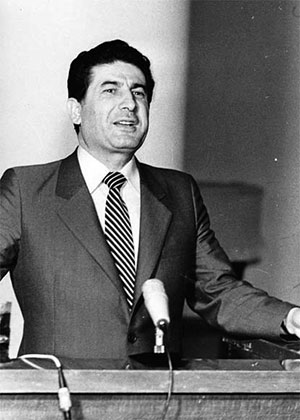
Anton
Kochinian was a remarkable, yet underrated figure in the history of
Soviet Armenia during the 1950-1970s, despite being in top leadership
positions for most of that period.
He
was born in the village of Shahali (now Vahagni), in the district of
Lori, on October 25, 1913, in the family of an agriculturist. He studied
in the local school, then entered the youth organization of the
Communist Party (1928) and studied in the school of the organization
until 1931. He went to Tiflis to study at the Armenian pedagogical
technical school in 1932, but left after a year and he was sent to
Yerevan to study at the agricultural school of the youth organization
(1933-1935).
 After
working on the editorial boards of local newspapers from Tavush and
Vayots dzor (1935-1937), Kochinian rapidly rose in the party ranks.
First he was secretary of the regional committee of the district of
Azizbekov (Siunik) from 1937-1939, and from 1939-1940 secretary of
personnel and then first secretary of the Central Committee of the
Communist Youth Organization. In 1940 he was elected member of the
Central Committee of the Armenian Communist Party, and in 1941-1943 he
led regional committees in Yerevan and Kotayk.
After
working on the editorial boards of local newspapers from Tavush and
Vayots dzor (1935-1937), Kochinian rapidly rose in the party ranks.
First he was secretary of the regional committee of the district of
Azizbekov (Siunik) from 1937-1939, and from 1939-1940 secretary of
personnel and then first secretary of the Central Committee of the
Communist Youth Organization. In 1940 he was elected member of the
Central Committee of the Armenian Communist Party, and in 1941-1943 he
led regional committees in Yerevan and Kotayk.
After
spending two years in Moscow as an auditor at the higher school for
party organizers, in 1946 he was elected third secretary of the Central
Committee of the Armenian Communist Party, and in 1947 secretary of
personnel.
In
November 1952 Kochinian was promoted to the post of president of the
Council of Ministers. He would occupy this position of prime minister
for almost fourteen years, during the tenures of Grigori Arutyunov
(1937-1953), Suren Tovmasian (1953-1960), and Yakob Zarobian (1960-1966)
as the party’s first secretaries. Kochinian was selected by the Moscow
leadership to replace Zarobian in February 1966 after the latter failed
to contain the demonstrations of April 1965 on the fiftieth anniversary
of the genocide.
During
his more than two decades both as prime minister and first secretary of
the party, Kochinian recorded a series of important achievements. The
economic progress of Armenia was backed by an important program of
industrialization. This included the construction of chemical factories
in Alaverdi and Kirovakan (nowadays Vanadzor), the industrial complexes
of Hrazdan and Charentsavan, and factories in Sevan and Dilijan,
complemented by railways that ensured transportation of raw materials
and production. The “Yeraz” truck factory (1964) in Yerevan and big
electronic factories in the city of Abovian were added in this period.
Thermoelectric centrals were built in Yerevan, Kirovakan, and Hrazdan,
as well as the hydroelectric central of Tatev and the cascade of
Vorotan. The construction of the 48 kilometers-long Arpa-Sevan tunnel,
which would bring the waters of the Arpa River to Sevan Lake, started in
1963. Kochinian’s active participation was instrumental in the decision
to build the nuclear central of Metzamor, started in 1969, which would
lead Armenia to energy self-sufficiency. Several thousand hectares of
orchards were planted, along the construction of the canal of Aparan and
the reservoir of Garni. The Yerevan-Sevan highway and the Kapan-Goris
route were also built.
Besides
a network of sanatoria, pioneer camps, and tourism areas throughout the
republic, the sports complex of Tzaghkadzor, which would be used to
train the Soviet winter sports teams, was built in the 1960s, and some
important public works in Yerevan started in the early 1970s, such as
enlargement of the Zvartnots airport (1973), the Hrazdan stadium (1971),
and the Rossiya movie theater (1970). The first steps to build the
subway network were taken in 1972.
Kochinian
was also instrumental in the inauguration of the genocide memorial of
Tzitzernakaberd (1967), the monument of Sardarabad (1968), and the
Erebuni museum (1968). The latter coincided with the celebration of the
2750th anniversary of the foundation of Yerevan with great fanfare. He also raised the issue of Karabagh in 1966.
During
Kochinian’s tenure as first secretary, Soviet Armenia earned three of
the five all-Soviet decorations it had throughout its history for
reaching high marks in economic activity (1968, 1970, and 1972).
Kochinian himself was twice decorated with the order of Lenin.
In
November 1974 he was replaced by Karen Demirchyan under pretexts of
“serious flaws in leadership” and practically left unemployed. He passed
away on December 1, 1990. On the centennial of Kochinian’s birth, two
busts were inaugurated in Yerevan and in his birthplace in Vahagni
(Lori).