Showing posts with label Armenian cinema. Show all posts

Friday, August 30, 2019

Birth of Robert Sahakiants (August 30, 1950)

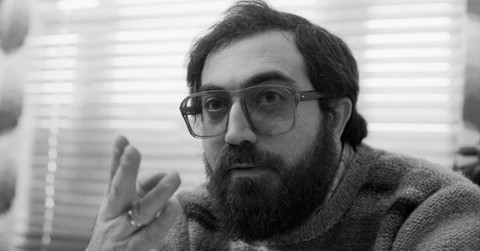
Robert Sahakiants was one of the stars of Armenian animation films both in Soviet and post-Soviet times.

He was born on August 30, 1950, in Baku (Azerbaijan). He moved to Yerevan in 1964 with his family. He finished high school there and entered the Khachatur Abovian Pedagogical Institute (now University). He was twenty-years-old when in 1970 he started working at the Armenfilm studios as an illustrator and animator. Two years later, he directed his first animation film, Lilit. Around that time, he was forced to abandon his studies for low assistance to classes. His fifth animation film, The Book of the Fox (1975), for which he also wrote the scenario based on the proverbs of Armenian medieval authors Vardan Aygektsi and Mekhitar Gosh, was the first Soviet rock-opera. He would write the scenarios for most of his films. In 1987 he earned the title of Artist Emeritus of Soviet Armenia and, in 2008 he became Popular Artist of the Republic of Armenia.

From 1972-2009 Sahakiants would direct fifty-four movies and write forty-eight scenarios. He also co-authored other animation movies produced by Armenfilm. He produced some of his most popular movies in the 1980s, such as Three Mulberry-Colored, Deep Blue Lakes (1981), Who Says Such a Lie (1982), The Talking Fish (1983), In the Blue Sea, in the White Foam… (1984), The Carnival (1985). His movies obtained awards in festivals held in France, Italy, Spain, Germany, Japan, as well as Ukraine, Russia, and Estonia.

Several of his movies were based on the tales of Hovhannes Toumanian, such as Kikos’ Death, Nazar the Brave, Three Mulberry-Colored, Deep Blue Lakes, Who Says Such a Lie, The Talking Fish, and The Carnival. Sahakiants did not just revive the classical tales but modernized them and gave them a contemporary sound for children. He created characters bound to be remembered, introduced with colorful “fireworks” and offered with his own interpretation.

Robert Sahakiants passed on September 24, 2009, in Yerevan, after a long illness and a complex heart surgery. Robert Sahakiants Production, headed by his son Davit, continues his legacy in the field of animated films.

Wednesday, October 24, 2018

Birth of Sos Sargsyan (October 24, 1929)

Sos Sargsyan became one of the most renowned Armenian actors in the second half of the twentieth century.

He was born in Stepanavan, in the Lori region of Armenia, on October 24, 1929. He debuted on the stage in 1947 as David Copperfield in a homonymous play based on Charles Dickens’ novel. He moved to Yerevan in 1948 and started performing at the Theater of the Young Spectator. Meanwhile, he entered the Yerevan Fine Arts and Theatre Institute, from where he graduated in 1954. Upon graduation, at the age of twenty-five, he entered the Gabriel Sundukian Drama Theatre, the premier theatrical ensemble of the country, where he worked for the next thirty-seven years.

Sargsyan was one of those actors who did not need to make recourse to external emphasis and emotions in order to reflect his feelings. During his lengthy career, he performed roles in many plays both by Armenian and non-Armenian authors. Roles like Ben Alexander (William Saroyan’s My Heart is in the Mountains), Don Quixote (Mikhail Bulgakov’s homonymous play), Iago (William Shakespeare’s Othello), or King Lear (Shakespeare’s homonymous play), among others, cemented his fame.

He played in over forty films, including unforgettable roles in Armenian classic movies like Guys from the Army Band (1961), Triangle (1
Sos Sargsyan in the film "Pepo"
967, Armenian SSR State Prize in 1975),
We Are Our Mountains (1969), Khatabala (1971), Nahapet (1977), Dzori Miro (1981), Gikor (1982), and others. His cinematographic participations included various Russian films, most particularly Andrei Tarkovsky’s Solaris (1972). He was the narrator of the documentary Matenadaran (1988, Armenian SSR State Prize).

In 1992 he established the Hamazkayin Theater, which he headed until the end of his life. Sargsyan continued directing and playing, both in theater and cinema. Simultaneously, he was the dean of the Yerevan Institute of Theater and Cinema from 1997-2005, and served as a member of its board of directors from 2006 until his death. He published several novels, memoirs, and collections of essays between 1991 and 2013.

His lengthy career of more than sixty years earned him many distinctions. He was named Popular Artist of Armenia in 1972 and of the Soviet Union in 1986). He was also awarded the Mesrop Mashtots medal of the Republic of Armenia (1996), the St. Sahak-St. Mesrop medal of the Armenian Church (2000), and the Mekhitar Gosh medal of the Republic of Mountainous Karabagh (2001). He was named honorary citizen of Yerevan in 2000 and earned the title of Professor in 2003.

Sos Sargsyan was also active in the political field. He was elected deputy to the Supreme Soviet of the USSR from 1989-1991, and in October 1991 he was nominated by the Armenian Revolutionary Federation as candidate in the first presidential election in independent Armenia. In 2009 he was elected to the National Assembly on the A.R.F. list. On the same year, he was elected as member of the Public Council, an advisory body to the President of Armenia.

The famous actor passed away on September 26, 2013, in Yerevan, and was buried at the Komitas Pantheon.

Saturday, September 30, 2017

Birth of Henrik Malian (September 30, 1925)

Henrik Malian, one of the most popular filmmakers in Soviet Armenia from the 1960s, was born in Telavi (Georgia) on September 30, 1925. After working during his teens as a draftsman at the aviation factory of Tbilisi (1942-1945), he moved to Yerevan. Here he studied at the Institute of Art and Theatre of Yerevan, in the section of direction, from 1945 to 1951. He continued his graduate studies in Moscow, where he finished courses of film and theater direction at the State Institute of Theatrical Art “Anatoli Lunacharsky” in 1953.


Malian’s career started in 1951 as a director in theaters of various towns of Armenia (Artashat, Kirovakan, Ghapan) and on television. In 1954 he entered Armenfilm, the cinema studios, where he was first an assistant director and, since the 1960s, a director. In 1961-1962 he spent a year at the Mosfilm studios, where he studied with two noted Soviet directors, Mikhail Kalatozov (Kalatozishvili) and Sergei Bondarchuk.


Malian’s first films were of a genre that mixed lyricism and comedy, such as The Guys of the Orchestra (1960), Road to the Circus (1963), and Monsieur Jacques and Others (1964). His breakthrough came with The Triangle (1967), one of his best films, which was crucial for the creation of a poetic style in Armenian cinema. The film was endowed with immediacy and a delicate taste for direction, with a powerful artistic discourse. He won the State Award of Armenia in 1975 for this film.

Malian characterized his films by the election of apparently minimal subjects, which he later turned into meaningful, psychologically deep generalizations. The fate of his heroes, their thoughts and experiences were linked to the events of their time. Such was the case of his next works: We Are Our Mountains (1969), Father (1972), and especially Nahapet (1977), which was released in the United States as Life Triumphs. The latter, for which he wrote the screenplay on a short novel by Hrachia Kochar, touched for the first time in Armenia the relatively taboo subject of the Armenian Genocide through the lenses of a survivor and his attempt to rebuild life after the catastrophe. 

Malian became People’s Artist of Armenia in 1977 and People’s Artist of the Soviet Union in 1982. He also wrote and directed A Piece of Sky (1980), a reconstruction of life in pre-genocide Kharpert, based on a fragment of Vahan Totoventz’s memoir Life on the Ancient Roman Road . He would still write several films in the 1980s, such as Gikor (1982, based on Hovhannes Tumanian’s short story) and White Dreams (1985, also based on another episode of Totoventz’s memoir), and direct and write A Drop of Honey (1984, also based on a short story by Tumanian). Yearning (1990), the first film to address Stalin’s repression, was posthumously filmed, on a screenplay written by Malian and Ruben Hovsepian (based on another short novel by Hrachia Kochar).

Henrik Malian was not only a director, but also a long-time teacher. He taught at the Khachatur Abovian Pedagogical Institute (now University) from 1971-1988, and was chair of Direction and Master Acting from 1975 on. He was a professor at his alma mater, the Institute of Art and Theater, from 1982 to 1988. In 1980 he founded and directed the Theater-Studio for Film Actors, which was renamed after him in 1988.

He passed away prematurely, at the age of 62, on March 14, 1988, in Yerevan. The Henrik Malian Theater Studio is now directed by his daughter, the actress Narine Malian.

Thursday, June 30, 2016

Birth of Mher Mkrtchyan (July 4, 1930)


Mher Mkrtchyan was one of the greatest Armenian actors of the Soviet period.
Son of survivors of the Armenian Genocide, he was born in Leninakan (nowadays Gumri) on July 4, 1930. His actual given name was Frunze, for which he was also known as “Frunzik,” but he later took the name Mher. His father wanted him to become a painter, but he started playing in the theatrical group of the textile factory of the town, which was next door to their home. He studied in the Art College and Theatre Studio of the city from 1945-1946, and then he played in the permanent group of the Mravian Theatre. He performed in a dozen of plays, and showed his maturity despite his young age.
He then moved to Yerevan, where he was accepted straight into the second year of the Acting Department of the Institute of Fine Arts and Theatre. He graduated in 1953 and he immediately started performing in the Sundukyan Academic Drama Theatre of Yerevan. He also directed many successful productions.
His film career began in 1955, and he played in 49 films until 1987. Mkrtchyan earned a reputation as one of the leading comedy actors of the Soviet Union thanks to his celebrated roles in Aybolit-66 (Rolan Bykov, 1966), Kidnapping, Caucasian Style (Leonid Gaidai, 1966), and Mimino (Georgi Daneliya, 1977). However, his acting talent and emotional depth were best displayed in several classic films of Armenian cinema: Triangle (1967), We Are Our Mountains (1969), Father (1973), Nahapet (1977), The Song of the Old Days (1982), Tango of Our Childhood (1985). In his posthumously published memoirs, Mkrtchyan wrote that his godfather in cinema was filmmaker Henrik Malyan:
“He was the first to notice me and trusted me to perform in his films, from Arsen (The Boys of the Orchestra), Gaspar (Triangle), Ishkhan (We Are Our Mountains), to Daddy (Father), Apro (Nahapet) and Grigor agha (A Piece of Sky), which all had the characteristic fate of the Armenian man: they are ingenious, hardworking, wistful, and dreamers.”
Among other honors, the actor won the USSR State Prize in 1978 and was also honored with the title of People’s Artist of the Armenian SSR.
Mher Mkrtchyan passed away at the age of 63 on December 29, 1993 in Yerevan. Thousands of people attended the funeral of their beloved actor. He was buried at the Komitas Pantheon. A museum remembers him in his birthplace Gumri and the Tekeyan Cultural Association of New York-New Jersey named its theater group after him.

Friday, June 5, 2015

Death of Vahram Papazian (June 5, 1968)

From Constantinople to Yerevan and from Paris to Moscow, Vahram Papazian would become the most accomplished Shakespearean actor of the Armenian scene worldwide for half a century.

He was born in Constantinople on January 6, 1888, in a middle-class family. He graduated from the Esayan School (1902) and the lyceum of Kadikoy (1902-1904), and had his debut on the stage in 1904. Then he went to the Murad-Raphaelian School of the Mekhitarist Congregation, in Venice, where he studied from 1905-1907.

In 1907 he departed for Paris and then for Baku, where he performed with an Armenian theater group for a few months. After this experience, he returned to Italy and studied at the Art Academy of Milan from 1908-1911. Famed actress Eleonora Duse was among his teachers. During his student years, he performed with Italian itinerant groups and gradually perfected his roles (Othello, Romeo, and Hamlet, among them). He returned to Constantinople in 1908 and his performances of Othello, at the age of 20, earned him the applause of Armenian audiences and the press. He went to Paris in the early 1910s to study the different currents of theater and become closely acquainted with acting techniques. As a professional actor, he performed from 1910-1913 in Constantinople and Smyrna, and from 1913-1917, in Baku and Tiflis. He enriched his repertory with a roster of roles in Armenian and non-Armenian plays.

Papazian as the title character in Shakespeare's Othello
Papazian played in fifteen Russian silent movies from 1917-1918 with the pseudonym of Ernesto Vahram, and would later play in three more films in 1922-1923. In 1920 he returned to Constantinople, where he performed until 1922. After the occupation of the city by the Kemalist forces, he settled in Soviet Armenia. He would perform and direct in Yerevan, Baku, and Tiflis between 1922 and 1927. He moved to Moscow in 1928 and then performed in Leningrad (now St. Petersburg) from 1929-1931. In 1932 he played in Lithuania, Letonia, and Estonia, and in the same year he left for Paris, where he played Othello with the Odeon Theater group; his performances were singled out by the French press. In 1933 he visited Berlin, where he met the famous director Max Reinhardt and studied closely the German school of acting.

Thereafter, he returned to the Soviet Union and was distinguished as People’s Artist of Armenia and Georgia in 1933, and People’s Artist of Azerbaijan in 1935. He toured the cities of the three countries in 1934-1935, and continued his tour through Russia and Ukraine from 1936-1941. He played in Moscow in 1941 and settled in Leningrad from 1941-1944, where he survived the German blockade.

After years of new presentations in Russia, Ukraine, Central Asia, and Transcaucasia, from 1946-1954, Papazian finally settled back in Yerevan as a member of the Sundukian Academic Theater, and he also directed plays in Yerevan and Leninakan (now Gumri). He returned to cinema in four films from 1953-1964, and in 1956 he was given the title of People’s Artist of the Soviet Union. In the last fifteen years of his life, the actor revealed himself to be an accomplished writer with his two-volume memoir, Retrospective Regard (1956-1957). He also wrote his reminiscences on Western Armenian actors, My Heart’s Duty (1959), and several books on performance analysis about the roles of Hamlet, Othello, and King Lear.

His art belonged to the classical school, enriched by elements of neo-romanticism and psychological realism. His performances of Shakespearean roles were grounded on the traditions of ancient tragedy and the Renaissance, as well as his own Armenian viewpoint.

Vahram Papazian passed away in Leningrad on June 5, 1968, and was buried in the Pantheon of Yerevan. The State Theater of Stepanakert (Karabagh) carries his name.

Thursday, January 9, 2014

Birth of Sergei Parajanov - January 9, 1924

"Everyone knows that I have three Motherlands. I was born in Georgia, worked in Ukraine and I'm going to die in Armenia," declared Sergei Parajanov, one of the most talented names of Soviet cinematography. Despite running afoul of censorship and repression, his original cinematic style made significant contributions to Ukrainian, Armenian, and Georgian cinema.

Parajanov was born in Tiflis, capital of Georgia, to Iosif Parajanov and Siranush Bejanova. At the age of 21, he traveled to Moscow (1945), enrolled in the directing department of VGIK (the All-Union State Institute of Cinematography), the oldest film school in Europe, and studied under directors Igor Savchenko and Aleksandr Dovzhenko.

In 1948 he was convicted of homosexual acts and sentenced to five years in prison, but was released under an amnesty after three months. In video interviews, friends and relatives contested the truthfulness of the charges. In 1950 he married his first wife, Nigyar Kerimova, from a Muslim Tatar family, in Moscow. She converted to Eastern Orthodox Christianity to marry him, and was murdered by her relatives because of her conversion a year later. After her murder, he left Russia for Kiev (Ukraine), where he produced three documentaries and several narrative films. He married his second wife, Svetlana Sherbatiuk, in 1956. Their son Suren was born in 1958 and they divorced in 1962.

In 1964 Parajanov abandoned socialist realism (the state-sanctioned art style in the Soviet Union) and directed Shadows of Forgotten Ancestors, a poetic film over which he had complete creative control. He would later dismiss all films he had directed before 1964 as “garbage.” This film won numerous international awards and turned him into a cult director.

He later left Kiev and moved to Armenia. He filmed Sayat Nova in 1968, choosing the life of the famous eighteenth-century Armenian troubadour as the apparent subject, but the film was immediately banned. He re-edited his footage and renamed the film The Color of Pomegranates. The film won much praise internationally and increased his popularity as a venerated director.

 A still from the movie The Color of Pomegranates.
His projects were systematically banned or scraped between 1965 and 1973 because of charges of deviation from accepted artistic norms, until Parajanov was sentenced to five years in a hard labor camp in Siberia on charges of homosexuality and pornography in December 1973. Many international artists protested on behalf of the filmmaker without effect, including Federico Fellini, Michelangelo Antonioni, Jean-Luc Godard, François Truffaut, Luis Buñuel, Françoise Sagan, Yves Saint Laurent, Andrei Tarkovsky, and others. He obtained an early release in December 1977.

The imprisoned filmmaker produced a large number of miniature doll-like sculptures and some 800 drawings and collages, many of which are currently displayed at the Parajanov Museum in Yerevan.

Sergei Parajanov, Tarkovsky's Night Bird, 1987, Collage, Mixed Media.
After his return from prison to Tbilisi, he could not pursue his career. He was imprisoned again in February 1982 on charges of bribery and freed nine months later, although his health was seriously compromised after the harsh conditions of the Siberian camp.

After his release, the support of Georgian intellectuals allowed him to produce his last two films, which received critical and public acclaim: The Legend of Suram Fortress (1984) and Ashik Kerib (1988). He moved back to Armenia, where he started a project that would remain unfinished: his final film, The Confession. Its original film footage was assembled and released as Parajanov: The Last Spring, by his close friend Mikhail Vartanov in 1992.

Sergei Parajanov passed away on July 20, 1990, in Yerevan, a victim of cancer, at the age of 66. He left a legacy of sixteen films (feature and documentary), and ten unproduced screenplays and projects, including films on the Armenian legend of Ara the Beautiful and the Armenian epic David of Sassoun.