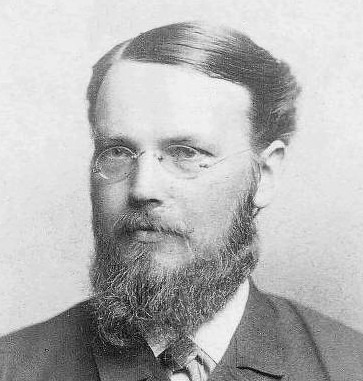
 In the fateful years that led to the end of the Ottoman Empire, Johannes Lepsius was the one personality who tried to raise Armenian issues among German public, especially a voice of alarm to document the genocide of 1915-1916 from its very beginning.
Protestant missionary and Orientalist, Lepsius was above all a humanist. He was the younger son of Carl Richard Lepsius, the founder of Egyptology in Germany. His siblings also become prominent personalities in science and art. He was born on December 15, 1858, in Berlin (Germany). He studied mathematics and philosophy in Munich, and earned a Ph.D. in 1880. He was trained as a Lutheran pastor and was on the board of the Syrian Orphanage of Jerusalem from 1884-1886, where he met his wife Margarethe Zeller. She passed away in 1898, leaving six children.
Lepsius became a missionary in the Ottoman Empire in the 1890s. He came to public attention when he traveled in disguise to gather evidence on the Turkish massacres of 1895-1896. His report on the pogroms, Armenien und Europa (1896), stirred considerable controversy and significantly affected international relations with the empire. He also helped found the Deutsche Orient Mission (German Mission for the Orient) to operate orphanages and schools for Armenian children.
Lepsius traveled to Constantinople in 1915 and gathered information about the ongoing massacres and deportations, while he unsuccessfully appealed to Turkish authorities to stop them. He also tried to lobby the German government. In 1916 he published privately Bericht über die Lage des armenischen Volkes in der Türkei (Report on the Situation of the Armenian People in Turkey; French edition, 1918), where he meticulously documented and condemned the annihilation. Lepsius was forced to secretly publish the report due to official military censorship. However, Lepsius managed to distribute more than 20,000 copies after the book was forbidden and before censorship was enforced. In the second edition, Der Todesgang des armenischen Volkes (The Death Walk of the Armenia People), he included an interview with Enver Pasha, held in June 1915.
Shortly after the publication of his report, Lepsius left Germany for the Netherlands to escape pursuit by the German police, and later brought his family. In June 1917 he resigned from the Deutsche Orient Mission because of disagreements with the committee. In an article published in 1925 in the magazine of the Mission, Der Orient, he disclosed his collaboration with the German Foreign Office, of which even top officials were unaware: “Soon after I resigned from my old mission, a circle of political friends suggested that I should stay in Holland and report regularly on the Dutch and British press. It becomes clear that I was serving patriotic interests from the fact that, during my three-year stay in Holland, I sent press reports daily to the military office of the Foreign Office, which were sent to Berlin through the embassy courier in The Hague.”
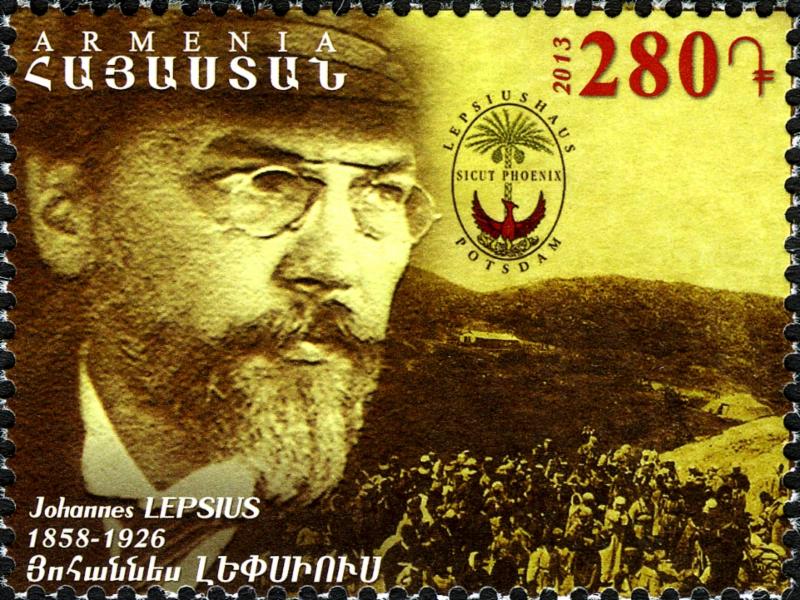 A stamp in homage to Johannes Lepsius issued in Armenia in 2013
The German responsibility in the Armenian genocide was a subject often discussed during World War I. In the first months following the defeat of Germany and Turkey, Germany faced allegations of war crimes in Europe and sought to avoid responsibility for crimes within Turkey. For his part, Lepsius was committed to unearthing the most comprehensive record possible of the genocide. Thus, while still in the Netherlands, he readily agreed to the foreign ministry's offer to let him prepare a series of books based on formerly secret German diplomatic records, beginning with a volume documenting German activities in Turkey and Armenia between 1914 and 1918: Deutschland und Armenien 1914–1918: Sammlung diplomatischer Aktenstücke (Germany and Armenia 1914–1918: Collection of Diplomatic documents) (1919). Although German officials claimed that they had released a copy of the complete record, they actually supplied Lepsius with censored versions of many documents. A systematic comparison of the published documents with the originals revealed that there were a great number of abridgements or even forgeries, and that important references to German policy with regard to the genocide, joint responsibility, as well as involvement of German officers in repressions against the Armenians had been systematically held back. In addition, the names of important Turkish people involved in the genocide were generally omitted. In the end, Lepsius’ collection presented frank and detailed evidence of the Young Turks’ genocidal campaign, but tended, unwittingly, to absolve Germany of any responsibility. The uncensored version of the German documents was published in 2005 by researcher Wolfgang Gust (also available in English translation).
In June 1921 Lepsius testified for the defense in the trial of Soghomon Tehlirian, the assassin of former Turkish Interior Minister Talaat Pasha.
Lepsius passed away on February 3, 1926, in Merano (Italy). Franz Werfel, who used his publications for his novel The Forty Days of Musa Dagh, portrayed him as a “guardian angel of the Armenians.” The “Johannes Lepsius Archive,” initially collected and organized by theologian Hermann Goltz at the Martin Luther University of Halle-Wittenberg, was moved in 2011 to the newly opened Lepsius House Museum, set in the house in Potsdam where Lepsius lived from 1908 and 1925, which also functions as a research center for genocide studies. A street in Potsdam is named after the German humanist, as well as a school in Yerevan.


