Showing posts with label Armenian painting. Show all posts

Saturday, March 9, 2019

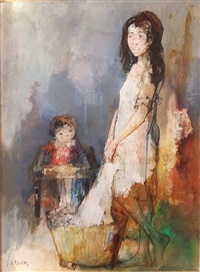
Birth of Jansem (March 9, 1920)

Jansem, a recognized French Armenian painter, was born Hovhannes Semerdjian on March 9, 1920, in Sölöz, a village near Brusa, nowadays Bursa, in northwestern Asia Minor (Turkey), which was also the birthplace of the famous writer Hagop Oshagan.

The Semerdjian family fled in 1922 to escape the massacre and deportation of Greeks and Armenians undertaken by the Kemalist movement in Asia Minor. They settled in Salonica (Greece), where Hovhannes spent his early childhood. After the death of his father, he moved to France with his mother in 1931. They settled in the suburban town of Issy-les-Moulineaux, one of the traditional concentrations of Armenians around Paris.

He broke the bones of his foot in an accident and had to spend three years in the hospital. From 1934-1936 he attended a variety of evening classes in Montparnasse and the Marais, in Paris. He met painter and teacher Ariel Ajemian, who taught him to draw, but he found his grand revelation in the works of Picasso.

He was admitted to the École des Arts Decoratifs (1936-1938), and completed a training course at the École des Beaux-Arts and at Atelier Sabatier in 1937. He adopted the pseudonym Jansem (from Jean Semerdjian) in his first exhibition in 1940 at the Salon des Independents. He would also be known as Jean Jansem. His paintings, which had been characterized by somber tonalities, took a new shape after his travel to Greece in 1950, when he discovered light. He eagerly sketched the shadowy figures of the Greek countryside that had surrounded him in his childhood and remained hidden in his subconscious. The yellow-green palette of his paintings was often associated to red, purely green, and orange tonalities. Critics defined him as a miserabliste, an artist of unfortunate people.

In the 1950s Jansem won many awards in France and Mexico, and was decorated with the Order of the Arts and Letters of France in 1953. For the next half a century, he would have exhibitions in Paris, New York, Chicago, London, Tokyo, Rome, Brussels, Lausanne, Beirut, and other cities, and many of his works were acquired by European and American museums and private collections. He had the exceptional privilege of having two museums dedicated to his work in Japan during his lifetime (1993 and 1997). He visited Armenia in 1973 and again in 2001, when he donated his series of 34 paintings, “Genocide,” to the Armenian Genocide Museum-Institute. He was decorated with the Mesrob Mashdots award and received an emeritus doctorate from the National Academy of Sciences of Armenia in 2002. In 2003 he was ordained a Knight of the French Legion of Honor.

Jansem passed away on August 27, 2013, at age 93, in Saint-Aignan-sur-Cher, in central France. 

Sunday, August 12, 2018

Death of Jean Carzou (August 12, 2000)

Carzou was the most famous Armenian painter in France with a unique style of painting.

He was born Karnig Zouloumian on January 1, 1907, in Aleppo (Syria), then part of the Ottoman Empire. He first studied at the school of the Marist Fathers and then, when he moved to Cairo in 1919, he went to the Kaloustian School. His brilliant academic performance earned him a scholarship and he moved to Paris in 1924, after graduation, to study architecture.

He graduated from the School of Architecture in 1929. He created his name from the first syllables of his name and surname, to which he added the French name Jean, but he always kept close to his Armenian roots and Armenian life. However, he abandoned architecture for the fine artist. He started working as a theater decorator but quickly realized he preferred drawing and painting. He worked as a street artist to support himself, and his sketches of politicians and public figures found their way into Parisian newspapers.

Cannes, Le Suquet
In 1930 Carzou had his first exhibition at the Salon des Artistes Independants, which he would continue annually for more than six decades, until 1992. In the 1930s he also participated in the exhibitions of the Union of Armenian Artists “Ani.” He had his first solo exhibition at Galerie Contemporaine in Paris, and from then on he would have more than a hundred personal exhibitions in France and abroad (Belgium, Germany, Lebanon, Cairo, Switzerland, England, and the United States). In 1966 he had his first personal exhibition in Yerevan, followed by a second exhibition in 1983 and a posthumous one in 2007. Following their trip to Armenia in 1966, his wife Nan Carzou would write a celebrated travelogue, Voyage en Arménie (Travel in Armenia), and his son Jean-Marie Carzou, a journalist, would produce the first comprehensive account about the Armenian Genocide in French, Arménie 1915: un genocide exemplaire (Armenia 1915: An Exemplary Genocide), in 1975. In 1980 he was awarded the “Martiros Sarian” prize in Armenia.

Carzou started working in stage designing for the Opera de Paris for several operas and ballets during the 1950s. His designs of settings and costumes made him known to the general public. In 1957 he created his famous antiwar series “The Apolcalypse.” In the 1950s and 1960s he also created book illustrations with his line drawings and engravings (Andre Maurois’ France, Ernest Hemingway’s A Farewell to Arms, Albert Camus’ Notebooks, Edgar A. Poe’s The Murders in the Rue Morgue ), and his sharp graphic style became extremely popular in the 1960s and 1970s. Meanwhile, he earned the coveted Hallmark prize in 1949, and became Knight of the French Legion of Honor in 1956 and Commander of the Order of Arts and Letters two years later. In 1955 the art magazine Connaissance des Arts rated him as one of the ten most important painters of his generation.

L'Apocalypse
Near the age of seventy, Carzou became the first living artist to have his work, “Distant Princess,” appear on a French postal stamp in 1976, and the following year he was elected a member of the French Academy of Fine Arts, succeeding painter Jean Boucheaud. In 1977 he was also awarded the National Order of Merit. However, he garnered a great deal of hostility from the art world with a statement that Pablo Picasso and Paul Cézanne were symbols of the “decadence in painting.”

After a long career as a painter, illustrator, and stage designer, in 1991 he finished the design of a chapel in Manosque (Alpes of Haute-Provence) with more than 600 square meters of paintings of a huge Apocalypse, which was not a literal illustration of St. John’s book of Revelation, but the depiction of the “climate of our times.” The chapel later became the headquarters of the Carzou Foundation.

The prolific French-Armenian artist lost his wife in 1978. He passed away near his son on August 12, 2000, in Perigueux, at the age of ninety-three.  

Thursday, May 31, 2018

Birth of Vartan Makhokhian (May 31, 1869)

Ivan (Hovhannes) Aivazovsky is the premier seascape painter in Armenian art, but his younger contemporary, Vartan Makhokhian (also spelled Mahokian), comes to a close second.

Makhokhian was born on May 31, 1869, in Trebizond (Trabzon). His father was a merchant who made sure that his six children had a good education. Makhokhian took an interest in drawing at the local Armenian school, and learned to paint when he continued his studies at the Sanasarian College in Erzerum (1882-1887), before returning to his hometown after five years of study. His artistic interests were not limited to painting, since he also learned to play violin and studied music theory.

His uncle persuaded Makhokhian to pursue an artistic career. At the age of twenty-two, he began studies at the Berlin Academy of Arts under the guidance of Eugen Bracht and Hans Gude. After graduating in 1894, he traveled to Crimea, where he met Aivazovsky and painted various sea scenes. He went back to Trebizond in 1895 and became a witness of the Hamidian massacres.

He fled to the port of Batum, in Georgia, and then to Europe. He held one of his first exhibitions in 1900 in Berlin. For the next two decades, he would be the subject of many articles in the European press. In 1904 he was accepted into the Berlin Artists' Association. He traveled to Egypt, where he had exhibitions in Alexandria and Cairo, then to Denmark, and finally settled in the island of Capri, in Italy, a place chosen as residence by well-known artists and intellectuals. Makhokhian returned to Germany in 1907 and participated in various exhibitions in Berlin, Düsseldorf, and Munich.

"Seaside scene. Norway" (Vartan Makhokhian)
The painter returned once again to his hometown in 1908, after the Ottoman Constitution was restored. He continued working there for the next six years, and after the beginning of World War I, Makhokhian moved again to Europe and this time he settled in Nice, France, where he would remain until the end of his life. He composed the symphony “The Sobbing of Armenia” from 1915-1917, reacting to the loss of his family in Trebizonda during the genocide, which was first performed in Monte Carlo (1918). He participated in the Paris Salon in 1921, 1922, 1923, and 1927, and had solo exhibitions in Nice (1918, 1931, 1936), Marseilles (1923), Paris (1925), and Monte Carlo (1932). The painter was awarded the Legion of Honor in 1925 and became a French citizen two years later.

From 1927-1930 Makhokhian also participated in the collective exhibitions of the “Ani” Artistic Society in Paris, and thus became better known in Armenian circles.

After a long illness, the painter passed away in Nice on February 10, 1937, at the age of 67. His works are found in the National Gallery of Armenia, the Art Museum of Nice, the museum of the Mekhitarist Congregation in Venice, and other places, as well as in many private collections.


Monday, April 30, 2018

Death of Panos Terlemezian (April 30, 1941)

Both an artist and a patriot, Panos Terlemezian made a remarkable contribution to Armenian fine arts in the first half of the twentieth century. He was born in Van, in the Armenian-populated suburb of Aygestan, on March 3, 1865, the son of a farmer. His love for painting was born during his studies in the local elementary school and then in the Central College of Van (1881-1886).

He graduated with honors and, afterwards, he taught drawing, aesthetics, and geography in the schools of Van from 1886-1889. Meanwhile, he became a member of the first Armenian political party, the Armenagan Organization, formed in Van. In 1890 he was arrested on charges of political activities against Sultan Abdul Hamid II, but was freed six months later for lack of evidence. In 1891 he was arrested again and sentenced to death, but two years later he was able to escape prison and go first to Persia and then to Tiflis. After doing menial jobs, in 1895 he went to St. Petersburg to follow studies at an art society school with a scholarship granted by Catholicos Mgrdich I (Khrimian Hayrig).

His studies were interrupted in 1897, when the Russian police arrested him in Reval (now Tallinn, the capital of Estonia) upon a request of the Ottoman government. He was transferred to half a dozen prisons until he was secretly exiled to Persia in 1898. He managed to escape again to Batum, in Georgia, and leave for Paris. In Paris he entered the famous Julian Academy, from which he graduated in 1904.

Upon his return to Eastern Armenia, Terlemezian, who had already participated in collective exhibitions in Paris, created various paintings inspired by his visits to Etchmiadzin, Sanahin, and other places. He settled in Tiflis, where he taught at the Nersessian and Hovnanian schools, and participated actively in cultural life from 1905-1908.

He traveled to Egypt and Algeria in 1908, and then resided in Paris for the next two years, where he continued painting. In 1910 he settled in Constantinople, where he would live until the beginning of World War I. Here he befriended some of the most prominent intellectuals of the period, and shared his residence with Gomidas Vartabed. In 1913 he gave his first individual exhibition in Constantinople and won the golden medal at the international exhibition of Munich. Returning to Van, he was one of the leaders of the resistance of April-May 1915 against the attack of Turkish regular troops. After the retreat of the Russian troops, he went to Etchmiadzin with the Armenian refugees and then to Tiflis. In 1916-1917 he became one of the founding members and organizers of the Society of Armenian Artists in Tiflis and its branch in Rostov-on-the-Don.

Terlemezian went abroad in 1920. He lived for a few years in Constantinople, Italy, and France, and in 1923 he settled in the United States, where he lived and presented individual exhibition in New York, Fresno, San Francisco, and Los Angeles during the next five years. He also participated in the Biennial of Venice (1924).

In 1928 he was invited by the government of Soviet Armenia to return. He would live in Yerevan until his death. He gave individual exhibitions in Yerevan and Tiflis. In 1930 he was given the title of Emeritus Artist of Soviet Armenia and became a member of the Society of Painters of the Soviet Union in 1932.
Panos Terlemezian passed away on April 30, 1941. The art school established in Yerevan in 1921 was posthumously named after him. 

Tuesday, February 27, 2018

Birth of Vardges Sureniants (February 27, 1860)

A multifaceted artist and intellectual, Vardges Sureniants is considered the founder of Armenian historical painting. He was born in Akhaltskha (Akhaltsikhe), in modern-day Georgia, on February 27, 1860. His father Hakop was a priest who taught religious history. After their family moved to Simferopol, in Crimea, in 1868, his father was appointed to the Armenian diocese in Moscow. This gave young Sureniants an opportunity to study at the prestigious Lazarian School from 1870-1875.
 
From early on, the future artist showed his interest and aptitude for the arts. He furthered his education at the department of Architecture of the Moscow Art School (1875-1878). He went to Munich (Germany), and after a year at the department of Architecture of the Academy of Fine Arts (1879), he made a crucial shift and studied at the department of Painting for the next five years until 1885.
 
Sureniants became interested in caricatures and sketches during his years at the Lazarian School. In Munich, some of his caricatures were published in the Fliegende Blätter magazine.
 
The painter traveled to Italy in 1881 and visited Venice, including the island of San Lazzaro. In the library of the Mekhitarist Congregation he studied Armenian fine arts and manuscripts. In 1883 he published his first article, about Armenian architecture, in the daily Meghu Hayastani of Tiflis.
 
After his return to Russia, in 1885–87 he traveled to Persia as a member of the scientific expedition led by Valentin Zhukovski, a professor of Oriental Studies at the University of Saint Petersburg. They visited the cities of Tabriz, Tehran, and Shiraz, and Sureniants spent several months in Ispahan. Afterwards, he translated William Shakespeare’s play Richard III and sent it to the celebrated Shakespearean actor Bedros Atamian (1849-1891), in Constantinople, to have it produced there. He would later translate Midsummer’s Night Dream and some of Shakespeare’s sonnets. He taught painting and general art history at the Gevorgian Seminary of Holy Echmiadzin in 1890-1891.
 
After 1892 Sureniants participated actively in the artistic, theatrical, and social life of Moscow, Saint-Petersburg, Tiflis, and Baku. He visited Ani and Lake Sevan, and became familiar with historical monuments and everyday customs of Armenian rural life. He also studied the Armenian illustrated manuscripts in the repository of the monastery of Holy Echmiadzin. He traveled to France and Spain in 1897-1898.
 
He has been categorized as a realist painter in his representations of landscapes and historical events, and played an important role in the revival of the Armenian past through art. His paintings would reflect the aesthetic knowledge acquired during his studies and his travels. In 1901 he held a solo exhibition of his works in Baku, which would be his only exhibition in his lifetime. Afterwards, he moved to St. Petersburg, where he worked as a stage decorator until 1915.

 
Sureniants was also known for his illustrations of famous literary works, such as Ferdowsi’s Shahname, Alexander Pushkin’s The Fountain of Bakhchisaray, Oscar Wilde’s fairy tales, and works by Belgian poet Georges Rodenbach and Armenian poets Smbat Shahaziz and Alexander Tzaturian.
 
His famous painting “Salome”(above, left) was included in the exhibition dedicated to the 100 th anniversary of the Academy of Fine Arts of Munich (1912). In 1915 he returned to the Caucasus, and in 1916 he founded the Armenian Artists’ Society, together with Yeghishe Tateosian, Martiros Sarian, and Panos Terlemezian. He also made many paintings of survivors of the Armenian Genocide.
  
In 1917 Sureniants moved to Yalta, in Crimea, where he was commissioned to draw the decorations for the newly built Armenian cathedral. He decorated the altar (above, right), walls, and dome of the church. However, he suffered a grave illness during his task. He passed away on April 6, 1921, and was buried in the courtyard of the cathedral he had contributed to decorate.

Monday, May 15, 2017

Birth of Arman Manookian (May 15, 1904)

The Hawaiian scenes of Arman Manookian, an Armenian-American painter with a premature and tragic end, have been rediscovered in the last years.


The elder of three siblings, he was born Tateos Manookian in Constantinople on May 15, 1904. His father Arshag was a printer and publisher of an Armenian newspaper. 


Tateos was a student at the St. Gregory the Illuminator school in Constantinople, whose principal was poet Taniel Varoujan. On the fatidic night of April 24, 1915, Varoujan was arrested (he would be killed on the road of exile months later), and Arshag Manookian and his brother-in-law hid in the family’s print shop to save their lives. Young Tateos’ father somehow fled the Ottoman Empire, only to die in France two years later during the epidemic of the Spanish flu. The Armenians of Constantinople lived in an atmosphere of terror until the end of World War I, with arrests, executions, partial exiles, and rumors and threats of general deportation hanging over their heads. The future painter would spend some time in Egypt during those years. His mother managed to sell the print shop and gave a large amount of money to her sixteen-year-old son, allowing him to leave for the United States.

Tateos Manookian arrived at Ellis Island in April 1920. He went to live with a relative of his mother in Providence, where he studied at the Rhode Island College of Design from 1920-1922. His talent was already apparent, as a state scholarship paid for his tuition to take classes in drawing. In 1923 he enlisted in the Marine Corps with a new name, Arman Theodore Manookian, and claimed American citizenship, which he actually did not have. 

In 1924 Private Manookian was assigned as a clerk to Major Edwin North McClellan, a Marine historian, who had worked for the previous five years preparing a history of the Marine Corps during World War I. History of U. S. Marines and Origin of Sea Soldiers, never published (the only extant complete copy is kept at the New York Public Library), would be eventually completed with more than a thousand pages of text and eight hundred pages of notes, and over a hundred illustrations by Manookian, who also started publishing some of his work in magazines. 

In 1925 McClellan, who was a mentor of sorts during their time together, was dispatched to Pearl Harbor, Hawaii, and took his talented clerk with him. The archipelago fired Manookian’s creativity, who transformed himself from an illustrator into an artist. His approach to Hawaiian culture was bound with idealization—“no more intriguing artists’ paradise than these mid-Pacific gardens of the Gods,” he stated in 1927—as shown in the historical and mythological images that he created to accompany McClellan’s pieces.

“Hawaiian Boy and Girl” (collection of John and Patsy Dilks)
In 1927 Manookian was honorably discharged as a corporal and decided to stay in Honolulu, while McClellan was called to the mainland and then to Nicaragua. The painter had found work as an illustrator with the Honolulu Star-Bulletin, and would continue working with the magazine Paradise of the Pacific. In the almost six years that he lived in Honolulu he produced paintings, magazine illustrations and, most impressively, murals that “were completely unlike anything that Honolulu audiences had previously seen,” in the words of art historian David Forbes. His use of color was particularly original. Another art historian, John Seed, who has researched Manookian’s life and art in depth, has noted: “His bond with Hawaii suggests a deep longing to be connected to a place and culture, perhaps as a replacement for what had been lost.”
"Men in an Outrigger Canoe Headed for Shore"


After the stock market crash of 1929, the Hawaiian economy declined, with tourism and construction slowing down. Manookian’s workload also went down. In late 1930 he met Cyril Lemmon, a young architect who dabbled in painting. They started working together, and Manookian moved to the home of his new friend, who had recently married.

He continued working until the end of his life, but he was emotionally fragile. The years of terror during the genocide and his uprootedness, as well as his separation from his mother and siblings, who had been able to move to Switzerland in the late 1920s, took its toll. On May 10, 1931, while the Lemmons and a few friends were playing the parlor game “Murder,” Arman Manookian drank poison and stumbled in the kitchen, never to regain consciousness.

A memorial exhibit for the unfortunate painter was held at the Honolulu Academy in the fall of 1933. Manookian’s works are held in several museums, and only 31 of his oil paintings are known to exist. They have become very valuable in the last few years, with several exhibitions held in Hawaii, where he was acknowledged as “Hawaii’s Van Gogh” in the House of Representatives resolution that recognized the Armenian Genocide.

Friday, May 5, 2017

Death of Martiros Sarian (May 5, 1972)

Martiros Sarian, one of the two names of Soviet Armenian culture who earned the title of Varbed (Վարպետ “Master”), was the founder of a modern Armenian national school of painting. 


He was born into an Armenian family in Nakhichevan-on-Don (now part of Rostov-on-Don, Russia) on February 28, 1880. In 1895, aged 15, he completed the Nakhichevan school. He received training in painting at the Moscow School of Painting, Sculpture, and Architecture (1897–1903) and then worked in the studios of the noted painters Konstantin Korovin and Valentin Serov. Soon Sarian became a member of a group of Moscow symbolist artists, and he began exhibiting his brightly colored paintings. He had works shown at the Blue Rose Exhibit in Moscow.


He first traveled to Armenia in 1901, visiting the regions of Lori and Shirak, the convents of Etchmiadzin, Haghpat, and Sanahin, Yerevan, and Lake Sevan. His first landscapes depicting Armenia (1902-1903) were highly praised in the Moscow press.

In 1904-1907 Sarian created the watercolor series "Fairy Tales and Dreams." Some pieces of this cycle were exhibited first at the Crimson Rose exposition in 1904 in Saratov and later at the sensational Blue Rose exposition in 1907 in Moscow. Starting from 1908, Sarian completely replaced watercolor with tempera. During this period, he took an active part in the exhibitions organized by the magazine Zolotoye Runo

From 1910 to 1914 he traveled extensively in Turkey, Egypt, northwestern Armenia, and Persia. These trips inspired a series of large, fresco-like works in which he attempted to communicate the sensuousness of the Middle Eastern landscapes. He also incorporated into a number of his paintings the Persian motifs he had seen in the Middle East. Like many Russian artists of the early decades of the 20th century, Sarian was greatly influenced by impressionism. He was also interested in the paintings of Henri Matisse and Paul Gauguin, as can be seen in his use of areas of flat, simplified color.

In 1915 he went to Etchmiadzin to help refugees who had fled from the Armenian Genocide. In 1916 he settled in Tiflis (now Tbilisi) where he founded the Society of Armenian Artists with fellow painters Yeghishe Tateosian, Vardges Sureniants, and Panos Terlemezian. 

He married Lusik Aghayan, daughter of writer Ghazaros Aghayan, in 1917. The newly married couple moved to Nor Nakhichevan, where Sarian continued painting. In 1920 he became director of the museum of Armenian Folklore in Rostov. In 1921 he moved to Yerevan with his wife and two children, Sarkis (future literary scholar) and Ghazar (future composer). He organized and became director of the museum of archaeology, ethnography, and fine arts (now the National Gallery of Armenia). He also participated in the establishment of the Yerevan Art College and the Artists Union of Armenia. In 1922 Sarian designed the coat-of-arms and the flag of Soviet Armenia, as well as the curtain of the First Drama Theater in Yerevan. In 1924 his works participated in the 14th Bienale of Venice. He was awarded the title of People’s Artist of Armenia in 1925.

 From 1926–1928 he lived and worked in Paris, but 40 paintings, most of his work from this period, were destroyed in a fire on board the boat on which he returned to Armenia, where he lived until his death. He spent most of his career painting scenes, especially landscapes of the homeland, often employing the impressionist technique of vivid, dappled color to capture the effects of light. He also painted many floral still lifes, as well as portraits.

In the difficult years of the 1930s, he was criticized as a formalist, since his work did not fit the state-sponsored artistic ideology of socialist realism. Sarian’s creative work was removed from the context of world modern art. A dozen of his portraits, which represented figures who were victims of the Stalinist purges, were destroyed in 1937. His famous portrait of Yeghishe Charents, however, survived. Nevertheless, he managed to continue his work and come out of this period unscathed. In 1941 he won the State Prize for his design of Alexander Spendiarian’s opera, Almast. 

Portrait of Yeghishe Charents, by Martiros Sarian


His work was subjected to new official criticism after World War II. Nevertheless, artistic freedom was more or less regained after the death of Stalin (1953), and Sarian returned to his traditional themes. His series of landscapes “My Homeland” won the State Prize in 1961. His 85th birthday was widely marked, and a documentary on his life and work was released in 1966, when he also obtained the State Prize of Armenia for the third time. The Martiros Sarian house-museum was opened in 1967, when his memoirs were also published. He was also elected as a deputy to the USSR Supreme Soviet several times and awarded the Order of Lenin three times, as well as other awards and medals. He was a member of the USSR Art Academy (1974) and the Armenian Academy of Sciences (1956).

Sarian continued his creative work almost until the end of his days. He passed away in Yerevan on May 5, 1972. He was buried at the Gomidas Pantheon, next to Gomidas Vartabed.

Friday, February 24, 2017

Death of Minas Avetisian (February 24, 1975)

"Toros Roslin's birth," fresco by Minas Avetisian

Minas Avetisian was one of the most important figures of Armenian painting in the second half of the twentieth century.
Minas (he is frequently named by his first name alone) was born on July 20, 1928, in the village of Jajur, near Leninakan (nowadays Gumri), in the family of a blacksmith. During the World War II years, he met by chance a local painter, Hakob Ananikian (1919-1977). This encounter became fateful for the future artist. In 1947 he entered the Panos Terlemezian Art School in Yerevan. Upon graduation, in 1952 he went to the Institute of Art and Theater, but a year later he moved to Leningrad (nowadays St. Petersburg), where he studied for the next seven years at the Ilya Rebin Institute of Painting, Sculpture, and Architecture (the former Art Academy of St. Petersburg). In 1960 he returned to Yerevan.
He entered the art world in his early thirties, relatively late, but his brief and intense career would turn him into a symbol of Armenian modernist art. He would come to produce some five hundred small and big paintings during the next fifteen years, characterized by their strong chromatic contrasts, with lyrical and sometimes tragic expression. His childhood impressions from life in the village became one of the most powerful creative sources for him. His production included landscapes, portraits, still lifes, and frescoes. He was also the illustrator for several ballets and theatrical works, such as Aram Khachatourian’s “Gayaneh” ballet and Alexander Spendiarian’s “Almast” opera, and the movie “This green, red world,” directed by Yuri Yerzinkian and Ernest Martirosian (1975). His art was especially influenced by Armenian miniature painting and the art of the Italian Renaissance.
His first individual exhibition, in 1960, was met with skepticism. The painter had already shown an unusual artistic thinking. His true value emerged in the “Exhibition of Five” in 1962, along painters Lavinia Bazhbeuk-Melikian, Alexander Grigoryan, Arpenik Ghapantsian, and Henrik Siravian. He was admitted to the Union of Painters of the USSR in the same year.
In 1964 Minas married fellow painter Gayane Mamajanian. They had two children, Arman (1966) and Narek (1969), also a painter. Four years later, he was honored with the title of Emeritus Painter of the Armenian SSR. Also in 1968 he appeared in Mikayel Vardanov’s film The Color of the Armenian Land.
Between 1970 and 1974, Minas produced 20 frescoes in Yerevan, Gumri, and the surrounding villages of Azatan and Vahramaberd. Some of them were seriously damaged after the earthquake of December 7, 1988. The buildings that harbored them were destroyed or left in precarious situation. However, the collaboration of experts from Bulgaria and Italy over the past three decades helped restore some of the frescoes and save them. Some of them were moved to Gumri and Yerevan. The acclaimed fresco “Toros Roslin’s Birth” was moved from Gumri to Minas’ museum in his hometown Jajur. Two other frescoes were restored and moved from Gumri to the Government House in Yerevan.
A catastrophic fire in the painter’s atelier, on the night of January 1-2, 1972, caused the loss of all the works collected there, including those to be showcased at an individual exhibition in Paris (some 300 works, including 120 paintings), and his personal archive (letters, etcetera).
On February 16, 1975, Minas Avetisian was struck by a taxi driver in Yerevan, and passed away on February 24. The circumstances of his death have remained unclear to the present. Both the fire of 1972 and the death of the artist are said to have been the handiwork of the KGB, the Soviet secret police, but this remains a conjecture. He was a popular name, and also an art dissident, since his style was far removed from the official orthodoxy of Socialist Realism.
Minas was posthumously awarded the State Prize of Armenia (1975) and the Martiros Sarian Prize (1980). Two films were also dedicated to him: Minas Avetisian (Marat Varjapetian, 1975) and Minas: Requiem (Mikayel Vardanov, 1989). Two museums dedicated to his work were posthumously opened in Yerevan (1977) and Jajur (1982). The latter was destroyed in the earthquake of 1988 and reopened in 2005.

Tuesday, August 9, 2016

Birth of Sarkis Katchadourian (August 9, 1886)

From July 27 to August 4, 2016, an exhibition at the National Gallery of Armenia, in Yerevan, commemorated the 130th anniversary of the birth of painter Sarkis Katchadourian. His name is barely known in the homeland, although he is buried there. New York Armenians of a certain age may remember his wife, Vava Sarkis Katchadourian (née Sarian, 1895-1984), also a painter.
Sarkis Katchadourian was born in Malatia (Western Armenia) on December 8, 1886. After his elementary studies in his hometown, he went to Erzerum, where he studied at the Sanasarian School. Here he developed his interests in the arts, which would lead him to go to Europe and pursue his artistic studies in such prestigious institutions like the Academy of Fine Arts of Rome (1908-1911) and the National School of Decorative Arts of Paris (1912-1914).
At the age of 28, he returned to Erzerum. But soon World War I would start, followed by the catastrophe of the Armenian Genocide. The young painter managed to survive and find refuge in the Caucasus. He lived in Tiflis until 1921. He was a witness of the tragedy of his people, becoming the “singer of Armenian grief” in his paintings, as Hovhannes Toumanian called him. He entered the Society of Armenian Artists of Tiflis in 1917.
Katchadourian moved to Yerevan in 1921. The newly established Soviet regime commissioned the design of the first stamps of Soviet Armenia to him. His works reflected life and nature of Armenia, the refugees, national feasts. He also excelled in portraiture. His paintings tended to combined classical principles, especially from Italian art, with the aesthetics of impressionism.
However, the painter could not fit into the political environment and soon left Armenia. He settled in Vienna (Austria), where he became a member of the Society of Artists of Vienna. After moving to Paris, he was the founding secretary of the Society of Armenian Artists “Ani.” He would have exhibitions in France, Italy, Great Britain, Egypt, Turkey, the Netherlands, and the United States.
Katchadourian became particularly famous after 1931, when he was selected by the government of Iran to restore the frescoes of the mosques and churches of the former capital of the Safavid dynasty, Ispahan. The artist achieved his mission after a detailed study, with amazing results. In 1934 he founded the museum of Armenian art in New Julfa, the Armenian suburb of Ispahan. He produced copies of his work in Ispahan, which were exhibited in Paris (1932 and 1934) and other European cities, as well as in New York (1932).
In 1937 Katchadourian went to India to study the famous temple caves of Ajanda (fifth-sixth centuries A.D.), and worked for the next four years to copy the frescoes that remained unknown and inaccessible to art scholars both there and in the island of Ceylon (nowadays Sri-Lanka). The exhibition of his work in Paris, New York, and other cities in 1942 opened a new page in the study of ancient Asiatic art. 
Sarkis and Vava Katchadourian moved from Paris to New York in 1940. He illustrated Edward Fitzgerald’s English translation of poet Omar Khayyam’s Rubaiyat (1946), with six pictures and 101 drawings. He passed away in Paris on March 4, 1947, after complications from a hernia surgery. In 1971 a cultural agreement was signed between France and Armenia. On the occasion, a series of 37 Indian and Sri Lankan copies by Katchadourian, acquired by the Guimet Museum of Paris, was donated to the National Gallery of Armenia and exhibited in the same year in Yerevan. Through the efforts of his widow, Sarkis Katchadourian’s ashes were moved to Armenia and reburied in Yerevan on December 28, 1977.