Showing posts with label Ottoman Empire. Show all posts

Sunday, March 3, 2019

The Treaty of Brest-Litovsk (March 3, 1918)

The Treaty of Brest-Litovsk, signed between Soviet Russia and the Central Powers, marked Russian defeat and the end of her participation in World War I.

The Bolshevik government had come to power in Russia after the October Revolution, but was in a desperate situation a few months later. The revolutionary government, as a first step in foreign affairs, released a decree about peace during the second All-Russian Congress of the Soviets on October 26, 1917. The decree, authored by Vladimir Lenin, proposed all belligerent countries to start negotiations to create a “fair democratic world.”

The Entente (Great Britain, France, United States, and Italy) rejected the decree and Soviet Russia went forward to sign a separate peace with the Central Powers. The negotiations started in Brest-Litosvk on December 9, with the participation of Russia, Germany, Austria-Hungary, Bulgaria, and the Ottoman Empire. The Soviet delegation, headed by Adolph Joffe, brought as conditions the evacuation of troops from occupied territories, freedom to nations enslaved during the war, relinquishing to all war compensations and penalties, et cetera.

The German delegation countered with its own plan, which included the annexation of the Baltic region to Germany and the division of Poland. Germany, besides, wanted to keep the Russian occupied regions in order to exploit their resources.

The Allies did not agree to negotiate peace, and Soviet Russia started separate negotiations with Germany on December 27. One month later, the Central Powers came to an agreement with the Central Rada (the all-Ukrainian revolutionary parliament) to obtain food from Ukraine in exchange for military aid. On the same night, Germany submitted an ultimatum to Russia to comply with German conditions, which entailed to take the German border to Narva, Pskov, and Dvinya. The next day, Lev Trotsky, who had taken over the Soviet delegation, answered that Russia would not sign the agreement, ceased the hostilities, and evacuated its troops. The Central Powers went on the offensive on February 18 in the entire Eastern front. The Russian armies could not resist and consented to an agreement on February 19. However, the Germans continued their offense and only stopped on February 22, dictating even harsher conditions.

The Central Committee of the Communist Party agreed to the signature of a peace treaty. The Treaty of Brest-Litosvk was signed on March 3, 1918. The harsh conditions of the treaty were humiliating. Russia lost the Baltic lands and part of Belorussia; Ukraine and Finland were declared autonomous republics, with the subsequent evacuation of the Red Army. More importantly, it also ceded to the Ottoman Empire the regions of Kars and Ardahan, which were Armenian territories, and Batum (Georgian territory) in the Caucasus. It is important to remember that, after the October Revolution and the retreat of the Russian troops, Turkey had gone on the offense and reoccupied the territories of Western Armenia lost to Russia in 1916, later invading the Caucasus. Interestingly, Russia no longer had effective presence in the region, and maintained a purely nominal attachment after the revolution.

The end of the hostilities allowed Germany to concentrate its forces on the southern front and start an offense from March 21 to June 17, 1918, but this was unsuccessful, as the Allied forces countered with a tactic of continuous attacks that finally ended in German defeat.

It is important to note that the Bolsheviks were not the legal and recognized authority of Russia in 1918, and therefore had no legal right to sign a treaty on behalf of the country. However, this signature allowed the Bolshevik government to keep the power and dismiss their opponents, particularly the Socialist Revolutionaries. In the end, this would also become a motive for the beginning of the bloody civil war in Russia that would last four years.

A supplementary agreement signed in Berlin on August 27 established the payment of six billion German marks by Russia to Germany as war compensation. However, the Treaty of Brest Litovsk was declared null and void by Russia on September 20 and after the end of the war, by Turkey on October 30, and by Germany on November 13.

Saturday, December 8, 2018

Death of Amirdovlat of Amasia (December 8, 1496)

After Mekhitar of Her, the first important author of Armenian medicine, Amirdovlat of Amasia was his remarkable successor in the late Middle Ages. The particular character of their work is that it was written in Middle Armenian, the spoken language of the time, and not in Classical Armenian, the language of learned people.

Amirdovlat was born in Amasia around 1420. He attended schools in Amasia and Sebastia, and wandered as a traveling physician in the Near East and Iran, collecting plant samples. It is believed that he learned medicine in Mesopotamia. He was fluent in Armenian, Greek, Latin, Persian, Turkish, and Arabic. In the late 1450s he moved to Constantinople, where he continued his studies of medicine, natural sciences, and philosophy. In 1459 he wrote The Study of Medicine, dedicated to anatomy, hygiene, pathology, and pharmacology. The first part is about anatomy and the second about pharmacology. In the same year, he also wrote his first Akhrabadin (an extensive treatise on pharmacology; the word akrabadin means “pharmacology” in Arabic, the language of medicine par excellence at the time).

The former capital of the Byzantine Empire had been conquered by the Ottoman Turks in 1453 by Sultan Mehmed II (1451-1481). In the 1460s Amirdovlat was selected as chief physician to the sultan and received the honorary title of physician-ophthalmologist. Afterwards, for unknown reasons, he spent ten years in exile, wandering throughout the Balkans. During these years, between 1466 and 1469, he wrote his major work on clinical medicine, The Benefits of Medicine, where he offered a description of the structure and importance of all organs, in the city of Philipopolis (now Plovdiv), in Bulgaria.

In the 1470s the Armenian physician returned to Constantinople and regained his position in the court of Mehmed II, enjoying the Ottoman sultan’s confidence until the latter’s death in 1481. In this period he produced Folk Medicine (1474), a work that included elements of magic medicine and astrology, and his second Akhrabadin (1481).

It was in the period 1478-1492 that Amirdovlat produced Useless for Ignoramuses, his major compendium of over 3,000 plants and plant names with their medical uses.

Mehmed II’s son Ahmed became a ruler of Amasia and Amirdovlat was invited by him to return to his birthplace, which he did. In the 1490s he journeyed to the city of Brusa for treatment with mineral waters and passed away on December 8, 1496, either in Amasia or, as other sources suggest, Brusa.

Saturday, November 17, 2018

Birth and Death of Bishop Karekin Servantzdian (November 17, 1840 – November 17, 1892)

Together with his mentor, Khrimian Hayrig, Bishop Karekin Servantzdian was a remarkable ecclesiastic who worked actively for the well-being of Armenians in their historical territories and even engaged in political activities. At the same time, he became a founder of sorts of Armenian folklore studies.

Servantzdiants was born in Van on November 17, 1840. He studied in his birthplace, and then graduated from the seminary at the monastery of the Holy Cross of Varak, where he was designated as teacher. When Khrimian became the superior of the monastery in 1858, he resumed the publication of his paper Ardzvi Vaspurakan, which had initially been printed in Constantinople (1855-1856), and named young Servantzdiants deputy editor of the weekly from 1860-1862.

Khrimian and the future ecclesiastic toured the Armenian provinces in 1860-1861. Servantzdian depicted the painful situation of the Armenian working class, subject to exploitation by Turks and Kurds. The Ottoman authorities took him under surveillance. He also collected samples of folkloric texts and sayings. His initiative contributed to the opening of schools in various places. In 1862 he became principal and teacher of the seminary attached to the monastery of Surp Garabed in Moush, and edited another publication by Khrimian, Ardzvi Darono (1863-1865), a biweekly. In 1866 he published a textbook, New Reader, in Constantinople.

In 1867 Servantzdian was ordained a celibate priest in Karin (Erzerum) and sent to Van as preacher. Soon he became general director of the schools of Karin, and two years later, he was designated deputy abbot of the monastery of Surp Garabed.

While a champion of popular education and culture, Servantzdian did not shy away from engaging in more difficult tasks. In 1872 he participated in the foundation of the clandestine political group “Union and Salvation,” created in Van. He was designated vicar of the diocese of Van in 1879. Patriarch Nerses Varjabedian sent him to tour the Armenian provinces in 1879-1880 and prepare exhaustive reports about the situation of the population. At the same time, he also recorded many samples of oral literature and described rites, customs, and beliefs. 

By then, Servantzdian was actively publishing his findings. His book of 1874, Գրոց ու բրոց (Krots oo prots, loosely “From Written and Oral Sources”), consecrated his name as the discoverer of the Armenian national epic David of Sassoon. The young priest recorded for the first time an account of the epic, which has been regarded as one of the best among 150 recorded published and unpublished accounts. He published another book of written texts, From Old and New, in the same year. New books appeared in the next decade: Manna (1876), where he included folkloric material and the description of the neighborhoods and historical monuments of Van; Toros Aghpar (1879), where he spoke about the economic situation of the country, and the Armenian emigration; and With Taste and Smell (1884), which included a description of Armenian places, historical monuments, and weather, and also literary sketches of various figures of the past and popular tales.

In 1881 Servantzdian participated in the organization of another patriotic secret organization, “The Black Cross,” and by order of the government had to leave Van. He became vicar of the diocese of Bitlis and then took the same position in Kharpert. He traveled to Echmiadzin in 1885 and was ordained bishop the next year. Then he was designated primate of Trebizonda and then of Daron, at the same time becoming abbot of Surp Garabed.

Servantzdian’s patriotic activities and stance triggered the displeasure of Sultan Abdul Hamid II. Consequently, Patriarch Haroutioun Vehabedian (1885-1888) fired him from his positions in Daron and had him sent back to Constantinople. Under strict surveillance, he worked as preacher at the Holy Trinity Church of the district of Pera, teacher at the Getronagan School, and chairman of the Religious Council. His contributions to the fields of ethnology and archaeology earned him an honorary membership in the Imperial Academy of Archaeology of St. Petersburg (Russia).

After a long illness, Bishop Karekin Servantzdian passed away on the day of his fifty-second birthday, November 17, 1892. His legacy became a stepping stone for the development of Armenian ethnology and folklore studies in the twentieth century.

Saturday, August 4, 2018

Death of Enver Pasha (August 4, 1922)

Anyone who is aware of the history of the Armenian Genocide has heard the name of Enver Pasha as one of its key executors.

Unlike its mastermind, Talaat, Ismail Enver Pasha was a military officer, born in Constantinople on November 22, 1881. He studied in different military schools and graduated in 1903 with distinction. In 1906 he was sent to the Third Army, stationed in Salonica. He became a member of the Committee of Union and Progress (CUP) during his service.

When the Young Turk coup broke out in June 1908, Enver became one of its military leaders. He was actively involved in the suppression of the attempt of countercoup of April 1909, which tried to restore Abdul Hamid’s absolute powers. Afterwards, he was sent to Berlin as a military attaché, where he strengthened the ties between German and Ottoman military.

During the Italo-Turkish war of 1911, Enver left Berlin and organized the defense of Libya, where he was appointed governor of Benghazi. He was called back to Constantinople when the First Balkan War started in October 1912 and ascended to the grade of lieutenant colonel. In the same year, the CUP fell from government and was replaced by the Liberal Union party. However, the severe Ottoman defeat in the First Balkan War weakened the government and Enver organized a coup in January 1913. The power returned to the CUP and the triumvirate formed by Enver, Talaat, and Jemal Pasha took charge until the end of World War I. Enver became Minister of War and married into the royal family. When in June 1913 the Second Balkan War broke out, he reversed some of the losses by recapturing Adrianople (nowadays Edirne) from the Bulgarians. 

Enver was an architect of the Ottoman-German alliance in World War I, expecting a quick victory that would benefit the empire. He assumed command of the Ottoman forces in the Caucasus. Pursuing his quest for a Pan-Turkic empire stretching to Central Asia, he wanted to force the Russians out and take back Kars and Batum, which had been ceded after the Russo-Turkish war of 1877-1878. His offensive in the thick of winter ended with a catastrophic defeat at the Battle of Sarikamish in December 1914 – January 1915 and tens of thousands of Turkish soldiers dying in the subsequent retreat. On his return to Constantinople, Enver blamed his failure on his Armenian soldiers, although in January 1915 an Armenian soldier had carried him through battle lines on his back and saved his life, and a letter written by Enver himself to the Prelate of Konia, Bishop Karekin Khachadourian, praised the Armenians for their bravery and faithfulness in February 1915.

Enver played a major role in the Armenian Genocide. He took the first steps by ordering the Armenian recruits in the Ottoman army to be disarmed and reassigned to labor battalions before their summary executions. These instructions were explained on the basis of accusations of treasonous activity, but the defeat of his army only provided the pretext for escalating a campaign of extermination that was also unleashed against the civilian population with the use of the secret paramilitary Special Organization ( Teshkilât-i-Mahsusa ) to systematically massacre deported Armenians.

After the collapse of the Russian front in 1918, the Ottoman armies advanced into the Caucasus. The Third Army, commanded by Vehib Pasha, entered the territory of Eastern Armenia, and was halted at the battles of Sardarabad, Bash Aparan, and Gharakilise in May 1918. A new military force called the Army of Islam, commanded by Enver’s half-brother Nuri, advanced towards the territory of today’s Azerbaijan and, in combination with the Tatars (Azerbaijanis), occupied Baku on September 15, organizing a massacre of the local Armenian population.

However, the Ottoman Empire was faced with defeat. Enver was dismissed from his ministerial position in October 1918, and a month later he fled into exile together with other CUP members. Tried in absentia by a postwar courts-martial for crimes of “plunging the country into war without a legitimate reason, forced deportation of Armenians, and leaving the country without permission,” he was condemned to death in July 1919.

Enver first went to Germany, and shuttled back and forth between Berlin and Moscow trying to build a German-Soviet alliance. He went to Baku in September 1920 and took part in the Congress of Eastern Peoples. In July 1921 he tried to return to Turkey, but Mustafa Kemal did not want him among his forces, as he explicitly rejected Enver’s Pan-Turkic ideas. He traveled to Moscow where he managed to win the trust of the Soviet authorities. In November 1921 he was sent by Lenin to Bukhara, in Turkestan, to help suppress a revolt against the local Bolshevik regime. Instead, along with a small number of followers, he defected to the rebels and united their different groups under his own command to fight against the Red Army.

On August 4, 1922, a cavalry brigade of the Red Army under the command of Hakob Melkumian (known in Russian sources as Yakov Melkumov) launched a surprise attack over Enver’s headquarters near the village of Ab-i-Derya. The attack ended with Enver’s death. There are different versions. According to Melkumov’s memoirs, Enver managed to escape on horseback and hid for several days in the village of Chaghan. After the hideout was located, the Soviet troops stormed the village and Enver was killed by Melkumov himself in the ensuing combat.

Enver’s body was buried near Ab-i-Derya. As it happened with Talaat in 1943, the remains of this executioner of the Armenian people were brought to Turkey in 1996 and reburied at the Monument of Liberty cemetery in Shishli, Istanbul. 

Thursday, July 19, 2018

Death of Zabel Asadour (July 19, 1934)

Zabel Asadour, also known by the pen name Sibil, was one of the few Armenian public women who reached recognition in her lifetime as a writer, but more importantly, as an educator and spokesperson for women.

She was born Zabel Khanjian on October 8, 1863 in Scutari, an Armenian-populated district of Constantinople. She received her education at the Armenian schools of the area and graduated from the Scutari Lyceum in 1879. Together with her eight classmates and with the guidance of her mother and aunt, she was among the founders of the Nation-Devoted Armenian Women Society (Azkanuver Hayoohyats Unkerootyoon), an organization that supported the construction, maintenance, and operation of a network for schools for Armenian girls in the Ottoman provinces. In the second session of the Society, young Zabel showed her maturity, when she declared: “Let’s work to avoid being in debt with the nation and humankind, to make our sisters in the provinces get the light of education, to have the female gender have a place in humankind… Many people say and will say that you cannot succeed, however, which big work has succeeded in its first attempt; if we do not succeed, at least we will have set the foundations and someone else will perfect it…”

In 1882 she married lawyer Garabed Donelian, with whom she had a daughter. From 1882-1889, they lived in Bilejik, Brusa, and Ankara. Khanjian worked as a teacher and opened schools, while contributing poetry and articles to the Armenian press in Constantinople under the synonyms of Anahid and Sibil, which she would finally adopt. After 1889 she returned to the Ottoman capital. In 1891 she serialized in the newspaper Arevelk her novel The Heart of a Girl, where she espoused her progressive views about the advancement of Armenian women.

Sibil co-edited the Masis journal with writers Krikor Zohrab and Hrant Asadour (1862-1928) from 1892 onward. She also wrote for other periodicals contributing literary works (poems, short stories, plays) and essays on women issues, education, and literature. In 1894 the Women Society was shut down by the Ottoman government, and it would only reopen in 1908, after the Young Turk revolution and the restoration of the Ottoman Constitution. Meanwhile, in the 1890s Zabel Donelian and Hrant Asadour had started a romantic liaison that would find its culmination after the death of Garabed Donelian in 1901 and their marriage in the same year. Sibil would have a daughter from her second marriage. In 1902 she collected her romantic poems in a volume entitled Reflections. She was also an accomplished translator of French poetry.

For the next decades, she continued her educational work as a teacher in the Esayan and Getronagan schools, as well as the Hamazkyats School and local British and French schools. Among her students were famed art historian Sirarpie Der Nersessian, journalist and feminist writer Haiganush Mark, actor Vahram Papazian, and many other important names of Armenian culture.

Together with her husband, an expert of the Armenian language, she wrote grammar and language readers that went through many reprints and remained in use in Armenian schools for many decades. In her twilight years, she collected her short stories in a volume, Souls of Women, published in 1926. Her seventieth birthday was marked with great pomp in Istanbul, Cairo, Alexandria, Paris and Plovdiv (Bulgaria) in 1933.

Zabel Asadour passed away on July 19, 1934, in Istanbul, and was buried at the Armenian cemetery of Shishli. 

Saturday, October 14, 2017

Birth of Rafael Nogales Méndez (October 14, 1879)

Among the many sources about the Armenian Genocide, the memoirs of Venezuelan soldier Rafael de Nogales Méndez occupy a particular place. Firstly, Nogales served in the Ottoman army, and secondly, his writings
did not show him as particularly appreciative of Armenians. This makes his testimony more compelling and trustworthy.
 
Nogales (his birth name was Rafael Inchauspe Méndez) was born in San Cristóbal, state of Táchira, on October 14, 1879. His father sent him to Europe, where he studied in Germany, Belgium, and Spain, and spoke German, French, and Italian fluently.
 
The thirst for adventure and the attraction of the military profession turned him into a soldier of fortune from the late nineteenth century. In 1898 he fought with Spain during the Spanish-American War. He returned to Venezuela in 1901, but he was critical of Cipriano Castro’s dictatorship. In 1902 a revolution started and Castro tried to have him arrested, but Nogales escaped to Nicaragua, where President Zelaya supported him in a failed expedition to overthrow the Venezuelan dictator. After spending time in Mexico, where he enjoyed the protection of another dictator, Porfirio Díaz, he went to China and then he was involved as a double spy in the Russo-Japanese war. In 1904-1905 he mined gold in Alaska. Then he returned to California, where he fought along the forces of Mexican revolutionary Ricardo Flores Magón. After the military coup of Juan Vicente Gómez in Venezuela, which overthrew Castro’s dictatorship, Nogales returned to his homeland (1908). He was appointed governor of the state of Apure, but two months later he made himself an enemy of the new president and had to go into exile.
 
He tried to join the French army at the outbreak of World War I, but he refused to renounce his Venezuelan nationality. In the end he enlisted in the Ottoman Army and was assigned to the Caucasus Front, where he reached the rank of major. During the siege of Van in April-May 1915 he led gendarmerie troops, but asked to be relieved for what he characterized as “unjustified massacres of Christians.” He wrote that the massacres were executed by Halil Bey, the commander and chief of the expeditionary army he had volunteered to serve. (Halil Bey was Minister of War Enver Pasha’s uncle.).

In his book Four Years Beneath the Crescent (1924), Nogales recounted the massacres perpetrated against the Armenian population of Van by order of Governor Jevdet bey (Enver’s brother-in-law): “Supported by the Kurds and the rabble of the vicinity, they [the civil authorities] were attacking and sacking the Armenian quarter. I succeeded at last, without serious accident, in approaching the Beledie reis of the town, who was directing the orgy; whereupon I ordered him to stop the massacre. He astounded me by replying that he was doing nothing more than carry out an unequivocal order emanating from the Governor-General of the province to exterminate all Armenian males of twelve years of age and over.”
 
Nogales visited Diarbekir (Diyarbakir) in June 1915, and was a witness to the widespread massacres of the local Armenians. According to his conversation with Governor Mehmet Reshid, the orders to massacre had been sent by Interior Minister Talaat Pasha.
 
The Venezuelan soldier was transferred from the Caucasus and continued fighting in Mesopotamia and Palestine. He was awarded the Iron Cross by Kaiser Wilhelm II of Germany and earned several Ottoman medals.
 
After the end of the war, Nogales worked with Nicaraguan revolutionary Augusto César Sandino and wrote Spanish books, including his memoirs of World War I, Four Years beneath the Crescent (1924), translated into English and German, The Robbery of Nicaragua (1928), and Memories of a Soldier of Fortune (1932). After the death of Gómez, he returned to Venezuela and was appointed to study the army of Panama, but died in Panama City on July 10, 1936.

Monday, June 26, 2017

Birth of Krikor Zohrab (June 26, 1861)

Known as the “prince of the Armenian short novel,” he was also a skillful and highly regarded lawyer, as well as an experienced member of the Ottoman Parliament. His parliamentarian immunity, however, was violated to turn him into one of the victims of the first wave of arrests and killings of intellectuals that began on April 24, 1915.


Krikor Zohrab was born into a wealthy family in the district of Beshiktash (Constantinople) on June 26, 1861. He started his elementary studies at the local Makruhian School. In 1870 his father passed away and his mother remarried, this time to a noted lawyer. Zohrab’s family moved to Ortakeuy, where he and his brother Mihran continued their education at the local Tarkmanchats School. In 1876 he entered the Galatasaray Institute, sponsored by the French government, which was the only institution of higher education in the Ottoman Empire at the time. He graduated in 1880 with a degree in civil engineering, but rather than working in that field, he went to work in his stepfather’s law office, and entered the law section of the Galatasaray Institute, which was soon closed due to lack of Muslim students (it had 45 Armenian, 2 Muslim, 2 Jewish, and 3 Greek students). In 1882 he enrolled in a newly opened law school, the Imperial University of Jurisprudence, but left two years later without graduating. In 1884 he passed an exam in the city of Edirne and obtained the title of lawyer.

Zohrab had already entered the literary field in 1878, becoming a contributor to the daily Lrakir at the age of 17. In the 1880s he would become one of the prolific names in the literary movement of the time. In 1885 he was the publisher of the journal Yergrakount of the Asiatic Society, edited by the famous satirical writer Hagop Baronian. He published there his first novel, A Disappeared Generation, which he released in book format in 1887. He edited the literary journal Masis in 1892-1893, to which he also frequently contributed with novellas. He also wrote for the dailies Arevelk and Hairenik. He joined the trend of realism, propelled by French writers such as Guy de Maupassant and Émile Zola, and became the master of this current genre, which became the only one to be called “school” in Armenian literature. 


Zohrab married Clara Yazejian in 1888. They had four children: Levon, Dolores, Aram, and Hermine. Dolores Zohrab-Liebmann would later become a philanthropist in New York City. In 1891 he was elected delegate to the National Assembly, but his election was annulled in a session of the Assembly because he was not yet thirty years old.


He took a long break from literature in 1893-1898, which included the impact of the Hamidian massacres of 1894-1896, devoting himself to his profession. He was well known to foreign citizens living in Constantinople, because he often represented them in the first commercial court, due to his knowledge of French. He was also a translator and legal advisor to the Russian embassy in Constantinople, and managed cases for Russian citizens. He also had the right to freely travel in Europe.

Masis, now a daily, made a comeback in 1898, again edited by Zohrab, who returned to his literary endeavors, coupling them with his professional activities, where he had already acquired a prestigious name. However, in 1906, after he defended a Bulgarian revolutionary in a criminal case, accusing a Turkish official of torture, he was disbarred. He went to Paris, where he published a law monograph in French. He was planning to settle in Egypt with his family when the Young Turk coup d’état of 1908 and the restoration of the Ottoman Constitution changed his plans. He returned to Constantinople, where he was elected member of the Ottoman Parliament. He was known for his eloquent speeches.  He vehemently defended Armenian interests and rights. After the double Adana massacre of April 1909, he strongly criticized the Turkish authorities for their actions and demanded that those responsible be brought to justice.

To serve the Armenian cause, he wrote an influential paper in French called “La question arménienne à la lumière des documents” (The Armenian Question under the Light of Documents), published in 1913 under the pseudonym Marcel Leart in Paris. It dealt with many aspects of the hardships endured by the Armenian population and denounced the government’s inaction.

Also in 1909-1911 he gathered his novellas and short stories in three volumes, Life as It Is, Silent Pains, and Voices of Conscience. He also published Known Figures, portraits of contemporaries, and From the Traveler’s Journal, a series of travelogues.


Simultaneously with the Ottoman Parliament, Zohrab also became a member of the Armenian National Assembly. He raised the issue of reforms for the Armenians in the Ottoman Empire, which led to the signature of the Russo-Turkish agreement in January 1914, thwarted after the beginning of World War I. 

After the wave of arrests of intellectuals on April 24 and the following days, Zohrab pleaded for the liberation of his compatriots and the cessation of the ongoing atrocities. He was personally acquainted and friends with many officials, including Ministry of Interior Talaat Pasha. However, his efforts were useless. Despite their parliamentary immunity, Zohrab and his colleague Vartkes Serengulian were both arrested on May 21, 1915, and dispatched to Diyarbakır for a purported trial by court martial. They were sent to Aleppo, where they remained for a few weeks, waiting for the result of attempts to have them sent back to Constantinople, to no avail. They were dispatched to Urfa, and killed in the outskirts of the town between July 15 and 20, 1915.


Krikor Zohrab’s memory as an outstanding writer and lawyer has remained alive for a century. His books have been widely published in popular and critical editions and his short stories have been included in many school textbooks. Most recently, on May 3, 2017, a plaque honoring him, in memory of the Armenian Genocide, was inaugurated at the School of Lawyers of the Appellate Court of Paris.

Sunday, June 4, 2017

Treaty of Batum (June 4, 1918)

In the early months of 1918, two parallel processes developed in the Southern Caucasus: on the one hand, Ottoman military actions, and on the other, diplomatic efforts. The signature of the Treaty of Batum marked a temporary end to both processes. 
After the second Russian Revolution (November 7, 1917, according to the Gregorian calendar) and the seizure of power by the Bolsheviks headed by Lenin, Soviet Russia took measures to sign a separate peace with the Central Powers. Russians and Ottomans signed the armistice of Erzinga on December 5, 1917, ending the armed conflicts between both sides. The armistice was followed by the Treaty of Brest Litovsk (March 3, 1918), which marked Russia’s departure from World War I. The Ottoman Empire and the delegation of the Seim (Parliament) of Transcaucasia, formed by Georgians, Armenians, and Tatars (not yet named Azerbaijanis), held the peace conference of Trebizonda between March 14 and April 5. The Ottomans offered to surrender any ambition in the Caucasus in return for the recognition of the conditions of the Treaty of Brest Litovsk, which delivered Western Armenia, Kars, and Ardahan to the Ottoman Empire. Akaki Chkhenkeli, head of the Transcaucasian delegation, accepted the treaty as a basis for further negotiation. However, Armenians refused to accept the situation and hostilities resumed. The Ottoman army advanced further to the east, despite Armenian resistance. 
A new peace conference between the Ottoman Empire and the newly-independent Republic of Trancaucasia (proclaimed on April 22) opened at Batum on May 11. The Ottomans left aside the Treaty of Brest-Litovsk and increased their demands to include Alexandropol (nowadays Gumri), Surmalu (including Mount Ararat), Akhalkalak, and Akhaltskha. They also requested the construction of a railroad that connected Kars and Julfa (in Nakhichevan) with Baku. The transport corridor would run through Armenia, which was to give free right of passage. The Armenian and Georgian members of the Republic’s delegation began to stall the negotiations. The Ottoman army moved ahead and occupied Alexandropol on May 14. Between May 21 and 28, the fate of Armenia and Armenians was decided in the historic battles of Sardarabad, Gharakilise, and Bash Abaran. After the dissolution of the Republic of Transcaucasia on May 26-27 with the declaration of independence of Georgia and Azerbaijan, on May 30 the Armenian National Council of Tiflis (nowadays Tbilisi) assumed the authority of the Armenian provinces, retroactive to May 28. 
Despite its defeat at the three battles, the Third Ottoman Army held positions 4 miles from Yerevan and 6 miles from Etchmiadzin. Armenians had exhausted their possibilities of resistance and had no choice but to make peace with Turkey and sign a treaty that, despite its humiliating conditions, would give them a minimum respite, hoping that the world war would end soon and the Allied victory would bring justice to their cause. 


The territory of the Republic of Armenia after the signature of the Treaty of Batum
Three separate treaties were signed in Batum between the Ottoman Empire and the three Transcaucasian republics on June 4-5. The treaty of “peace and friendship” signed with the Republic of Armenia, represented by Alexander Khatisian, Hovhannes Kajaznuni, and Mikayel Babajanian, tacitly recognized its independence, ironically, three years after the genocide had started. The treaty left to Armenia Yerevan, Etchmiadzin, and the district of Nor Bayazid (now Gavar), around Lake Sevan. Parts of the districts of Sharur, Yerevan, Etchmiadzin, and Alexandropol were seized by the Ottoman Empire, as well as Akhalkalak and Akhaltskha, with a total of almost 18,000 square miles and a population of around 1,25 million people. Armenia was left with a landlocked territory of around 4,250 square miles (half of the extension of New Jersey), fifty kilometers of railway in the north and six kilometers extending west from Yerevan. 
As historian Richard Hovannisian wrote in 1967: “Thus, the Republic was created under conditions so tragic as to defy adequate description. Yet, there was an Armenia. In mid-1918, even that was a remarkable accomplishment.” The situation would change by the end of 1918.

Wednesday, April 26, 2017

Birth of Henry Morgenthau, Sr. (April 26, 1856)

Righteous men were a plenty during the years of the Armenian Genocide, and Henry Morgenthau, Sr., Ambassador of the United States to the Ottoman Empire, was the prominent American name among them.
Morgenthau was born in Mannheim (Germany) on April 26, 1856. He was the ninth of eleven children to a Jewish family. His father, Lazarus Morgenthau, was a prosperous manufacturer and merchant, who bought tobacco from the United States and sold it back as cigars. However, the American Civil War hit him severely: German cigar exports ceased after a tariff on tobacco imports was set in 1862. Four years later, the family migrated to New York. Despite his father’s unsuccessful attempts to re-establish himself in business, Henry Morgenthau—who knew no English on his arrival at the age of ten—graduated from City College in 1874 and from Columbia Law School in 1876. Beginning a career as a successful lawyer, he would later make a substantial fortune in real estate investments. He married Josephine Sykes in 1882 and had four children. He served as a leader of the Reform Jewish community in New York.
In 1911 Morgenthau, then 55, left business to enter public service. He became an early supporter of President Woodrow Wilson’s election campaign in 1912. He had hoped for a cabinet post, but Wilson offered him the position of ambassador to the Ottoman Empire, with the assurance that it “was the point at which the interest of American Jews in the welfare of the Jews of Palestine is focused, and it is almost indispensable that I have a Jew in that post.” The encouragement of his friend, Rabbi Stephen Wise, led him to reconsider his decision and accept the offer, although Morgenthau was no Zionist himself.
The United States remained neutral after the beginning of World War I, and since the Allies had withdrawn their diplomatic missions following the outbreak of hostilities, both the American embassy and Morgenthau himself additionally represented their interests in Constantinople. American consuls in different parts of the Empire, from Trebizond to Aleppo, reported abundantly about the Armenian plight and documented the entire process of the Armenian Genocide. Morgenthau continuously kept the U.S. government informed of the ongoing annihilation and asked for its intervention. His telegram to the State Department, on July 16, 1915, described the massacres as a “campaign of race extermination.” He intervened upon the Young Turk leaders to stop the mass killings, although unsuccessfully. His friendship with Adolph Ochs, publisher of The New York Times, ensured a wide coverage of the Armenian atrocities throughout 1915.
Morgenthau reached out to his friend Cleveland H. Dodge, a prominent American businessman, who was instrumental in the foundation of the American Committee for Armenian and Syrian Relief in 1915 that would later become Near East Relief (nowadays the Near East Foundation). Finding “intolerable” his “further daily association with men . . . who were still reeking with the blood of nearly a million human beings,” as he wrote in his memoirs, he returned to the United States in February 1916 and campaigned to raise awareness and funds for the survivors, resigning from his position as ambassador two months later. In 1918 he published his memoirs, including his account of the genocide, as Ambassador Morgenthau’s Story (published in Great Britain as The Secrets of the Bosphorus).
He attended the Paris Peace Conference in 1919, and worked with various war-related charitable bodies. He also headed the American fact-finding mission to Poland in 1919 and was the American representative at the Geneva Conference in 1933. He died on November 25, 1946, in New York City, at the age of 90, following a cerebral hemorrhage, and was buried in Hawthorne, New York. Morgenthau was the father of Henry Morgenthau, Jr., Secretary of the Treasury during the administration of Franklin Roosevelt, and the grandfather of Robert Morgenthau, long-time District Attorney in Manhattan, and historian Barbara Tuchman. He appeared in “Ravished Armenia,” the film based on the memoirs of survivor Aurora Mardiganian, commissioned by the Near East Relief. One of his dialogues with Talaat is portrayed in the forthcoming film The Promise. 

Thursday, December 15, 2016

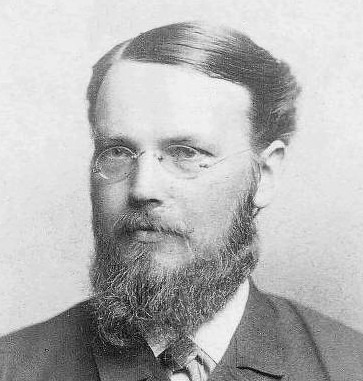
Birth of Johannes Lepsius (December 15, 1858)

In the fateful years that led to the end of the Ottoman Empire, Johannes Lepsius was the one personality who tried to raise Armenian issues among German public, especially a voice of alarm to document the genocide of 1915-1916 from its very beginning.

Protestant missionary and Orientalist, Lepsius was above all a humanist. He was the younger son of Carl Richard Lepsius, the founder of Egyptology in Germany. His siblings also become prominent personalities in science and art. He was born on December 15, 1858, in Berlin (Germany). He studied mathematics and philosophy in Munich, and earned a Ph.D. in 1880. He was trained as a Lutheran pastor and was on the board of the Syrian Orphanage of Jerusalem from 1884-1886, where he met his wife Margarethe Zeller. She passed away in 1898, leaving six children.

Lepsius became a missionary in the Ottoman Empire in the 1890s. He came to public attention when he traveled in disguise to gather evidence on the Turkish massacres of 1895-1896. His report on the pogroms, Armenien und Europa (1896), stirred considerable controversy and significantly affected international relations with the empire. He also helped found the Deutsche Orient Mission (German Mission for the Orient) to operate orphanages and schools for Armenian children.

Lepsius traveled to Constantinople in 1915 and gathered information about the ongoing massacres and deportations, while he unsuccessfully appealed to Turkish authorities to stop them. He also tried to lobby the German government. In 1916 he published privately Bericht über die Lage des armenischen Volkes in der Türkei (Report on the Situation of the Armenian People in Turkey; French edition, 1918), where he meticulously documented and condemned the annihilation. Lepsius was forced to secretly publish the report due to official military censorship. However, Lepsius managed to distribute more than 20,000 copies after the book was forbidden and before censorship was enforced. In the second edition, Der Todesgang des armenischen Volkes (The Death Walk of the Armenia People), he included an interview with Enver Pasha, held in June 1915.

Shortly after the publication of his report, Lepsius left Germany for the Netherlands to escape pursuit by the German police, and later brought his family. In June 1917 he resigned from the Deutsche Orient Mission because of disagreements with the committee. In an article published in 1925 in the magazine of the Mission, Der Orient, he disclosed his collaboration with the German Foreign Office, of which even top officials were unaware: “Soon after I resigned from my old mission, a circle of political friends suggested that I should stay in Holland and report regularly on the Dutch and British press. It becomes clear that I was serving patriotic interests from the fact that, during my three-year stay in Holland, I sent press reports daily to the military office of the Foreign Office, which were sent to Berlin through the embassy courier in The Hague.”


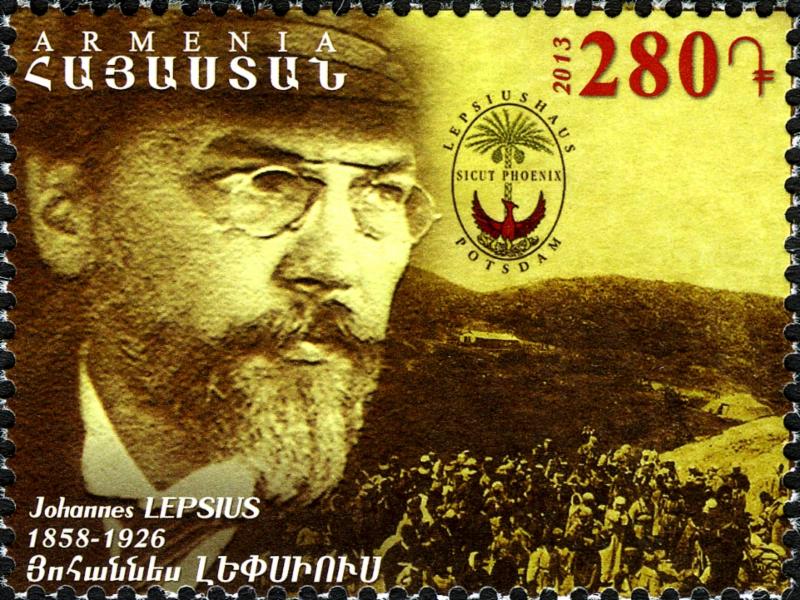
A stamp in homage to Johannes Lepsius issued in Armenia in 2013

The German responsibility in the Armenian genocide was a subject often discussed during World War I. In the first months following the defeat of Germany and Turkey, Germany faced allegations of war crimes in Europe and sought to avoid responsibility for crimes within Turkey. For his part, Lepsius was committed to unearthing the most comprehensive record possible of the genocide. Thus, while still in the Netherlands, he readily agreed to the foreign ministry's offer to let him prepare a series of books based on formerly secret German diplomatic records, beginning with a volume documenting German activities in Turkey and Armenia between 1914 and 1918: Deutschland und Armenien 1914–1918: Sammlung diplomatischer Aktenstücke (Germany and Armenia 1914–1918: Collection of Diplomatic documents) (1919). Although German officials claimed that they had released a copy of the complete record, they actually supplied Lepsius with censored versions of many documents. A systematic comparison of the published documents with the originals revealed that there were a great number of abridgements or even forgeries, and that important references to German policy with regard to the genocide, joint responsibility, as well as involvement of German officers in repressions against the Armenians had been systematically held back. In addition, the names of important Turkish people involved in the genocide were generally omitted. In the end, Lepsius’ collection presented frank and detailed evidence of the Young Turks’ genocidal campaign, but tended, unwittingly, to absolve Germany of any responsibility. The uncensored version of the German documents was published in 2005 by researcher Wolfgang Gust (also available in English translation).

In June 1921 Lepsius testified for the defense in the trial of Soghomon Tehlirian, the assassin of former Turkish Interior Minister Talaat Pasha.

Lepsius passed away on February 3, 1926, in Merano (Italy). Franz Werfel, who used his publications for his novel The Forty Days of Musa Dagh, portrayed him as a “guardian angel of the Armenians.” The “Johannes Lepsius Archive,” initially collected and organized by theologian Hermann Goltz at the Martin Luther University of Halle-Wittenberg, was moved in 2011 to the newly opened Lepsius House Museum, set in the house in Potsdam where Lepsius lived from 1908 and 1925, which also functions as a research center for genocide studies. A street in Potsdam is named after the German humanist, as well as a school in Yerevan.