Showing posts with label Byzantium. Show all posts

Saturday, August 17, 2019

Death of Hrach Bartikian (August 17, 2011)

It is an interesting fact that some of the leading experts of Armenian history and philology in Soviet times were repatriates, sometimes taking advantage of their knowledge of the main language of the field (Greek, Arabic, Turkish, Farsi, and the like). Their expertise not only made a significant contribution to their particular areas of interest, but also helped in the formation of the next generations of scholars.

One of such experts was Hrach Bartikian. He was born on July 7, 1927, in Athens (Greece), the son of Mikayel Bartikian, a philologist and journalist. He studied at a local Armenian school and then at a Greek high school, from which he graduated in 1945. The next year he moved to Armenia with his family, like many other members of the Greek-Armenian community, during the repatriation movement of 1946-1948.

Bartikian would pursue higher education at Yerevan State University. He graduated with honors from the Faculty of History in 1953 and continued post-graduate studies at the Institute of History of the Academy of Sciences of Armenia, but in Leningrad (nowadays St. Petersburg), under the guidance of well-known academician Hovsep Orbeli. In 1958 he defended his doctoral dissertation, “Sources for the Study of the History of the Paulician Movement,” at the State University of Leningrad. It was published in Yerevan three years later in Russian. In 1971 he would defend his second doctoral dissertation, “The Byzantine Epic Digenis Akritas and Its Significance for Armenian Studies.”

Meanwhile, from 1957 until 2010 he worked at the Institute of History of the Academy as junior researcher (1957-1961), senior researcher (1961-1980), and head of the medieval history section (1980-2010). He passed away on August 17, 2011, at the age of eighty-four.

For almost half a century, Hrach Bartikian’s name would become synonymous with Armeno-Byzantine studies in Armenia. Besides some 150 scholarly articles, he also published seventeen books, including the Armenian translations, with study and notes, of various noted Byzantine historians (Procopius of Caesarea, Constantine Porphyrogenitus, John Scilitzes, Teophanos the Confessor, and others), the Armenian translation of the Byzantine epic Digenis Akritas, the Modern Armenian version of Armenian medieval historian Mateos Urhayetsi’s Chronicle, and a collection of documents, Greek Archival Documents about Armeno-Greek Relations during the First Republic (1918-1920) 

Bartikian started his scholarly career with the study of the Paulician movement, a sectarian manifestation born in Armenia, which had a second life in the Byzantine Empire, and then he devoted himself to the study of Armeno-Byzantine relations during and after the time of the Bagratuni dynasty, making a substantial contribution in the field. He was also a prolific researcher of epigraphic inscriptions and seals.

The historian was also a well-known specialist of the relations of the Armenian Kingdom of Cilicia and Byzantium. For this reason, he was invited to participate in the 1993 conference on Cilicia organized by the Armenian Prelacy and spearheaded by Archbishop Mesrob Ashjian, Prelate, of blessed memory.

Hrach Bartikian’s extensive and erudite scholarly production would earn him many scientific accolades. He was elected member of the Academy of Athens (1980), the Tiberina Academy of Art, Literature, and Sciences of Rome (1987), and the Academy of Sciences of Armenia (1996). He was decorated with the medal of Mesrop Mashtots of the Academy of Sciences of Armenia, the medal of Aristoteles of the University of Salonica (1981), and the Prize of the President of Armenia (2005), the latter for his three-volume Armenian-Byzantine Studies.

Saturday, July 14, 2018

Death of St. Nerses Lambronatsi (July 14, 1198)

St. Nerses Lambronatsi is remembered as one of the most significant figures in Armenian ecclesiastical and literary history for his relatively short, but prolific life during the time of the Armenian Kingdom of Cilicia.

He was born in 1153 in the fortress of Lambron. His baptismal name was Smpad. He was son of Oshin II, the lord of Lambron, from the Hetumian family, and nephew of Catholicos Nerses IV Shnorhali (1166–1173). His mother Shahandukht, from the Pahlavuni family, was a descendant of St. Gregory the Illuminator. He received his early education at the monastery of Skevra, which was continued at the superior school of Hromkla, the seat of the Catholicosate of All Armenians, under the supervision of his uncle Nerses and his successor Grigor III Tgha (1173-1193). Ordained in 1169 at the age of 16 by his uncle, who gave him his own name, he was elevated to episcopacy and consecrated Archbishop of Tarsus in 1175, at the age of twenty-two.

Nerses Lambronatsi was well versed in sacred and profane sciences and had an excellent knowledge of Greek, Latin, Syriac, and probably Coptic. He preferred to lead a life of meditation and solitude, and since he did not feel ready to take upon his administrative duties, he visited the monasteries in the region of Antioch to get acquainted with monastic life among non-Armenians and to satisfy his scholarly appetite. During this period, he translated The Rule of St. Benedict, The Dialogues of Pope Gregory the Great, and the Book of Revelation (1179).

Nerses contributed to the promotion of literacy, helped schools and libraries, monasteries and churches, and made a substantial donation towards the purchase and copy of manuscripts. He ordered or personally copied many ancient Armenian manuscripts, including the oldest and best extant copy of Gregory of Narek’s Book of Tragedy, which he ordered in 1173.

Returning to his pastoral duties, Nerses became a champion of the cause of Church unity. By unity he did not mean absorption of one Church by the other, and he remained a staunch defender of the Christological position of the Armenian Church. He has been regarded as a forerunner of the current ecumenical movement. In 1179 he attended the Council of Hromkla, where he may have delivered his address on unity, the Synodal Discourse, considered a masterpiece of eloquence and style. He was a first-rate orator, and his other speeches, homilies, panegyrics, and orations have literary merit. In 1195 he wrote Letter to King Levon, a spirited piece of polemical literature, where he rejected the accusations of having taken a pro-Byzantine position.

Nerses Lambronatsi is one of the most prolific writers in Armenian literature, and famous as a writer and translator. His Commentary on the Mystery of the Mass is still one of the best commentaries on the Eucharist in the Armenian Church. He also wrote other interpretive works, including commentaries on Cyril of Jerusalem’s various writings and others on the Psalms, the books of Solomon, the Book of Daniel, the Gospel of Matthew, et cetera, and a biography in verse of his uncle St. Nerses Shnorhali.

Lambronatsi was also interested in ecclesiastic and secular law. The lack of a written code of civil law led him to translate various legal works from Greek and Syriac that were used until the adoption of the Code of Law of Mekhitar Gosh. A multifaceted author, he also wrote the letter and music of twenty-three liturgical hymns ( sharagan ).

The union of the Armenian and Greek Churches was decided upon but never consummated due to the death of Emperor Manuel I Comnenus in 1180. Manuel's successors abandoned the negotiations and persecuted the Armenians. However, Levon II, Prince of Cilicia, made a last effort in 1197. He sent an embassy to Constantinople led by Nerses, which engaged in discussions on religious questions with Emperor Alexius III Angelus and Patriarch George II, without success.

Prince Levon wanted to secure the title of king for himself and sought the support of Pope Celestine III and of Emperor Henry VI of the Holy Roman Empire. The Pope sent Conrad, Archbishop of Mainz, to Tarsus, where Levon was crowned king on January 6, 1198.

Six months later, on July 14, 1198, Nerses Lambronatsi, who had spent his last years at the court as secretary, palace counsel, and translator, suddenly passed away in the monastery of Skevra while he was giving a sermon and was buried there. He was later canonized by the Armenian Church.

His students dedicated songs to him and wrote biographical sketches of his life. One of those students, Grigor Skevratsi, characterized his teacher in the following terms: “He emanated like a source, advanced like a river, and expanded like a sea.” 

Friday, July 21, 2017

Death of Stepanos Siunetsi (July 21, 735)

Stepanos Siunetsi was a very prolific medieval author and translator, as well as an important figure of the Armenian Church.

He was the son of Sahak, a clergyman, and was probably born in 688. His father was an archpriest in Dvin, the capital of Armenia and seat of the Catholicosate, where Stepanos studied. Afterwards, he received his religious education first in the monastery of Makenetsots (province of Gegharkunik, near Lake Sevan) and then in the famous seminary of Siunik, directed by Movses Kertogh. He was consecrated archimandrite and replaced the latter as director of the seminary. A few years later, he returned to Dvin, where he continued his intellectual activities. 

In 710 Stepanos traveled abroad to pursue what we would today call “graduate studies” in Athens and Constantinople, where he studied Greek and Latin literature, learned musical theory, and deepened his knowledge in theology and literary scholarship. He also produced translations from the works of several authors, such as Pseudo-Dionysus the Areopagite, Nemesius of Emesa, and Gregory of Nyssa.

Around 720 he returned to Armenia and settled in Dvin, where he continued his literary and ecclesiastic work. He wrote biblical commentaries and, above all, church hymns, which entered the Sharaknots (collection of hymns) of the Armenian Church and are praised for their musical quality and freshness. He also wrote a commentary of Dionysus Thrax’s Art of Grammar. During his preaching, he met Prince Sembat Bagratuni, a staunch defender of the resolutions of the Council of Chalcedon, who quarreled with Stepanos and subjected him to persecution and death threats. The ecclesiastic escaped to Constantinople in disguise and found refuge near an Orthodox hermit to continue his theological and philosophical studies.

In 728 he went to Rome and brought the texts of several Fathers of the Church (Cyril of Alexandria, Athanasius of Alexandria, and Epiphanius of Cyprus) to Armenia. Catholicos David I received him with joy for this important discovery, which was coincidental with the death of Bishop Hovhan of Siunik. Stepanos was consecrated bishop and prelate of Siunik. Upon the request of the Catholicos, he wrote the work Commentary on the Four Evangelists, which is the only work of the old school of commentary of Siunik that has reached us in a twelfth-century manuscript discovered by Bishop Garegin Hovsepiants, future Catholicos of the Holy See of Cilicia, in 1917. (The Commentary was recently translated into English by Dr. Michael B. Papazian.)

Historian Stepanos Orbelian (thirteenth century) described Stepanos Siunetsi as a spiritual pastor of “sweet severity” and a careful guide, who both “nurtured the children with the milk of Christ” and “stroke the vicious ones like a sword.” Unfortunately, his severity towards the vicious ones cost him his life. 

In 735 the prelate made a pastoral tour of the twelve districts of Siunik, where he redecorated the churches, preached the word of the Gospel and advised and punished sinful people. He visited the town of Moz in the valley of Yeghekis. He admonished  a woman of lewd behavior to repent, but she continued her indecent ways, and the bishop excommunicated her. Seeking revenge, the woman persuaded her lover to kill Stepanos while he slept. He was unable to carry it out, and the woman took the sword and killed Stepanos. The unfortunate ecclesiastic was buried in the church of St. Christopher.

According to Stepanos Orbelian, a strong earthquake hit the area for forty days in the same year, causing the death of some 10,000 people. Because of the lamentations of the population (symbolized by the interjection vay/վայ in Armenian), the region was said to have taken the name of Vayots Dzor (valley of the vays). The catastrophe was ascribed to a divine punishment for the tragic murder of Stepanos Siunetsi. His body was reburied in the monastery of Tanahat, where a small chapel was built over his tomb. In 1273-1279 the chapel was replaced by a magnificent church.

Stepanos’ sister, Sahakdukht, was also a teacher and the first Armenian female composer known as such. She renounced to worldly life and carried the life of a hermit in a cave at the gorge of Garni, near the ruins of the homonymous pagan temple. She taught children and composed church hymns.

Tuesday, January 10, 2017

Birth of Nicholas Adontz (January 10, 1871)


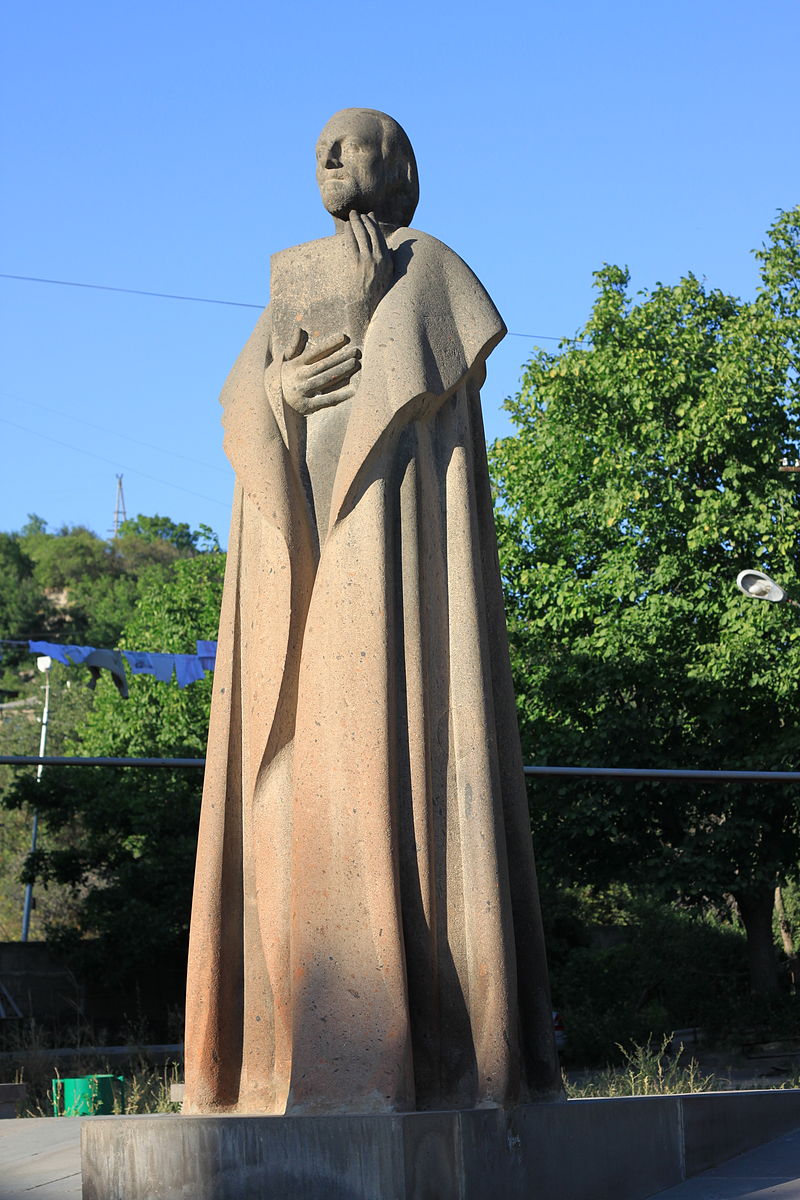
A statue of Nicholas Adontz near the
museum of history of Sisian, named after him.

Nicholas Adontz was one of the most influential Armenian historians and philologists in the first half of the twentieth century at an international level. Poet Mushegh Ishkhan, one of his students in Brussels, wrote about him: “Nicholas Adontz seemed to be Armenia, the embodiment of its better qualities, its human image. He was the Armenian man, in the traditional, modern, and noble sense of the word; the living fortress of Armenian ancient culture, heroic history, beauty, and virtues of the Armenian character, who knows how to instill joy and pride.”

He was born Nikoghayos Ter-Avetikian in the village of Brnakot (Sisian, region of Siunik/Zangezur) on January 10, 1871. He traced his roots to Ter Avetik, a priest who was a close ally to David Bek, the hero of the Armenian rebellion of Siunik from 1722-1728. He studied for a very short period at the monastic school of Tatev and then at the Gevorgian Seminary of Holy Echmiadzin (1882-1891). He interrupted his studies and moved to Tiflis, where he studied Russian for a year and then entered the second year of the Russian gymnasium (1892-1894). He adopted the last name Adontz, derived from an ancestor of their family, to avoid being called “Ter-Avetikov.”

Adontz’s dreams to pursue higher education were fulfilled thanks to the sponsorship of benefactor Alexander Mantashov (Mantashiants). He first studied at the School of History and Philology of the University of St. Petersburg (1894-1899), where he had among his teachers the famous Orientalist Nikolai Marr. After graduating from the university, Mantashov sponsored his three-year sojourn in Europe, where Adontz studied and researched in Munich, Paris, Oxford, and Venice. In 1902, once the agreement was finished, he returned to St. Petersburg, where he passed his examinations for a master’s degree. Then he went to the Caucasus, where he studied the manuscripts of Echmiadzin and Tiflis. He also published a journal of Armenian literature, Banber grakanutian yev arvesti (1903-1904).

In 1908 Adontz published Armenia in the Period of Justinian in Russian, a remarkable study on the social and political structures of early medieval Armenia. He defended it as his master’s thesis in April 1909 and was appointed assistant professor at the University of St. Petersburg. His second monograph in Russian, Dionysus of Thrace and the Armenian Commentators, published in 1915, was an edition, along with the Greek original, of the early medieval Armenian translation of the grammar of Dionysus Thrax (a Greek grammarian of the second century B.C.), based on 30 manuscripts. He defended it as his Ph.D. dissertation and was appointed professor of the chair of Armenian and Georgian philology in 1916.

Also in 1916, Adontz first participated in the works of an archaeological expedition to Mush and Erzerum, and later headed an expedition to Van, at a time when Western Armenia was mostly occupied by Russia. In 1917-1918 he became honorary trustee of the Lazarian College of Moscow. After the October Revolution, he successfully fought to avoid that the Armenian manuscripts from Echmiadzin, and the Armenian libraries of the Lazarian College and the Moscow churches were incorporated into the “Alexander III” library of Moscow. In the spring of 1920 the Russian Academy of Sciences decided to send him abroad in a six-month study trip. The Armenian scholar did not wait for the documentation to be completed and left Russia on his own.

Adontz, who had actively participated in political activities about the Armenian Question in the 1910s, first settled in London and published the book Towards the Solution to the Armenian Question (in English, 1920). The next year he moved to Paris, where he had been named consultant for the Armenian National Delegation. He married singer Olga Hovnatanian and lived in the French capital for the next ten years. He continued publishing and lecturing, supported by benefactor Abraham Ghoukassiantz.

In 1931 an Armenian Studies chair, funded by millionaire Robert Werner; Eva-Zarouhi Nubar, Countess d’Arschot Schoonhoven (daughter of Boghos Nubar Pasha, founding president of the Armenian General Benevolent Union), and the Armenian community of Brussels, was founded within the Center of Oriental Studies at the Free University of Brussels (Belgium). Adontz was appointed to the position. He would teach an array of courses on Classical and Modern Armenian, as well as subjects of Armenian and Byzantine Studies, while continuing his publications and lectures.

However, Brussels did not offer him peace of mind. After a long illness, his wife passed away in 1935. He was deeply affected by this loss, and its impact took a strong toll from his body. In May 1940 Belgium was occupied by Nazi Germany. Adontz’s health problems became worse and he was diagnosed with pulmonary tuberculosis. He was admitted to a hospital in October 1941 and passed away on January 27, 1942. He was buried in the cemetery of Brussels. Adontz left more than 120 scholarly articles and monographs on the history and literature of Medieval Armenia, Armenian-Byzantine relations, Armenian-Greek philology, mythology, religion, and linguistics, in Armenian, Russian and French. In the last years of his life, he worked on a history of Armenia from the beginnings to the twentieth century, but he only completed the first volume (Paris 1946; Armenian translation, 1972). A collection of his most important Armenian-Byzantine studies was published in French (1965). The importance of his works for scholarship is evidenced by the fact that Armenia in the Period of Justinian was translated into English and published by historian Nina Garsoian in 1970 with revisions, a bibliographical note, and appendices (an Armenian translation appeared in 1987), while Dionysus of Thrace and the Armenian Commentators was published in French in 1971. Many of his works have appeared in Armenian since 1989, including a six-volume collection published in Yerevan from 2006-2011.