Monday, February 13, 2017

Birth of Catholicos Nerses V (February 13, 1770)


Catholicos Nerses V Ashtaraketsi was one of the most relevant names of the Armenian Church in the nineteenth century. The future Catholicos was born Toros Shahazizian on February 13, 1770. He graduated from the Seminary of Echmiadzin and was consecrated celibate priest. He soon reached an influential position among the clergy.
At the beginning of the nineteenth century, the Southern Caucasus was under the domination of Persia. Russia was pressing towards the south with the aim of occupying the region. Bishop Nerses had an active participation in the Russo-Persian war of 1804-1813 and the Russo-Turkish war of 1806-1812. This contributed to the strengthening of the political relations of the Holy See and the Russian government.
In 1814, Nerses, elevated to the rank of archbishop, was designated primate of the diocese of Georgia and moved to Tiflis, which was already under Russian rule. He took measures towards the renewal of the diocese and the conversion of Tiflis into an Armenian intellectual center. In 1824 he opened the first Armenian lyceum of the Southern Caucasus, which was called Nersisian after him and became an education center for the next hundred years. He also founded a print shop in the school and set the grounds for editorial work.
Archbishop Nerses Ashtaraketsi established close relations in Tiflis, the capital of the viceroyalty of the Caucasus, with Russian authorities and leaders. In 1816 he was decorated with the order of St. Anna in first grade. The Armenian community of Georgia, thanks to his tireless efforts, became an influential driving force in Armenian political and cultural life.
The prelate organized groups of Armenian volunteers that participated in the Russo-Persian war of 1826-1828 along the Russian army. He personally participated in the liberation of Yerevan, Etchmiadzin, and Sardarabad. After the occupation of Yerevan in 1827, he was designated member of the provisional administration of the region. He also had an important role in the organization of Armenian immigration from Persia into Eastern Armenia. In January 1828 Nerses Ashtaraketsi was decorated again, this time with the order of Alexander Nevski.
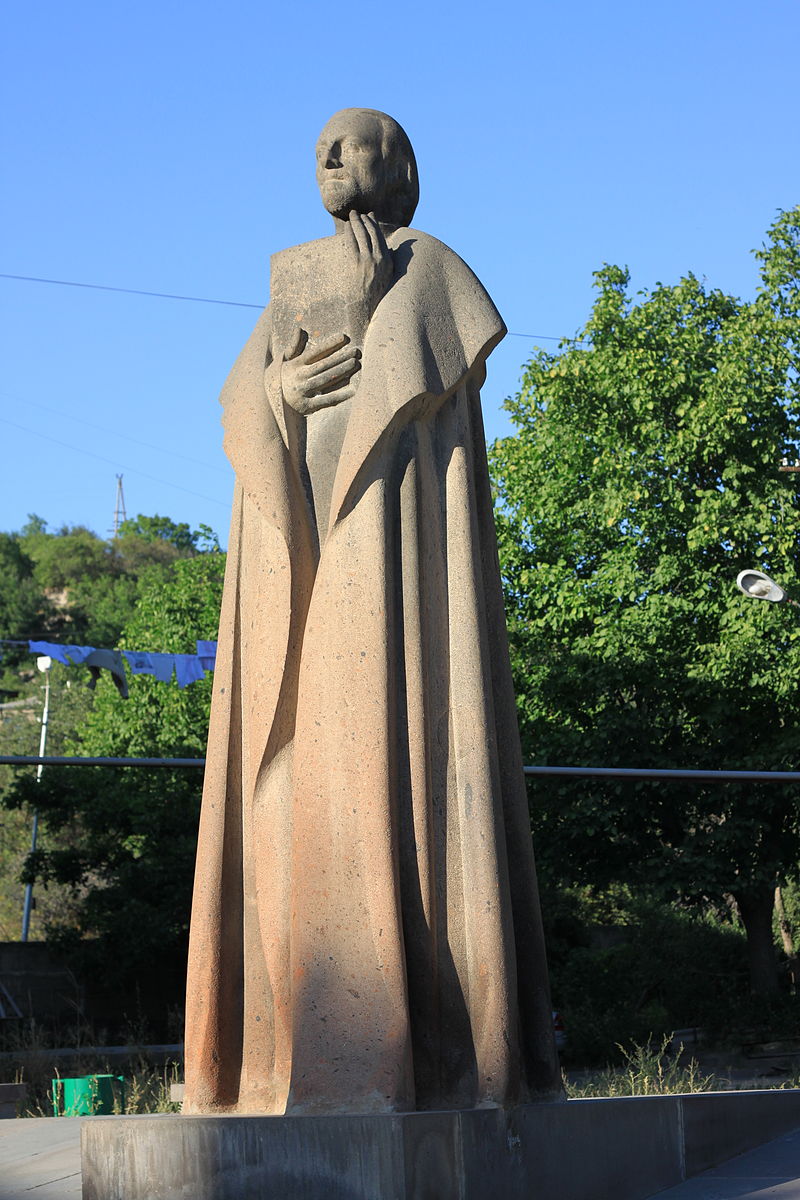
Statue of Nerses V in Ashtarak
His push for Armenian autonomy under Russian protection, however, was not well received by the imperial government. General Ivan Paskevich, commander of the Russian army in the Caucasus, persecuted autonomist leaders. The prelate was charged with a series of fake accusations, such as persecuting the Muslim population, enriching Holy Etchmiadzin on account of the royal treasury, and organizing an Armenian army. He was dismissed from his position in the administration and sent away from the Southern Caucasus in May 1828 with a designation as primate of the diocese of Nor Nakhichevan and Besarabia. Nerses Ashtaraketsi’s exile of sorts ended in 1843, when he succeeded Hovhannes VIII as Nerses V, Catholicos of All Armenians. He returned to Etchmiadzin and, despite his advanced age, he managed to be an active player in the public field, as well as in education and economy of the Holy See. The illusions of Armenian autonomy had left place to his support for a conservative current that fought to maintain the national spirit and traditional order of the Armenian Church. He pursued a prudent policy in his relations with the Russian state, but also with the Ottoman Empire and Persia. His encyclicals and writings continuously exhorted the Armenians to avoid steps that could displease the authorities. His efforts contributed to normalize the relations with the Armenian Patriarchate of Constantinople.
Nevertheless, he fought to restore the rights of the Catholicos that had been diminished by the Polozhenye, the statute of the Armenian Church issued by the Russian government in 1836. Catholicos Nerses often took a defiant attitude and left aside the statute. He did not fill the vacant positions of the Synod created by the Polozhenye, limited the attributions of the primates, and zealously controlled the incomes belonging to the Holy See. He also prepared a new statute of the Church, which centralized the administration in the hands of the Catholicos.
Nerses V passed away in Tiflis at the age of 87 in 1857 on the day of his birth, February 13. A school and a street in his birthplace, Ashtarak, have been named after him, and his statue was placed in the central square of the town in 2009.

Saturday, February 4, 2017

Death of Hakob Manandian (February 4, 1952)

Historian and philologist Hakob Manandian was one of the most respected names in the field of Armenian Studies during the first half of the twentieth century.
He was born in Akhaltskha (Javakhk, nowadays Georgia) on November 22, 1873. He had his elementary education in the Karapetian School of his birthplace (1880-1883). In 1883, after the death of his father, he moved to Tiflis, where he continued his education in the first gymnasium of the city.
In 1893 twenty-years-old Manandian went to Germany to pursue higher education. He entered the School of Philosophy of the University of Jena, while following the courses of Oriental studies and linguistics at the universities of Leipzig and Strasbourg. He studied with the best scholars of the time, including well-known names in Armenian Studies like Heinrich Hübschmann and Heinrich Gelzer. In 1897 he defended his doctoral dissertation in philosophy  about the identity of the author of History of Aghvank, the earliest source on the history of the region between Artsakh and the right bank of the river Kura. This dissertation was published in Leipzig in the same year (Beiträge zur albanischen Geschichte, 1897).
Manandian moved to St. Petersburg in the fall of 1897 and finished his studies in one year at the School of Oriental Studies of the local university with a diploma of doctoral candidate in Armenian and Persian philology. After a year spent researching Armenian manuscripts in the libraries and museums of London, Paris, Vienna, and Venice, in 1899 he accepted an offer from the Gevorgian Seminary of Holy Etchmiadzin and started a thirty year career as an educator. He became a teacher of classical Greek and German, Greek literature, and history of philosophy until 1905. Meanwhile, he was one of the editors of the short-lived Armenological journal Zeitschrift für armenische Philologie (1901-1903).
In 1905 Manandian settled in Tiflis, where he taught German, Armenian, Armenian literature, English literature, and other subjects in the Russian gymnasia (1905-1907) and the Nersesian School (1906-1907). In 1909 he graduated from the Law School of the University of Dorpat (Tartu, nowadays Estonia). In the 1910s he moved to Baku and taught at the Popular University (1911-1913) and the Commerce School (1915-1919).
When Armenia declared its independence in 1918, Manandian was not only a seasoned teacher with two decades of experience, but also a well-reputed scholar. He was invited by the University of Yerevan in December 1919 (officially opened in Alexandropol) and became acting dean of the School of History, Linguistics, and Literature. After the establishment of the Soviet regime, he remained at the university. In the next ten years, he became rector (1921-1922), dean of the schools of Oriental Studies and History and Literature (1921-1924), head of the chair of Armenian history (1921-1925), and professor of the same chair (1925-1931). He left the university in 1931 to devote himself to scholarship.
Among his more than 150 works in Armenian, Russian, and German, Manandian produced a string of Armenian books in the last twenty-five years of his life, which cemented his lasting contribution to Armenian Studies. The first one was his monograph The Philhellenic School and Its Periods of Development (Armenian, 1928), followed by The Trade and Cities of Armenia in Relation to Ancient World Trade (Russian, 1930, translated by Nina Garsoian into English, 1965), Weights and Measures in the Oldest Armenian Sources (Armenian, 1930), Feudalism in Ancient Armenia (Armenian, 1934), The Main Roads of Ancient Armenia (Armenia, 1936), and others. However, his main works in this regard were the seminal monograph Tigranes II and Rome (Armenian, 1940, translated by George Bounoutian into English, 2007), and his masterwork, the three-volume Critical Survey of the History of the Armenian People (Armenian, 1945, 1952, 1957). The latter was meant to be a comprehensive history of Armenia from the sixth century B.C. to the sixteenth century A.D., which nevertheless remained unfinished.
Manandian’s scholarly and educational work was recognized in his lifetime. He became an emeritus scientific figure of Armenia in 1935, and received a second doctorate in history, without defense of a dissertation, in 1938. A year later, he was elected member of the Academy of Sciences of the Soviet Union and, in 1943, member of the newly founded Academy of Sciences of Armenia. His contribution was also recognized by the Soviet Armenian government with the order of the Red Banner of Labor. He passed away on February 4, 1952. A street in Yerevan was named after him in the 1990s.

Monday, January 30, 2017

Birth of Paris Marie Pishmish (January 30, 1911)

Like her colleague Alenoush Terian in Iran, Paris Marie Pishmish played an instrumental role to establish the study of modern astronomy in Mexico.
She was born Marie Soukiassian in Constantinople on January 30, 1911. Her father Soukias was the grandson of Mikayel Pishmish, a member of the amira class that had an important role as the Armenian commercial and professional elite in the Ottoman Empire, who was Minister of Finance under Sultan Abdul-Aziz (1861-1876), and her mother Filomen was the niece of Mateos Izmirlian, Patriarch of Constantinople (1894-1896) and Catholicos of All Armenians (1908-1910). The high society environment where she was raised put high priority in education.
She first attended an Armenian elementary school and continued on to the Üsküdar American Academy for Girls, an elite private school in Constantinople, where she discovered her interest in mathematics. Pishmish became one of the first women to graduate in Mathematics and Classical Astronomy from the Science School of Istanbul University in 1933.
Pishmish taught mathematics and astronomy at the Getronagan High School in Istanbul, and worked as an assistant at the Observatory throughout her doctoral program in astronomy. She received her doctorate in 1937. Her advisor, the noted German astronomer Erwin Freundlich, arranged a postdoctoral fellowship for her at Harvard in 1938. After the beginning of World War II, she became an assistant astronomer at Harvard College Observatory (HCO), a position she held from 1939 to 1942. She also met Felix Recillas, a Mexican student of mathematics sent to study astronomy, whom she married in 1941. Mexico was building a modern astronomical observatory in Tonantzintla, near Puebla, inaugurated in 1942 with an international congress. Felix and Paris Pishmish-Recillas also attended. The thirty-one-year-old Armenian scientist, the first professional astronomer that Mexico had, was hired to work at the observatory, where she worked until 1946.
She had two children, Elsa Recillas Pishmish (an astrophysicist) and Sevin Recillas Pishmish (a mathematician, 1943-2005), and spent two years with internships in Princeton and in Chicago. In 1948 Pishmish accepted a position as an astronomer at the Tacubaya National Observatory, affiliated with the National Autonomous University of Mexico in Mexico City, where she taught for over fifty years. The astrophysics program that she founded in 1955 has remained in place at the National Autonomous University of Mexico and her critical role in enriching the field of astronomy has helped to fashion Mexico into a center for astrophysical research.
Pishmish was involved in all stages of the development of astronomical studies in Mexico, from writing the first modern astronomy and astrophysics curricula to acquiring the best, state-of-the-art technology. She was also devoted to teaching and training new generations of scientists, some of whom went on to make great contributions to astronomy and other scientific disciplines. The university recognized her efforts with the award of a Ph.D. honoris causa and the Science Teaching Prize.
Many of her most notable accomplishments are in her research. Over the course of her career, she wrote over 120 scientific articles on various aspects of astrophysics and the study of galaxies. Twenty-two stellar clusters bear her name.
She also fostered the publication of Mexican astronomical journals. From 1966 to 1973 she edited Boletín de los Observatorios de Tonantzintla y Tacubaya. She was also founding editor of Revista Mexicana de Astronomía y Astrofísica since its inception in 1974.
Pishmish was also an active member of the International Astronomic Union, and headed the Mexican delegation to all its general assemblies from 1958 to 1994. Her career was also marked by research trips, conferences and visiting professorships at universities and research institutions around the world, including the Byurakan Observatory in Armenia, where she was invited by the eminent Soviet Armenian astronomer Viktor Hambardzumyan. In her memoir, Reminiscences in the Life of Paris Pişmiş: A Woman Astronomer (1998, co-written with her grandson Gabriel Cruz González), she recounted with particular enthusiasm her visits to Armenia where she delighted in being able to communicate in her native language.
Marie Paris Pishmish passed away on August 1, 1999. Her positive influence turned her into an effective role model, especially for young women. At the time of her death, 25 per cent of the eighty astronomers working at the Astronomy Institute of the National Autonomous University were women.

Sunday, January 22, 2017

Birth of Haig Patigian (January 22, 1876)

The growth of the Armenian American community in the early twentieth century included the names of various artists. One of them was the sculptor Haig Patigian.
He was born in Van on January 22, 1876. His parents were teachers at the American Mission School. His father Avedis was interested in visual art too, and was the first person to take up photography in Van. However, when the Turkish authorities noticed him walking around the city and photographing picturesque scenery, they accused him of selling photos of Van’s fortifications to the Russians. He fled to the Caucasus in 1888 and traveled to the United States, settling in Fresno, California. In 1891 he was able to send for his family. His wife Marine and their five children (a sixth would be born in America) were able to make their way to Fresno. He eventually would purchase a ranch and set to produce raisins.
On the left, Haig Patigian with the bust of Helen Mills; on the right, the model herself
Haig Patigian started as an apprentice at a sign painter’s shop in 1893 and opened his own shop three years later. His older brother Horen (Khoren) was making a living in San Francisco as a newspaper illustrator, and he decided to make the leap himself in 1898. In 1900 he was hired as an illustrator for the evening newspaper SF Bulletin. His brother died a year later from pneumonia, followed by his mother several months later. He was devastated by their loss, and of his youngest sister, who passed away from tuberculosis.
Patigian, who had been engaged in self-teaching, turned this string of losses into a work of art. He created his first real statue in plaster, “The Unique Soul,” depicting a male nude fighting despair. Its display at the Press Club was immediately celebrated in local newspapers. In 1905 he was hired to create a statue of the late President William McKinley for the town of Arcata, in northern California. The completed statue was in a foundry and was prepared for shipping on April 18, 1906, the day of the Great Earthquake and Fire of San Francisco. Although he was informed that the foundry had been destroyed, and his statue along with it, he found out that some mechanics had saved it. The statue was unveiled in Arcata on July 4, 1906. In October, Patigian sailed to Paris, where he remained for a year. He re-created his work, “Ancient History,” which had been destroyed in the studio in San Francisco’s Fire, and entered it in the 125th official exposition of the Salon des Artistes Francais.
Patigian returned to San Francisco in late 1907 and married Blanche Hollister, the daughter of a landowner and Sacramento legislator, in the New Year of 1908. They would have two children, Hollis and Haig Jr. In the same year, he joined the Bohemian Club, of which he served as president from 1920-1922 and 1947-1948. He was assigned the sculptural works for the Palace of Machinery at the Panama Pacific International Exposition in 1914, and also produced a bronze monument for Dr. Chester Rowell (1844-1912), founder of the Fresno Republican, former mayor of Fresno and California state senator, which was placed on Courthouse Square in Fresno. Rowell was sympathetic to immigration and especially Armenians—who had a hard time in Fresno—and had been the Patigian family’s doctor. During the Armenian Genocide, Patigian created a medal for the Armenian Relief Fund.
Already a household name in American sculpture, Patigian received steady commissions after 1914, which included his “Lincoln,” in front of the City Hall of San Francisco (1928, see picture to the left), considered one of the best in the United States, and his bust of President Hoover that entered the White House in 1929, among many other works mostly spread throughout San Francisco and other places in California. During World War II, when metal for statues was scarce, he turned to watercolors. Many of his works during this period are in private collections, as well as clubs in San Francisco.
His wife Blanche passed away on September 10, 1950. Nine days later, on September 19, Haig Patigian, who already had a heart condition, followed her.

Sunday, January 15, 2017

Birth of Osip Mandelstam (January 15, 1891)

Osip Mandelstam, a famous Russian poet, was the author of one of the finest essays on Armenia in the twentieth century. His sojourn in the country helped him end his poetic block during the years when Stalinism was in the rise and his own life would end in a concentration camp.
Mandelstam was born to a wealthy Jewish family on January 15, 1891, in Warsaw (Poland), then part of the Russian Empire. Soon after his birth, his father, a leather merchant, was able to receive a dispensation that freed their family from the Pale of Settlement—the western region of the empire where Jews were confined to live—and allowed them to move to the capital Saint Petersburg.
Mandelstam entered the prestigious Tenishevsky School in 1900 and published his first poems in the school almanac (1907). After studying in Paris (1908) and Heidelberg (1909-1910), he decided to continue his education at the University of St. Petersburg in 1911. Since Jews were forbidden to attend it, he converted to Methodism and entered the university the same year, but did not obtain a formal degree. He formed the Poets’ Guild in 1911 with several other young poets. The core of this group was known by the name of Acmeists. Mandelstam wrote The Morning of Acmeism, the manifesto for the new movement, in 1913. In the same year, he published his first collection of poems, The Stone.
Mandelstam married Nadezhda Khazina (1899-1980) in 1922 in Kiev (Ukraine) and moved to Moscow. In the same year, he published in Berlin his second book of poems, Tristia. Afterwards, he focused on essays, literary criticism, memoirs, and small-format prose. His refusal to adapt to the increasingly totalitarian state, together with frustration, anger, and fear, took their toll and by 1925 Mandelstam stopped writing poetry. He earned his living by translating literature into Russian and working as a correspondent for a newspaper.
In 1930 Nikolai Bukharin, still one of the Soviet leaders and a “friend in high places,” managed to obtain permission for Osip and Nadezhda Mandelstam for an eight-month visit to Armenia. During his stay, Osip Mandelstam rediscovered his poetic voice and was inspired to write both poems about Armenia and an experimental meditation on the country and its ancient culture, Journey to Armenia (published in 1933): “The Armenians’ fullness with life, their rude tenderness, their noble inclination for hard work, their inexplicable aversion to anything metaphysical and their splendid intimacy with the world of real things – all of this said to me: you’re awake, don’t be afraid of your own time, don’t be sly.” As poet Seamus Heaney, winner of the Nobel Prize of Literature, wrote in 1981, “The old Christian ethos of Armenia and his own inner weather of feeling came together in a marvelous reaction that demonstrates upon the pulses the truth of his belief that ‘the whole of our two-thousand-year-old culture is a setting of the world free for play.’ Journey to Armenia, then, is more than a rococo set of impressions. It is the celebration of a poet’s return to his senses. It is a paean to the reality of poetry as a power as truly present in the nature of things as the power of growth itself.”
Mandelstam was ferociously criticized in Pravda for failing to notice “the thriving, bustling Armenia which is joyfully building socialism” and for using “a style of speaking, writing and travelling cultivated before the Revolution,” meaning that it was counterrevolutionary.
In November 1933 Mandelstam composed the poem “Stalin Epigram” (also known as “The Kremlin Highlander”), which was a sharp criticism of the climate of fear in the Soviet Union. He read it at a few small private gatherings in Moscow. Six months later, in 1934, he was arrested and sentenced to exile in Cherdyn (Northern Ural), where he was accompanied by his wife. After he attempted suicide, the sentence was reduced to banishment from the largest cities in European Russia, following an intercession by Bukharin. The Mandelstams chose Voronezh.
This proved a temporary reprieve. In 1937 the literary establishment began to attack Mandelstam, accusing him of anti-Soviet views. In May 1938 he was arrested and charged with “counter-revolutionary activities.” He was sentenced to five years in correction camps in August. He arrived to a transit camp near Vladivostok, in the far east of Russia, and died from an “unspecified illness” on December 27, 1938.
Like so many Soviet writers, after the death of Stalin, in 1956 Mandelstam was rehabilitated and exonerated from the charges brought again him in 1938. His full rehabilitation came in 1987, when he was exonerated from the 1934 charges. Nadezhda Mandelstam managed to preserve a significant part of her husband’s work written in exile and to hide manuscripts. She even worked to memorize his entire corpus of poetry, given the real danger that all copies of his poetry would be destroyed. She arranged for the clandestine republication of Mandelstam’s poetry in the 1960s and 1970s, and also wrote memoirs of their life and times, the most important being Hope against Hope (1970).

Tuesday, January 10, 2017

Birth of Nicholas Adontz (January 10, 1871)


A statue of Nicholas Adontz near the
museum of history of Sisian, named after him.

Nicholas Adontz was one of the most influential Armenian historians and philologists in the first half of the twentieth century at an international level. Poet Mushegh Ishkhan, one of his students in Brussels, wrote about him: “Nicholas Adontz seemed to be Armenia, the embodiment of its better qualities, its human image. He was the Armenian man, in the traditional, modern, and noble sense of the word; the living fortress of Armenian ancient culture, heroic history, beauty, and virtues of the Armenian character, who knows how to instill joy and pride.”

He was born Nikoghayos Ter-Avetikian in the village of Brnakot (Sisian, region of Siunik/Zangezur) on January 10, 1871. He traced his roots to Ter Avetik, a priest who was a close ally to David Bek, the hero of the Armenian rebellion of Siunik from 1722-1728. He studied for a very short period at the monastic school of Tatev and then at the Gevorgian Seminary of Holy Echmiadzin (1882-1891). He interrupted his studies and moved to Tiflis, where he studied Russian for a year and then entered the second year of the Russian gymnasium (1892-1894). He adopted the last name Adontz, derived from an ancestor of their family, to avoid being called “Ter-Avetikov.”

Adontz’s dreams to pursue higher education were fulfilled thanks to the sponsorship of benefactor Alexander Mantashov (Mantashiants). He first studied at the School of History and Philology of the University of St. Petersburg (1894-1899), where he had among his teachers the famous Orientalist Nikolai Marr. After graduating from the university, Mantashov sponsored his three-year sojourn in Europe, where Adontz studied and researched in Munich, Paris, Oxford, and Venice. In 1902, once the agreement was finished, he returned to St. Petersburg, where he passed his examinations for a master’s degree. Then he went to the Caucasus, where he studied the manuscripts of Echmiadzin and Tiflis. He also published a journal of Armenian literature, Banber grakanutian yev arvesti (1903-1904).

In 1908 Adontz published Armenia in the Period of Justinian in Russian, a remarkable study on the social and political structures of early medieval Armenia. He defended it as his master’s thesis in April 1909 and was appointed assistant professor at the University of St. Petersburg. His second monograph in Russian, Dionysus of Thrace and the Armenian Commentators, published in 1915, was an edition, along with the Greek original, of the early medieval Armenian translation of the grammar of Dionysus Thrax (a Greek grammarian of the second century B.C.), based on 30 manuscripts. He defended it as his Ph.D. dissertation and was appointed professor of the chair of Armenian and Georgian philology in 1916.

Also in 1916, Adontz first participated in the works of an archaeological expedition to Mush and Erzerum, and later headed an expedition to Van, at a time when Western Armenia was mostly occupied by Russia. In 1917-1918 he became honorary trustee of the Lazarian College of Moscow. After the October Revolution, he successfully fought to avoid that the Armenian manuscripts from Echmiadzin, and the Armenian libraries of the Lazarian College and the Moscow churches were incorporated into the “Alexander III” library of Moscow. In the spring of 1920 the Russian Academy of Sciences decided to send him abroad in a six-month study trip. The Armenian scholar did not wait for the documentation to be completed and left Russia on his own.

Adontz, who had actively participated in political activities about the Armenian Question in the 1910s, first settled in London and published the book Towards the Solution to the Armenian Question (in English, 1920). The next year he moved to Paris, where he had been named consultant for the Armenian National Delegation. He married singer Olga Hovnatanian and lived in the French capital for the next ten years. He continued publishing and lecturing, supported by benefactor Abraham Ghoukassiantz.

In 1931 an Armenian Studies chair, funded by millionaire Robert Werner; Eva-Zarouhi Nubar, Countess d’Arschot Schoonhoven (daughter of Boghos Nubar Pasha, founding president of the Armenian General Benevolent Union), and the Armenian community of Brussels, was founded within the Center of Oriental Studies at the Free University of Brussels (Belgium). Adontz was appointed to the position. He would teach an array of courses on Classical and Modern Armenian, as well as subjects of Armenian and Byzantine Studies, while continuing his publications and lectures.

However, Brussels did not offer him peace of mind. After a long illness, his wife passed away in 1935. He was deeply affected by this loss, and its impact took a strong toll from his body. In May 1940 Belgium was occupied by Nazi Germany. Adontz’s health problems became worse and he was diagnosed with pulmonary tuberculosis. He was admitted to a hospital in October 1941 and passed away on January 27, 1942. He was buried in the cemetery of Brussels. Adontz left more than 120 scholarly articles and monographs on the history and literature of Medieval Armenia, Armenian-Byzantine relations, Armenian-Greek philology, mythology, religion, and linguistics, in Armenian, Russian and French. In the last years of his life, he worked on a history of Armenia from the beginnings to the twentieth century, but he only completed the first volume (Paris 1946; Armenian translation, 1972). A collection of his most important Armenian-Byzantine studies was published in French (1965). The importance of his works for scholarship is evidenced by the fact that Armenia in the Period of Justinian was translated into English and published by historian Nina Garsoian in 1970 with revisions, a bibliographical note, and appendices (an Armenian translation appeared in 1987), while Dionysus of Thrace and the Armenian Commentators was published in French in 1971. Many of his works have appeared in Armenian since 1989, including a six-volume collection published in Yerevan from 2006-2011.

Saturday, December 31, 2016

Birth of Nairi Zarian (December 31, 1900)

Many Soviet Armenian writers who flourished in the first half of the twentieth century were survivors of the Armenian Genocide. Several of them were from Van, and one of them, famous and infamous for different reasons, was Nairi Zarian.

His actual name was Hayastan Yeghiazarian. He was born on December 31, 1900, in the village of Kharagonis, in the province of Van. He was a fifteen-year-old boy in 1915, among the survivors of the first phase of massacres in the surroundings of Van around the time of the self-defense of the city against Ottoman regular forces (April-May 1915). Van was saved by the arrival of Russian troops and Armenian volunteers, which were ordered to retreat in July. The Armenian civilians took refuge in the Caucasus and young Hayastan was among them. From 1915-1921 he lived in orphanages of Dilijan and Yerevan, where he received his initial education. He published his first poem in 1918.

He met poet Yeghishe Charents around this time, who shortened his long name. “Hayastan” became the poetic name for Armenia, “Nairi,” and abbreviated “Yeghiazarian” into “Zarian.” Nairi Zarian graduated from the Diocesan School of Yerevan and, in 1927, from the School of History and Literature of Yerevan State University. In 1933 he finished graduate school in literature at the State Academy of Art Sciences of Leningrad (now St. Petersburg).

Zarian entered the literary fray in the 1920s, while Soviet Armenian literature confronted the winds of modernization brought by “proletarian” literature, which would be soon crushed by state control that would lead to Stalinism. He published his first collection of poetry in 1926. In the 1920s and 1930s he was on the editorial board of several short-lived literary periodicals, such as Grakan dirkerum and Grakan serund, and his literary positions would be characterized by their intense politicization. He first became noted by his poem “Rushan’s Rock” (1930), which depicted “the socialist resistance of an Armenian village.”

After the rise of Stalin to power, Zarian aligned himself entirely with power. His poem “Stalin” earned him the Lenin State Prize in 1935. After the death of Aghasi Khanjian, First Secretary of the Communist Party of Armenia, in July 1936, he set himself to denounce the so-called “nationalist and Trotskist” tendencies of some of Khanjian’s protégés and the best writers of the time, like Charents, Axel Bakunts, and many others, in an article published a week later. He concluded it with the following statement: “The real, true way for the literature of Soviet Armenia is the road of Socialist Realism, the road of people’s brotherhood and a society without classes, the road of Lenin and Stalin.” Zarian’s active role in 1936-1937, when the main names of the Soviet Armenian intelligentsia were arrested, shot, or sent to Siberia with trumped-up charges of conspiratorial or ideological deviation, earned him powerful criticism after the death of Stalin (1953). Nevertheless, in 1937 he was arrested, but he saved himself by writing the novel Hatsavan about the collectivization of the economy, executed by Stalin in the early 1930s.

During World War II, when nationalism was briefly conflated with Soviet patriotism, Zarian followed through with works of this kind. Some of his patriotic poems, as well as his play in verse Ara the Beautiful (1944), earned him recognition. He was president of the Armenian Writers Union from 1944-1946, and from 1951-1958 he was deputy of the Soviet Supreme of Armenia and president of the Armenian Committee for the Defense of Peace.

Nevertheless, after 1953 he gradually lost his influence in literary life, although he continued publishing books of poetry and prose until the end of his life. In a meeting of the Writers Union about the cult of personality during Stalin’s time, the writers debated violently, with accusations flying from one to the other. Nairi Zarian reportedly said in his own defense: “Even Isahakian gave tribute to Stalin’s glorification.” Avetik Isahakian (1875-1957), who was president of the Union since 1946 and a well-known name in Armenian poetry, responded: “Comrade Nairi just spoke about tribute. I suggest: let’s take back those tributes from my writings and Nairi’s writings, and see what remains underneath…” 


Nairi Zarian passed away in Yerevan on July 11, 1969. A street in the Armenian capital carries his name.