Sunday, January 26, 2014

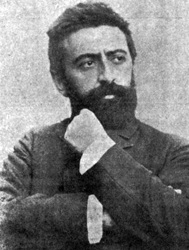
Birth of Paruyr Sevak - January 26, 1924

Paruyr Sevak was the successor of Yeghishe Charents in Soviet Armenian poetry, and was widely admired during his lifetime. Both had a short life, tragically cut off, although under different circumstances.

Paruyr Ghazarian was born in the small village of Chanakhchi (now Zangakatun), in the district of Ararat, in Armenia. His parents were humble villagers. He attended the local school and graduated with honors in 1940, moving to Yerevan to study at the philological faculty of Yerevan State University. He had written his first poetry at the age of thirteen, and three of his poems appeared for the first time in the monthly Sovetakan Grakanutiun in 1942, with the signature Paruyr Sevak. The editor of the monthly, Ruben Zarian, was a literary scholar fond of Rupen Sevag, a fine poet who had been killed together with Taniel Varoujan in the Armenian genocide, and thought of perpetuating his memory by using his name as a pseudonym for the 18-year-old beginner.

Sevak graduated in 1945 and started postgraduate studies of Armenian literature at the Manuk Abeghian Institute of Literature of the Armenian Academy of Sciences. However, he had to cut his studies short in 1948. In the same year, he published his first book, The Immortals Command. He married linguist Maya Avagian and had a son, Hrachia.

In 1951 he moved to Moscow to study at the Maxim Gorky Institute of World Literature. There he met his future second wife, Nelly Menagharishvili, who would give him two more sons, Armen and Koriun. He graduated in 1955 and worked there from 1957-1959 as an instructor at the chair of Literary Translation.

Meanwhile, during the eight years of ostracism, he had managed to publish poetry, translations, and literary criticism in the Soviet Armenian press. His three books of poetry, however (Uncomprising Intimacy, 1953; Love Road, 1954; and With You Again, 1957), failed to unleash his entire potential. His long poem of 1959, The Unsilenced Belfry, dedicated to the life of Komitas Vardapet, made his name instantly known by Armenian readers throughout the world. The book earned him the National Prize of Armenia in 1966.

Sevak went back to Yerevan in late 1959, and returned to the Manuk Abeghian Institute of Literature as a scholarly researcher from 1963-1971. He served as secretary of the Board of the Writers Union of Armenia from 1966-1971. In 1968 he was elected a representative at the Supreme Soviet of the Armenian SSR.

During the sixties, Sevak became the most powerful voice of Armenian poetry, and his articles on literary and public issues were widely read. In 1963 he published a groundbreaking collection of poetry, The Man in the Palm, which marked the return to the path of modernism that had been closed since the death of Charents a quarter of a century before.

In 1966 the poet and scholar defended a doctoral dissertation on the life and work of Sayat-Nova, the popular troubadour of the eighteenth century. After a defense of his dissertation that lasted four hours, his work was so highly esteemed that he was conferred with a second doctorate degree when the dissertation was approved and published in 1969.

Paruyr Sevak was not a dissident, but, as many intellectuals under the Soviet regime, some of his work clashed with censorship. This was particularly notorious when his last collection of poetry, Let There Be Light, was printed in 1969, but because of censorship issues, the entire edition of 25,000 copies remained undistributed until his death on June 17, 1971, in a car crash, while driving back to Yerevan. His wife also died in the crash, and only his two children survived. The circumstances of the accident were suspicious, and they have given fodder to lingering doubts about foul play by the Soviet regime.

The 47-year-old poet and his wife were buried in the backyard of his home, in Chanakhchi, which later became a museum. The village was renamed Zangakatun after the independence of Armenia in honor of his poem The Unsilenced Belfry (Անլռելի զանգակատուն, Anlreli zangakatun).

Sunday, January 19, 2014

Birth of Dikran Khan Kelekian - January 19, 1868

The Assyrian reliefs of Genii and King Assurnasirpal, as well as the winged bull and lion from the ninth-century B.C. Palace of Assurnasirpal, which are today at the Metropolitan Museum in New York, were originally acquired in 1932 by John D. Rockefeller. The seller was a notable collector and dealer of Islamic art, Dikran Kelekian, who by that time was working together with his son, Charles (1900-1982). The representation of the head of Tutankhamun, seen in the museum's collection and on the cover of the catalogue of the Egyptian Wing, was acquired from the Kelekians in the late 1940s.

Dikran Kelekian was born in Caesarea (Kayseri) to a family originally from Persia. He was the son of an Armenian banker. He studied ancient Near Eastern history at Robert College (now Bogazici University) in Constantinople (now Istanbul) and continued his education in Paris. He set himself up, with his brother Kevork, in the antiquities business in Constantinople at the age of 24 and soon acquired a reputation as a knowledgeable collector and dealer specializing in Islamic art, particularly pottery. He came to the United States in 1893 as a commissioner for the Persian Pavilion at the Chicago World’s Fair. He soon established shops in New York (Le Musée de Bosphore), Paris, London, and Cairo, where he and his brother flourished as vendors, selling works of art and antiquities.

In 1902 the Shah of Persia elevated Kelekian to the title of khan and appointed him to serve as the Persian consul in New York. His gallery became the headquarters of the consulate. He served as a member of the jury for the Paris World’s Fair of 1900, and was the general commissar of the Persian Empire at the Louisiana Purchase Exposition de Saint Louis, also known as St. Louis World’s Fair (1904), mounting a large display of his wares, accompanied with an illustrated catalogue. He eventually became an American citizen. His collections were featured in a number of international exhibitions in Paris, Munich, London, and New York over the decades. He is the author of Potteries of Persia, Being a Brief History of the Arts of Ceramics in the Near East (1909).

Kelekian was a member of the Central Board of Directors of the Armenian General Benevolent Union and in 1909 he funded an AGBU orphanage bearing his name in Deort Yol (Cilicia) for Armenian refugees fleeing the Adana massacres.

Regarded as the “dean of antiquities” in the United States, he acted as an adviser to great American collectors, including Henry Walters, George Blumenthal, and Louisine and Henry Havemeyer. Art critic Roger Fry described him as having an "omnivorous acquisitiveness." In his book The Kelekian Collection of Persian and Analogous Potteries, 1885-1910 (1910), he stated his aesthetic views. For him, Persian art was a precursor of avant-garde art, which he defended with passion. Along with Coptic, Paleo-Christian, or Persian art, his gallery promoted the works of Matisse, Rouault, Derain, and Picasso in the United States.

Kelekian’s Cairo gallery served as a base for purchasing Egyptian antiquities, including Late Antique, commonly referred to as Coptic, textiles. In 1943 Milton Avery painted Kelekian in his gallery, posed before a Coptic textile. The “School of Paris” rendered homage to him with an exhibition of twenty-one portraits at the Gallery Durand Ruel (1944).

At age 83, Kelekian died in January 1951, when he fell from the twenty-first floor of the St. Moritz hotel in New York. His son first took the succession, and then the business was maintained by his granddaughter Nanette until 1990. Sometime in the early twentieth century, Kelekian had assembled an album of approximately one thousand textile fragments, which she donated to the Metropolitan Museum of Art in 2002.

Thursday, January 9, 2014

Birth of Sergei Parajanov - January 9, 1924

"Everyone knows that I have three Motherlands. I was born in Georgia, worked in Ukraine and I'm going to die in Armenia," declared Sergei Parajanov, one of the most talented names of Soviet cinematography. Despite running afoul of censorship and repression, his original cinematic style made significant contributions to Ukrainian, Armenian, and Georgian cinema.

Parajanov was born in Tiflis, capital of Georgia, to Iosif Parajanov and Siranush Bejanova. At the age of 21, he traveled to Moscow (1945), enrolled in the directing department of VGIK (the All-Union State Institute of Cinematography), the oldest film school in Europe, and studied under directors Igor Savchenko and Aleksandr Dovzhenko.

In 1948 he was convicted of homosexual acts and sentenced to five years in prison, but was released under an amnesty after three months. In video interviews, friends and relatives contested the truthfulness of the charges. In 1950 he married his first wife, Nigyar Kerimova, from a Muslim Tatar family, in Moscow. She converted to Eastern Orthodox Christianity to marry him, and was murdered by her relatives because of her conversion a year later. After her murder, he left Russia for Kiev (Ukraine), where he produced three documentaries and several narrative films. He married his second wife, Svetlana Sherbatiuk, in 1956. Their son Suren was born in 1958 and they divorced in 1962.

In 1964 Parajanov abandoned socialist realism (the state-sanctioned art style in the Soviet Union) and directed Shadows of Forgotten Ancestors, a poetic film over which he had complete creative control. He would later dismiss all films he had directed before 1964 as “garbage.” This film won numerous international awards and turned him into a cult director.

He later left Kiev and moved to Armenia. He filmed Sayat Nova in 1968, choosing the life of the famous eighteenth-century Armenian troubadour as the apparent subject, but the film was immediately banned. He re-edited his footage and renamed the film The Color of Pomegranates. The film won much praise internationally and increased his popularity as a venerated director.

 A still from the movie The Color of Pomegranates.
His projects were systematically banned or scraped between 1965 and 1973 because of charges of deviation from accepted artistic norms, until Parajanov was sentenced to five years in a hard labor camp in Siberia on charges of homosexuality and pornography in December 1973. Many international artists protested on behalf of the filmmaker without effect, including Federico Fellini, Michelangelo Antonioni, Jean-Luc Godard, François Truffaut, Luis Buñuel, Françoise Sagan, Yves Saint Laurent, Andrei Tarkovsky, and others. He obtained an early release in December 1977.

The imprisoned filmmaker produced a large number of miniature doll-like sculptures and some 800 drawings and collages, many of which are currently displayed at the Parajanov Museum in Yerevan.

Sergei Parajanov, Tarkovsky's Night Bird, 1987, Collage, Mixed Media.
After his return from prison to Tbilisi, he could not pursue his career. He was imprisoned again in February 1982 on charges of bribery and freed nine months later, although his health was seriously compromised after the harsh conditions of the Siberian camp.

After his release, the support of Georgian intellectuals allowed him to produce his last two films, which received critical and public acclaim: The Legend of Suram Fortress (1984) and Ashik Kerib (1988). He moved back to Armenia, where he started a project that would remain unfinished: his final film, The Confession. Its original film footage was assembled and released as Parajanov: The Last Spring, by his close friend Mikhail Vartanov in 1992.

Sergei Parajanov passed away on July 20, 1990, in Yerevan, a victim of cancer, at the age of 66. He left a legacy of sixteen films (feature and documentary), and ten unproduced screenplays and projects, including films on the Armenian legend of Ara the Beautiful and the Armenian epic David of Sassoun.

Tuesday, January 7, 2014

Death of Vahan Terian (January 7, 1920)

At the beginning of the twentieth century, the lyrical production of Vahan Terian marked a new era in Eastern Armenian poetry. He was hailed by Hovhannes Tumanian as the most original poetical voice of his age, and his works closed the first period of modern Armenian literature.

His real name was Vahan Ter Grigorian. He was born on January 28, 1885 in the village of Gandza, in the region of Akhalkalak (Djavakhk), today in Georgia. He departed to Tiflis, where his elder brothers were studying, in 1897. He learned Russian with them and prepared to enter the Lazarian Oriental Institute in Moscow. He was admitted in 1899 at the Institute, where he met and befriended several young people who would become important public and literary figures, such as Alexander Miasnikian, Poghos Makintsin, Tsolak Khanzadian, and others. He graduated in 1906 and entered Moscow University.

However, Terian had already engaged in revolutionary activities, as a sympathizer of the Bolshevik branch of the Russian Social Democratic Party. Soon after entering the university, he was arrested and briefly jailed in the prison of Butirka in Moscow.

After his liberation, he published his first volume of poetry, Twilight Dreams, in Tiflis (1908). It was very well-received by readers and critics for its originality. Sadness and pain, spring and love, the homeland and its fate were some of the markers of his poetry, which became the basis for many songs still interpreted today. He married Susanna Pakhalova in 1911 and published the first volume of his collected poetry, titled Poems, in 1912, where he gathered also works written after 1908. He left Moscow University in 1913 and went to St. Petersburg University, where he majored in Oriental Studies.

His wife died in 1916 after giving birth to a daughter, who did not survived. In the same year, the first signals of tuberculosis appeared in the poet. Terian went to the Caucasus for treatment, but the first Russian Revolution (March 1917) prompted him to abandon the region and return to St. Petersburg. He became a close collaborator to Stalin, the future strongman of the Soviet Union.


Terian participated actively in the second Russian Revolution of November 1917, led by the Bolshevik Party, and the civil war that ensued. As Armenian representative at the Commissariat of Nationalities led by Stalin, he participated actively in the writing of the decree on Western Armenia that was issued in January 1918 and proclaimed its freedom of self-determination. As a member of the Central Executive Committee of Soviet Russia, Terian was assigned a mission in Turkestan in late 1919, but his illness had gotten worse and the poet was forced to stop in Orenburg, in Russia, where he passed away on January 7, 1920 at the age of 35. His daughter Nvard, fruit of his relationship with Anahit Shahinjanyan, was born posthumously, in April 1920.

The memory of the poet has been evoked in July in his birthplace with a “Day of Terian Poetry” since 1967, which gathers thousands of admirers every year.
Tomb of Vahan Terian at the Komitas Pantheon in Yerevan

Wednesday, January 1, 2014

Founding of Hantes Amsorya - January 1, 1887

The two oldest Armenian periodicals of the world have been published since the nineteenth century and belong to the Mekhitarist Congregation. The first one is Pazmaveb (Բազմավէպ), founded in 1843 in Venice, and the second one is Hantes Amsorya (Հանդէս Ամսօրեայ), founded in 1887 in Vienna. We should note that the Congregation, founded by Mekhitar of Sebastia in 1701 and established in the island of San Lazzaro, in Venice (Italy), in 1717, suffered a division in 1771 and a second branch settled in Vienna (Austria) in 1811. The two branches reunited in 2001 under a single authority with headquarters in San Lazzaro, although the two Mekhitarist monasteries continue their activities.

Father Arsen Aydinian (1825-1902), who was abbot of the Vienna congregation from 1866 until his death, was most famous as the author, in 1866, of a grammar of Modern Armenian which set the grounds for the development of Western Armenian as a literary language. However, he was also the founder of Hantes Amsorya. The name of the journal simply means “Monthly Review.”

The journal succeeded two previous periodicals published by the Viennese monks, Dzanotutiunk vajarakidutian (“Notes of Commerce,” 1819) and Yevroba (“Europe,” 1847-1863). Between 1887 and 1894 it had general educational purposes, but starting in 1895 it became the flagship publication of Armenian Studies in the world until the foundation of the Armenian Academy of Sciences and the Yerevan State University and the publication of regular periodicals of Armenian Studies in the Republic of Armenia. Edited by a member of the Congregation, Hantes Amsorya was initially a monthly (until 1915) and then became bimonthly, quarterly, semi-annual and, since 1980, yearly. Despite the changes in periodicity, it attracted successive generations of Armenian and non-Armenian scholars, who have published articles and lengthy studies in all sorts of disciplines in Armenian, German, English, French, and Italian.

Since the late nineteenth century, most studies first published in Hantes Amsorya have been later reprinted as books in a collection maintained by the Mekhitarist Congregation and called National Library (Ազգային Մատենաշար, Azkayin Madenashar). During the past decade, the journal has been published simultaneously in Vienna and Yerevan.

Saturday, December 21, 2013

Birth of Arpiar Arpiarian - December 21, 1852

Arpiar Arpiarian was not only an influential Armenian writer of the nineteenth century, but also the pioneer of realism in Armenian literature, and, as many of his pioneer, a political activist, to which he ultimately sacrificed his life.

Arpiarian was born aboard a ship. His parents, who were originally from Akn (an Armenian town near the Euphrates River where noted poets like Siamanto and Misak Medzarents were born), were traveling from the Black Sea port of Samsun to Constantinople. The family settled in the suburb of Ortakiugh (Ortaköy), where Arpiarian attended the local Tarkmanchats Armenian School. At the age of fifteen, he was sent to Venice, where he attended the Murat-Raphaelian school of the Mekhitarist Congregation. He studied Armenian language and history with the famous Mekhitarist poet and scholar Ghevont Alishan, and he also became familiar with French and Italian literature.

After his graduation from the school, he returned to Constantinople, where he worked as a bookkeeper and then was offered a secretarial position at the Armenian Patriarchate. However, his true call was journalism and literature.

He started contributing to the newspapers Masis, in Constantinople, and Mshak, in Tiflis. He wrote articles flavored with satire in the latter, under a pen name, about various aspects of Armenian life in Constantinople. He visited the Caucasus in 1884 on the election of Catholicos Makar I and met Grigor Artzruni, the influential editor of Mshak, as well as several famous writers, like Raffi, Perch Proshian, Ghazaros Aghayan, and others. This visit left a lasting impact on his life and outlook. He later became an editor of Masis, along with famous writer and politician Krikor Zohrab. Simultaneously, he launched a daily called Arevelk with the aim of promoting closer links between Western and Eastern Armenians.

Arevelk attracted many writers who became the core of literary realism among Armenians. Arpiarian is considered the founder of that literary movement, which revolutionized Armenian literature. He was the mentor of a generation of Armenian realist writers, such as Dikran Gamsaragan (1866-1940), Levon Pashalian (1868-1943), and, later, Yerukhan (1870-1915).

Politics had already attracted Arpiarian since the early 1880s, and in 1889 he joined the Social Democrat Hunchakian Party, of which he would become one of its main leaders. He was among the chief organizers of the Kum Kapu demonstration in light of Sultan Abdul Hamid II’s treatment of Armenians. Arrested as a revolutionary, he was released in 1891. In that year, he founded and edited a new and very influential daily, Hairenik, which was suppressed by the sultan in 1896.

Arpiarian fled the Hamidian massacres in 1896 to London, where he published two monthly reviews, Mard and Nor Gyank, in the next few years. In the same year, the fracture of the Hunchakian Party began as a result of ideological dissent. He led one of the split factions, the Reorganized Hunchakians (Veragazmial Hunchakian), which rejected the socialist ideology of the party and eventually left it. Bitter partisan quarrels would continue over the next years and Arpiarian would make many enemies among his former comrades.

He traveled to Paris and then to Venice in 1901-1902. In the Italian city, he wrote his most successful and popular work, the novella The Crimson Offering (Կարմիր ժամուց), where he depicted the opposition between the revolutionary youth of the provinces, symbolized by a priest, Der Housig, and the conservative stance of the Armenians of Constantinople, represented by Hairabed Efendi, a trustee of the church where the priest had been called to serve. Arpiarian settled in Cairo three years later, where he edited the literary monthly Shirag.

On February 12, 1908, his political enemies assassinated him while Arpiarian was returning home from the market. His last words were “I am Armenian.” Writing after his death, poet and political activist Vahan Tekeyan (1878-1945) noted: “There were two people inside him, the patriot and the skeptic. The first killed him.”

However, Arpiarian’s name has continued to resonate in Armenian literature more than a hundred years after his death.

Monday, December 16, 2013

Birth of Chahan de Cirbied - December 16, 1772

The Institute Nationale des Langues et Civilisations Orientales (INALCO, National Institute of Oriental Languages and Civilizations), commonly known in French parlance as Langues O’, is an institution of higher education located in Paris, with roots that go to the seventeenth century. It is the direct heir to the Ecole des Jeunes de Langues founded by Colbert, prime minister of Louis XIV, in 1669, and of the Ecole des Langues Orientales Vivantes recreated by the Convention in 1795, shortly after the French Revolution.

Ninety-three languages and civilizations are taught at this institution. One of them is Armenian, and it happens that it has been taught there for 215 years, making INALCO probably the oldest establishment throughout the world that has taught Armenian on a university level. However, its mission is not only to learn about languages, peoples, and cultures on a purely academic level, but to know, in the primary sense of the term, all the others, the interlocutors and testify the richness and diversity of the people of the world.

The roots of the Armenian Chair at the former Ecoles des Langues Orientales Vivantes (School of Living Oriental Languages) are related to Napoleon Bonaparte and to a little-known Armenian writer, Jacques Chahan de Cirbied, whose Armenian name was Hagop Shahan Chrbedian (Յակոբ Շահան Ջրպետեան).

Cirbied was born in Edesa (nowadays Urfa). He had settled in Rome (where he became a priest), in Florence, and in Genoa between 1789 and 1792, and it seems that he met Napoleon somewhere in Italy. He moved to Paris in 1792, and his courses of Armenian were officially announced on December 11, 1798, to commence effectively in 1799. Unfortunately, Cirbied’s knowledge of French was poor, and for this reason his courses had to be temporarily interrupted between 1801 and 1811.

An imperial decree dated February 27, 1812, issued in Moscow, where Napoleon was engaged in the Russian campaign, gave Cirbied the title of professor at the l'École Spéciale des Langues Orientales (Special School of Oriental Languages).

Cirbied published eight books in French between 1811 and 1830. Among them, we mention: La grammaire arménienne (Armenian Grammar, 1811 and 1823), Histoire arménienne (Armenian History, 1818), and Grammaire de Denis de Thrace (Grammar of Denys of Thrace), 1830. He was succeeded in 1827 by his disciple P. E. Vaillant de Florival. He put himself to the service of Russia and was a member of the secret committee created by the governor of Yerevan, I. F. Paskevitch, to elaborate the bylaws that would regulate the relations between the Armenian Church and the Russian Empire (the Polozhenie, which would be issued in 1836). Cirbied passed away in 1834.