Wednesday, December 19, 2012

Death of Grigor Artzruni - December 19, 1892

Grigor Artzruni was one of the most prominent names in Armenian journalism during the nineteenth century. He founded and edited the most important newspaper of Russian Armenians, Mshak. 

He was born in Moscow in 1845, but he moved to Tiflis during his childhood. After studying in the Russian gymnasium of the city, he went back to Russia to continue his higher education in Moscow and St. Petersburg. After graduation, in 1867 he was admitted to the University of Heidelberg (Germany), where two years later he graduated with a Ph.D. in Political Economy and Philosophy. Afterwards, he spent a year in Venice and Vienna, studying Armenian with the Mekhitarist Fathers. He taught in 1870-1871 at the Gayanian Girls Schools, and on January 1, 1872 published the inaugural issue of Mshak, which he would edit until his death.

His newspaper became the most important voice of Armenian progressive thought and a champion of political liberalism. He worked towards the introduction and the absorption of the ideas of European liberalism, adapting it to Armenian reality. He was an ideologue of freedom and justice, equality of rights, and democracy, at a time when the Russian Empire was going through political upheaval. Artzruni made an important effort to minimize the distances between Eastern and Western Armenians; among the prominent contributors to Mshak were the great Eastern Armenian novelist Raffi (1835-1888), who first published several of his masterpieces in the newspaper, and his Western Armenian colleague Arpiar Arpiarian (1854-1908).

Artzruni’s efforts also turned the cause of the liberation of Turkish Armenians a focus of the activities of Armenians in Russia. The internationalization of the Armenian Question after the Treaty of Berlin (1878) also resulted in the politicization of the Armenian youth and the subsequent creation of the Armenian political parties.

As the editor of Mshak, he played a role in the birth of all three parties: the Armenagan (1885), the Hunchakian (1887), and the Armenian Revolutionary Federation (1890). Mshak’s circle,according to Kristapor Mikayelian, one of the founders of the ARF, had a central role in the creation of the Federation of Armenian Revolutionaries (Hay Heghapokhakanneri Dashnaktsutiun), a union of all revolutionary groups, which became the forerunner of the party. Novelist and playwright Shirvanzade (1858-1935), who was not a sympathizer of the ARF, wrote the following in his memoirs:
“The young group surrounding Artzruni set the foundations of the ARF. The main forces were Dr. Hovhannes Loris-Melikian, Kristapor Mikayelian, Simeon Zavarian, Martiros Shatirian, Kostandin Khatisian, Levon Sargsian, Gabriel Mirzoyan, and a few others, whose names I have forgotten. 

“. . . Those two [Mikayelian and Zavarian] came to visit Grigor Artzruni and exchanged information. That group, together with a few bourgeois, organized the twenty-fifth anniversary of Grigor Artzruni’s journalistic activities, and turned that celebration into a sort of prelude to the ARF.

“The ARF was organized with Grigor Artzruni’s knowledge and sponsorship, but without his immediate participation. Artzruni feared endangering the existence of Mshak, which was above everything else for him. Realizing that people wanted to use his popularity to raise money, he did not believe very much in the sincerity of their friendship.”

Grigor Artzruni died in Tiflis at the age of 47. His burial was a national event throughout the Caucasus. Russian authorities even tried to block the ceremonies. The police made an effort to contain the thousands in the funeral procession away from the main thoroughfares of Tiflis. After his internment (December 27, 1892), there were incidents with the police and dozens of Armenians were arrested and imprisoned.

Friday, December 7, 2012

Beginning of the Armeno-Georgian War - December 7, 1918

One of the many conflicts which the first Republic of Armenia had to confront was the short, but crucial Armeno-Georgian war.

Relations between Armenians and Georgians had been strained for a long time. Georgians had resented Armenian role in the country during Russian rule. The largest concentration of Armenian urban population in the Transcaucasus was in Tiflis. The fact, among others, that the mayors of the Georgian capital in the last decades of Russian domination had been Armenian (one of them was Alexander Khatisian, a future Prime Minister of the independent Armenian Republic) did not fare well with the native elite.

After the Russian Revolution, Georgians played their own cards in the attempt to safeguard the existence of Georgia vis-à-vis Ottoman Turkish advance, and at times, they had allied with Muslims during the short-lived Transcaucasian Republic of April-May 1918 and left Armenians alone. In June 1918, shortly after the declaration of independence of both countries, the districts of Lori, Javakhk, and Borchalu had been, until 1917, part of the governorship of Tiflis within the viceroyalty of the Caucasus. Georgian troops entered Lori, which had a 75% Armenian population, in order to forestall an Ottoman advance on Tiflis. Turkish forces started to withdraw after the signature of the Armistice of Mudros (October 31, 1918), which marked the defeat of the Ottoman Empire in World War I.

Georgia laid claim to Lori and Akhalkalak, both of which were populated overwhelmingly by Armenians. Georgian ambition to annex these territories flouted pre-independence agreements made by the major national forces in the Caucasus—Armenians, Georgians and Tatar-Azerbaijanis—to mark out new state borders in accord with demographic facts and wishes of the majority populations. Georgian ambitions were driven by another equally important domestic consideration. The historical animosity against Armenian economic power in Georgia was seized and nurtured, following independence, to destroy its bastions. The Georgian state had every interest in weakening its Armenian neighbor, which it regarded not only as a competitor over territories, but also as a potential defender of Armenians in Georgia and a contender in the struggle for hegemony over the Caucasus.
 

Georgian exactions in the areas of Lori and Borchalu (plundering the population, confiscating crops, foodstuffs, and property) triggered reaction from the locals. Armenian groups occupied the south of Lori. Full-scale military clashes, starting on December 7, followed attempts by Georgian forces to repress an Armenian uprising protesting misrule and abuse. Five days later, the Prime Minister of Armenia, Hovhannes Kajaznuni, sent the following message to his Georgian colleague, Noy Zhordania:

“The conduct of Georgian troops in Borchalu, in that part of Armenia occupied forcibly by Georgia, has created an intolerable situation. Only the immediate withdrawal of Georgian troops from that region can prevent new bloodshed and lead to the restoration of friendly, lasting relations between Georgia and Armenia. . . . In the event of refusal or evasion on your part, the Armenian government will be obliged to take the necessary measures to protect the citizens of Armenia from the violence and lawlessness of the Georgian troops.”

The logical rejection of this message and the failure of diplomatic options opened the doors of war. Armenian forces, led by General Dro, made substantial gains in the first ten days. By December 25 they had reached positions 30 miles from Tiflis, when the Allied representatives in Tiflis finally intervened to put an end to the meaningless war. Georgians recovered some initiative in the last week of December. Meanwhile, Armenians were subjects to many arrests, expropriations, and bribery in Tiflis and surrounding communities.

The draft British plan established that Georgian troops would remain in Akhalkalak and northern Borchalu, whereas Armenian forces would settle in southern Borchalu, and the British would take positions between the two opponents. This forced Armenians to relinquish their gains during the war. Georgia accepted the plan and the Allies decided to impose it with or without the approval of the government of Armenia. Finally, hostilities stopped on December 31 when the parties agreed to the British-brokered ceasefire. The result of the war was inconclusive, according to historian Richard Hovannisian: “The question remains disputed although the fact that all battles had taken place in lands formerly held by the Georgian army is not. Statistically, the Armenians had suffered fewer casualties than the Georgians and had given less than a hundred prisoners, while they had captured two armored trains, twenty-eight cannons, nearly seventy-five machine guns, two hundred loaded freight cars, and as many as a thousand Georgian prisoners. But even these figures, when appearing to disprove the Georgian boast of a smashing triumph do not in themselves prove a decisive Armenian victory.”

A bilateral peace agreement signed on January 17, 1919, created a neutral zone between both countries along the lines of the British draft. Georgia failed to establish the border line and lost a small section of prewar-controlled land that was reorganized into a neutral zone. The territorial gains of Armenia (a tiny strip of land in the county of Borchalu) were negligible, compared with previous expectations. The conclusion to the war and the final anti-democratic settlement expressed accurately both the balance of forces and the predatory ambitions of the Georgian elites. Armenia, against its will, against the wishes of the local population, and against previously agreed principles of dividing territory according to the democratic wishes of national majorities, was forced to concede the larger part of disputed areas. According to historian Firuz Kazemzadeh,

“The West was treated to a sad spectacle of two peoples, ruled by parties which were members of the Second International and professed peace to be their chief aim, fighting over a few strips of land in the manner of a Germany or a Russia. Those who were called upon to decide the destinies of mankind at Paris could never again trust Georgia or Armenia. The enemies of Transcaucasia's independence were provided with excellent material, on the basis of which they could, and did, argue that Armenia, Georgia, and Azerbaijan ruled by the Dashnaks, the Mensheviks and the Musavatists, were incapable of preserving order and of guaranteeing a peaceful existence to their peoples. Even in Transcaucasia, doubts were raised whether this land could stand on its own feet.”

After the sovietization of Armenia (December 1920) and Georgia (March 1921), the neutral zone was divided between both countries. Thus, the current Armeno-Georgian border was established.

Sunday, December 2, 2012

The Treaty of Alexandropol - December 2-3, 1920

The Armenian-Turkish war of 1920 put the Republic of Armenia on the brink of collapse. It also brought back the very real threat of physical disappearance for the Armenian people. The secret pact signed between the Turkish Great National Assembly led by Mustafa Kemal (Ataturk) and Soviet Russia in August 1920 had ensured the support of Bolshevism to the Turkish insurgents. The latter, unlike the Ottoman legal government, were leading the so-called “war of independence” against Greece in order to overturn the partition of the Ottoman Empire that included the division of current Turkey into different zones of influence and the loss of most of its territories.

Turkish forces commanded by General Kiazim Karabekir had already reached Alexandropol (now Gumri) at the end of November 1920 when a ceasefire was forced upon the Armenian government. On the other side, a small group of Armenian Bolsheviks had crossed the border from Soviet Azerbaijan into Armenia on November 29 and proclaimed Armenia a Soviet republic, appealing for the intervention of the Red Army. The government of the Republic of Armenia, led by Prime Minister Simon Vratzian (who had assumed power on November 25), was forced to choose the lesser of two evils: to turn away the potential annihilation of Eastern Armenians, it decided to relinquish power to the Communists. The change of regime was legalized through the signature of an agreement between the authorities of the Republic of Armenia and Boris Legran, representative of the Russian Soviet Federative Socialist Republic (RSFSR), in the morning of December 2, 1920. It was enforced on the same day at 6 pm. It established that Armenia would become an independent Soviet Socialist republic within the frontiers that had been under the jurisdiction of the government before the Turkish invasion and a revolutionary committee would take power temporarily. On its final session of the same day, the government of the Republic of Armenia decided to resign power. After more than two and half years, the first independence had come to an end.

Alexander Khatisian
The sovietization of Armenia did not end the Turkish menace. Karabekir threatened to resume his offensive unless his terms were accepted. The onerous terms obliged Armenia to renounce the Treaty of Sevres and all claims to Western Armenia and the province of Kars, and to accept temporary Turkish jurisdiction in Nakhichevan, among other issues. Alexander Khatisian, representative of the Republic of Armenia, signed the treaty in the wee hours of December 3. 

However, the Armenian government had already resigned and, therefore, Khatisian had no power whatsoever. On the other hand, Kiazim Karabekir represented the Great National Assembly of Turkey, with headquarters in Ankara, but the legal authority of Turkey, until November 1922, was in the hands of Sultan Mehmed VI and the Ottoman government in Constantinople. Legally, none of the signing parties had any attribution to stamp their signature under the document. Writes Richard Hovannisian: “Denounced and branded a traitor by Soviet and other non-Dashnakist authors, Khatisian justified his action as an exigency measure taken with the knowledge of the new Erevan government and intended to give time for the Red Army to enter Armenia in sufficient numbers to block a further Turkish advance. Realizing that he had not legal jurisdiction, Khatisian hoped that the new Soviet government, with the support of Russia, would repudiate his action and force the Turks to withdraw, at least to the pre-war boundaries.”

The Treaty of Alexandropol was never ratified and was replaced by the treaties of Moscow and Kars (March and October 1921). The latter was signed by the Great National Assembly of Turkey, Soviet Russia, Soviet Armenia, Soviet Georgia, and Soviet Azerbaijan. However, these treaties cannot be recognized as valid according to international law. Mustafa Kemal had not been invested with any powers by the legally recognized Ottoman government, and Soviet Armenia was not a legally recognized state anymore.

Thursday, November 22, 2012

Introduction of the “Dram” as Armenia's Currency - November 22, 1993

The first independent Republic of Armenia (1918-1920) used Russian rubles as currency. The Armenian banknotes, which kept “rubli” (ռուբլի, ruble) as the name of the currency, were designed by painter Arshag Fetvadjian (1866-1947). They were under printing in Europe when Armenia became a Soviet republic in December 1920 and were never put into circulation.

After the second independence, the Central Bank of Armenia was created on March 27, 1993. The new Armenian monetary unit was called dram (դրամ); the name, which means “money” in Armenian, was also the name of the silver coins in circulation during the Armenian kingdom of Cilicia (1199-1375). Interestingly, the word դրամ, pronounced tram, designates “money” in Western Armenian; Eastern Armenian uses the word փող (pogh) to designate “money.” Pogh was also the name of a certain type of copper coins in the Armenian state of Cilicia. 

The devaluation of the Russian ruble (which initially continued as the currency in the former Soviet Union following the collapse of the state) prompted the replacement of old currency by new one, and a flood of worthless old Russian rubles into Armenian forced the introduction of the dram, earlier than anticipated, on November 22, 1993. The initial value was 1 dram = 200 Russian rubles, while 1 American dollar equaled 14 drams. The high inflation of the period 1993-1994 in Armenia depreciated the dram to a value of 1 U$S = 100 AMD.  It reached 420 drams per dollar in March 1995 and stabilized afterwards (450 AMD per dollar in 1997). On November 19, 2012, the exchange rate was 407 dram per American dollar. 

The banknotes issued in 1993-1995 were put out of circulation in 2005. Their value went from 10 to 5,000 drams. This old series, which today only has a historical value, featured different national symbols:  for instance, the 10 dram note showed the Yerevan Central Train Station and the statue of David of Sassoun (across the station) on the obverse and Mount Ararat on the reverse, while the 5000 dram note exhibited the pagan temple of Garni on the obverse and the head of goddess Anahit kept in the British Museum on the reverse.

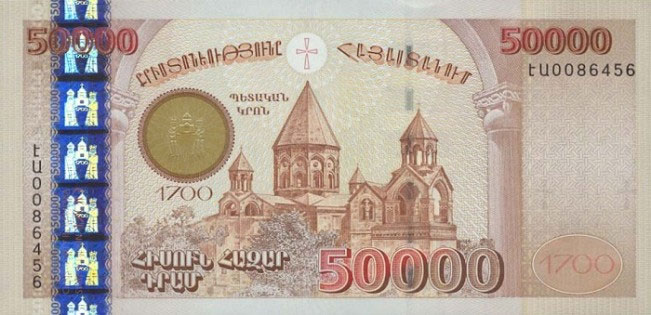
A new series of banknotes, currently in circulation, was issued starting in 1998. The first six values, from 50 to 20,000 drams (the notes of 50, 100, and 500 were later put out of circulation and replaced by coins), featured six figures of twentieth century Armenian culture and an image related to them: Aram Khachaturian, Victor Hambardzumian, Alexander Tamanian, Yeghishe Charents, Hovhannes Tumanian, and Avetik Isahakian. The 50,000 dram banknote was issued in 2001, on the 1700th anniversary of Christianity in Armenia, and featured the cathedral of Holy Etchmiadzin. The highest value, 100,000 dram, pictured King Abgar V of Edessa, who according to tradition received the painting (portrayed alive) of Jesus Christ from St. Thaddeus

Sunday, November 18, 2012

Death of Hovhannes Masehian - November 18, 1931

Hovhannes Masehian (1864-1931) was a Persian Armenian diplomat and writer, who became the foremost translator of Shakespeare into Armenian. He was born in Tehran in 1864. His father, Dzeruni Khan Masehian, was the chief jeweler of Shah Naser al-Din (1848-1896). From 1870 to 1878 he studied at the newly opened Haigazian School in Tehran. Afterwards, he went to Tabriz to continue his studies with his maternal uncle, Andon Khan Yervandian, who was the tutor of the heir prince. After three years of studies, in 1881 he went to Paris where he studied philosophy, law, political economy, and literature at the College de France. 

Masehian returned to Tehran in 1884, where he taught at the Haigazian School and was hired as a translator at the royal court. He traveled to London in 1897 as the chief translator for the Persian delegation sent to participate in the fiftieth anniversary of the coronation of Queen Victoria. Ten years later, he would be the first secretary of another delegation sent to London for the Queen’s sixtieth anniversary. Meanwhile, in 1895 he had been named head of office of the Ministry of Foreign Affairs of Persia. He managed different positions in the ministry until 1901, when he was designated counselor to the Persian ambassador in Berlin. He became chargé d’affairs in 1906 and held the position until his return to Persia in 1911.

By that time, Masehian had also become a household name in Armenian letters. As the official translator of the Shah’s court (he knew some ten languages), he had translated around 30 books into Persian, of which there is no trace. In 1894 he published his first version of Shakespeare’s Hamlet in Tiflis. The famous Eastern Armenian poet, Hovhannes Hovhannisian, wrote, “This translation of Hamlet leaves a very beautiful impression on us; first, because . . . the translator knows his mother tongue very well and uses his knowledge with confidence, an advantage that many of our famous authors and translators may envy; second, because that language is rich and poetic, a necessary condition to translate authors such as Shakespeare.” Other translations followed: As You Like It, King Lear, Romeo and Juliet, and Merchant of Venice. Masehian was unable, however, to publish his translations of Otello, Macbeth, and The Tempest. He continued his work until 1901, when he traveled to Europe as a diplomat; by 1909, he had translated nine Shakespearean plays and had translated anew his unpublished works.

In 1912, after spending a year in Tehran as chief of the secretariat of the Persian court, Masehian was faced with an unprecedented task. It was unheard of a Christian to represent diplomatically an Islamic country like Persia. However, disputes among the officers of young Ahmad Shah (1909-1925) ended when in 1912 the sovereign signed the decree that designated the Armenian diplomat as Ambassador of Persia in Germany. He held this position until March 1916, when he went to Paris, probably commissioned by the Shah. In 1919 he represented Persia in the Peace Conference at Versailles.

In the meantime, in 1916 Masehian had been officially invited to London as a speaker in the festivities of the 300th anniversary of Shakespeare’s birth. Between 1921 and 1923, he was able to publish several more of his translations in the presses of the Mekhitarist Congregation, in Vienna: Hamlet, Otello, Macbeth, and Merchant of Venice. Indeed, Hamlet and The Merchant of Venice were published in new versions. In the 1910s he had also translated Antonio and Cleopatra, Much Ado about Nothing, Julius Caesar, and A Midsummer Night’s Dream. Between 1923 and 1931, the indefatigable translator finished new translations: Coriolanus, Timon of Athens, and Winter’s Tale. “I am convinced that the translation of Shakespeare’s works,” he wrote to his friend, the poet Avetik Isahakian, “will leave a deep influence on our literature. If the giants of German literature have been impacted by Shakespeare, how much more our writers need that impact? This is why I have devoted myself to that task with all my energy.” He also was a translator of works by other literary giants: Johann Wolfgang Goethe, Lord George Byron, Heinrich Heine, Omar Khayyam, and Rabindranath Tagore.

In 1927 Masehian was elected to the Persian Parliament. In the same year, he was designated as Ambassador to London. He held the position until 1929, when Persia established diplomatic relations with Japan and Masehian became the first ambassador to that country from 1929-1931. Because of illness, in 1931 he tended his resignation to Reza Shah (1925-1941) and left Tokyo to return to Persia. However, on his way he died in Harbin (China) on November 18, 1931. The efforts of the Armenian community of China and the special permission of Reza Shah allowed for his remains to be moved from China to Persia and be buried in Tehran on April 1, 1932.

A school of Shakespeare studies was developed in Soviet Armenia and several good translators appeared in the next decades. However, according to many specialists, Masehian’s translations remain unsurpassed.

Friday, November 9, 2012

Death of Father Ghevont Alishan (November 9, 1901)

Father Ghevont Alishan was one of the foremost names in nineteenth century Armenian scholarship and literary history. He authored several mammoth books on Armenian history, archaeology, and geography, which are still regarded as precious primary sources.

Kerovpe Alishan was born in Constantinople on July 18, 1820. His father, Bedros Alishanian, was an antiquarian and numismatist. He was sent to the monastery of San Lazzaro, the center of the Mekhitarist Congregation in Venice, in 1832. He studied for four years at the seminary and then continued his higher studies. In 1841 he became a teacher at the Moorat-Raphaelian School of the Congregation, in Venice. He started to contribute his poems to the flagship journal of the Mekhitarists, Bazmavep, published since 1843. He became principal of the School in 1848. The Italian rebellion against Austrian rule in that year, as part of the revolutionary movement that exploded throughout Europe, fired his imagination. He wrote several patriotic poems, of which the most famous was the one dedicated to Vahan Mamikonian (nephew of Vartan Mamikonian, the hero of the battle of Avarayr) that starts with the words Բա՛մբ, որոտան... (Pamp, vorodan...). This would become a celebrated patriotic march, a sort of unofficial Armenian hymn until the first decades of the twentieth century.
Between 1850 and 1853, Alishan visited some important European cities, such as Rome, London, Paris, Berlin, and Vienna, where he studied Armenian manuscripts and cultural artifacts, and gathered materials for his future investigations. During his journey, he translated the fourth chant of Lord Byron’s famous poem, Childe Harold.
 
He became the principal of the Mekhitarist school of Paris, Samuel-Moorat, from 1858-1861. He quit his position in November 1861 and returned to San Lazzaro. Again in 1866 he took the helm of the Moorat-Raphaelian School and worked as a principal until 1872. Afterwards, he abandoned the educational field to concentrate on his scholarship of Armenian Studies until his death on November 8, 1901.
He was one of the pioneer names in Armenian romantic poetry and his works, written between 1840 and 1852, were collected in five volumes published in 1857-1858. Most of those poems, however, were written in classical Armenian (krapar) and remained inaccessible for the general public. He became celebrated for a small collection of works written in modern Armenian (ashkharhapar) between 1847 and 1850.
His main contribution to Armenian culture was his important scholarly work. He executed a methodical plan of collecting information and systematically reconstructing Armenian antiquity. His poems and his works made him a household name. He never visited Armenia, but his extensive research was famous for its geographical accuracy. He wrote about Armenian ancient and medieval history, literature, mythology, and other issues. Some of his most important works include “Shirak,” “Sisakan,” “Sisuan,” “Ayrarat,” “Nerses Shnorhali and His Family,” “Ancient Belief or Armenian Pagan Religions,” “Armenia and Venice."

Thursday, November 1, 2012

Death of Aghpiur Serop - November 1, 1899

Aghpiur Serop is today remembered as one of the noted names in the first generation of Armenian freedom fighters, in the last decade of the nineteenth century. 

His real name was Serop Vartanian. He was born in the village of Sokhort, in the district of Khlat (province of Bitlis), in 1864. His brothers were prosperous villagers; one of them was the head of the village.
 
In the 1880s, the deteriorating situation of the Ottoman Empire during the reign of Abdul Hamid and the rise of political awareness in the Armenian provinces had created the urge for self-defense against the violence and exploitation exerted by Turks and Kurds. The legend of the Armenian fedayees (the freedom fighters) would be born at this time. On September 3, 1901, Tumanski, Russian deputy consul of Van, would write to the Russian ambassador in Constantinople: “The fedayees are really people who have lost their patience. They have sworn to take revenge, somehow, from their oppressors.”

Serop was a hunter. In 1885 he married seventeen-year-old Sose, one of the beautiful girls of the village. One day he engaged in a fight with two Kurds who tried to take his gun. Serop killed one of his attackers and made the other flee. His uncle helped him escape the vengeance of the Kurds. He went to Constantinople to live with another uncle. There he entered the ranks of the Armenian Revolutionary Federation. The police of the capital was informed that he was a wanted person in Khlat and Serop was forced to escape to Romania in 1892. He settled in the city of Sulina and opened a coffee shop; however, in 1893 a cholera epidemic compelled him to go out of business and move to the Caucasus. For the next two years, he lived in between the Caucasus and Western Armenia.
  
After the beginning of the massacres of 1895, he returned to Khlat heading a group of 27 fighters and organized the self-defense of the Armenian villages. The
people baptized Serop with the nickname aghpiur (“source”), meaning “the one who gives life.” His military actions had actually instilled new spirit in the population and taught the importance of armed defense against injustice.
 
Many fedayees who fought in his group, such as Mushegh of Bitlis, Balabekh Garabed and others, later became battalion commanders. The future General Antranig also became a member of his group.
 
In 1896 he organized new groups of self-defense and distributed them in the villages; he also obtained weapons from the Caucasus. He fought throughout the province of Bitlis in 1897. He wrote one of the heroic pages of the history of the fedayee movement on October 20, 1898. During the combat of Babshen, which lasted until late night, Serop’s group of 17 inflicted heavy losses to an entire Turkish battalion.
 
The Ottoman government put a price to the life of Serop. He left Khlat and found refuge in the mountains of Sassoun. His wife Sose and his two sons, age 12 and 2, joined him. On November 1, 1899, Serop and his comrades were surrounded in the village of Gelieguzan. An Armenian traitor poisoned Serop, and despite a desperate fight, most of the Armenian fedayees were killed. Serop, paralyzed and unable to fight, was beheaded by the Turks. Two of his brothers and his elder son Hagop were killed in the fight, while his little brother Samson was saved by Serop’s sister-in-law.
 
Serop’s head was paraded by the Turks around the city of Bitlis, and afterwards it was delivered to the Armenians, who buried it in the church of Surp Garmrak. His wife Sose had fought until she was taken prisoner. However, Turkish commander Ali, who admired her bravery, had her grave injuries cured and was later liberated. The Armenian traitor, Ave, was killed by the fedayees a few months later.
 
Sose, called Mayrig (“little mother”) by the people, moved to Van after the revolt of Sassoun in 1904 and later to the Caucasus. She finally settled in Alexandria (Egypt) in 1920, where she passed away in 1953. Her remains were moved to Yerevan in 1998 and reburied in the military cemetery of Yerablur.
 
Aghpiur Serop had become a living legend. Many songs and poems were written about him and his wife. Avetik Isahakian, then a 24-year-old young poet, in 1899 wrote his poem “To the memory of Serop,” whose first stanza says:
 
        Mount Nemrut has a thousand sources,
        All of them go down the plain of Moush,
        Only the source of Serop’s heart
        Goes into the heart of the poor people.